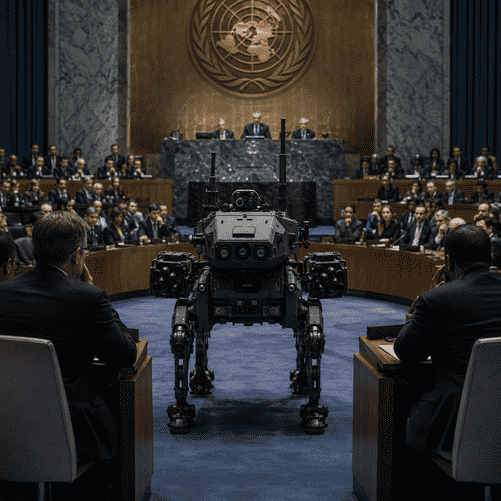
António Guterres warns that lethal autonomous systems cross a moral line, as the debate over military artificial intelligence intensifies after Anthropic’s dispute with the Pentagon.

United Nations Secretary-General António Guterres has renewed his call for an international ban on lethal autonomous weapons, warning that machines must never be allowed to decide who lives and who dies.
Speaking in Geneva, Guterres described weapons systems capable of taking human life without human oversight as “politically unacceptable” and “morally repugnant.” His message was directed at governments now debating how far artificial intelligence should be allowed to go in modern warfare, as militaries around the world race to integrate faster, more automated systems into defense operations.
The issue centers on so-called lethal autonomous weapon systems, often referred to by critics as “killer robots.” Unlike remotely piloted drones or conventional guided weapons, these systems could use sensors, algorithms and onboard decision-making to identify, select and attack targets with little or no direct human intervention. For Guterres, that possibility represents a dangerous break from basic principles of human responsibility in war.
The U.N. chief has urged states to conclude a legally binding international instrument by 2026, one that would prohibit autonomous weapons that operate without meaningful human control and regulate other forms of military autonomy. The negotiations are taking place within the framework of the Convention on Certain Conventional Weapons, where governments have debated the issue for years but have not yet reached a global treaty.
Supporters of strict regulation argue that delegating life-and-death decisions to machines would make accountability almost impossible. If an autonomous system misidentifies a civilian as a combatant, escalates a conflict by mistake or acts unpredictably in a complex battlefield, responsibility could be spread across programmers, commanders, manufacturers and governments. Critics also warn that once such weapons are deployed at scale, they could lower the political cost of war by reducing the immediate risk to soldiers.
The renewed U.N. warning comes as the role of artificial intelligence in national security has become a central political and commercial issue. The debate was sharpened by the recent clash between Anthropic, the maker of Claude, and the Pentagon. According to court documents and reporting on the dispute, Anthropic resisted allowing its AI models to be used for autonomous weapons or mass domestic surveillance, while U.S. defense officials pushed for broader flexibility in “lawful” military uses.
The disagreement escalated dramatically. The Pentagon reportedly labeled Anthropic a supply-chain risk after the company refused to abandon its restrictions, a designation that threatened its access to federal contracts and triggered legal action. A federal judge later temporarily blocked parts of the government’s punitive measures, giving Anthropic an early legal victory while the case continued.
For technology companies, the controversy highlights the growing tension between commercial AI development and military demand. Advanced AI systems can assist with intelligence analysis, logistics, cybersecurity and battlefield planning. But when those same tools are linked to targeting, surveillance or autonomous combat, companies face difficult questions about whether technical safeguards are enough and who ultimately controls the use of their models.
Defense officials and some military analysts argue that AI could improve precision, accelerate decision-making and reduce risks to soldiers. They say adversaries are already developing autonomous capabilities, making it dangerous for democratic governments to restrict themselves too heavily. But humanitarian organizations and arms-control advocates counter that speed and efficiency cannot justify removing human judgment from lethal force.
The dispute is also geopolitical. The United States, China, Russia and other military powers are all investing heavily in artificial intelligence, robotics and autonomous systems. Without binding rules, critics fear a new arms race in which states compete to deploy faster, cheaper and more independent weapons, even before the ethical and legal consequences are understood.
Guterres’s intervention is therefore more than a symbolic appeal. It is a warning that the world may be approaching a point where technology moves faster than international law. The question facing governments is no longer whether artificial intelligence will transform warfare, but whether human beings will remain clearly responsible for the decision to kill.
For the United Nations, the answer is unequivocal: machines should not be granted the power to take human life on their own. The challenge now is whether states can turn that principle into binding law before autonomous weapons become a permanent feature of the battlefield.