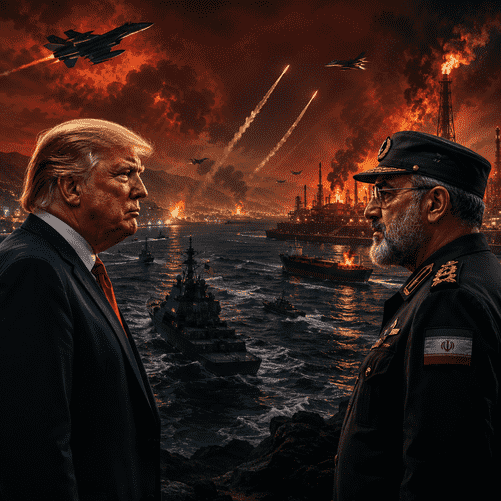
The U.S. president declared the interim accord “over” after overnight exchanges of fire, while Tehran threatened a forceful response and markets braced for deeper instability in the Gulf.

President Donald Trump has declared that a fragile ceasefire agreement with Iran is “over,” warning that the United States is prepared to launch further strikes after a renewed outbreak of violence in the Gulf.
Speaking on Wednesday, July 8, 2026, as tensions escalated around the NATO summit in Ankara, Trump sharply attacked Iran’s leadership and said Washington no longer saw value in continuing with the interim accord. Reuters reported that the deal had been designed as a 60-day ceasefire window for negotiations toward a longer-term resolution, but indirect talks in Qatar failed to produce progress.
The breakdown followed fresh exchanges of fire overnight, including reported Iranian attacks on U.S. military bases in Bahrain and Kuwait and earlier attacks on commercial shipping in the Strait of Hormuz. In response, the United States launched strikes against multiple Iranian targets, including air-defense assets and paramilitary vessels, according to reports from Reuters and the Associated Press.
Trump’s rhetoric was unusually severe even by the standards of recent U.S.-Iran confrontation. He said the ceasefire had collapsed, described Iranian leaders as “scum” and “sick people,” and warned that additional American military action could follow. The Associated Press reported that Trump also raised the possibility of hitting civilian infrastructure and seizing Kharg Island, a major hub for Iranian oil exports.
Tehran, meanwhile, accused Washington of violating the agreement and threatened a severe response. Iranian officials warned that the country could again move against critical maritime routes, including the Strait of Hormuz and the Bab-el-Mandeb Strait, while also reconsidering elements of its nuclear posture. Such threats immediately revived fears that a bilateral military confrontation could broaden into a regional crisis affecting energy supplies, shipping routes and U.S. allies across the Gulf.
The economic impact was immediate. Reuters reported that the renewed escalation helped push oil prices sharply higher, while global stock and bond markets weakened as investors assessed the risk of a wider conflict. The United States also revoked a key Treasury license that had allowed Iran limited oil and petrochemical sales through August, requiring related transactions to wind down earlier than expected.
The crisis places NATO allies in an uncomfortable position. Trump’s remarks came as Western leaders were already trying to manage divisions over defense spending, U.S. strategy in the Middle East and the future of American security commitments. The Guardian reported that Trump also criticized several allies during the Ankara summit, including over their level of support for U.S. operations against Iran.
For now, both sides appear to be signaling strength rather than compromise. Trump has insisted that further U.S. action remains on the table, while Iran has framed its response as a defense of sovereignty and deterrence. That leaves the diplomatic track severely weakened, if not entirely dead.
The most immediate danger is miscalculation. A strike on energy infrastructure, a missile attack on a Gulf base, or a closure attempt in the Strait of Hormuz could quickly transform the ceasefire’s collapse into a broader regional war. What began as an interim diplomatic arrangement has now become a test of whether Washington and Tehran can still step back before the next round of retaliation becomes harder to control.