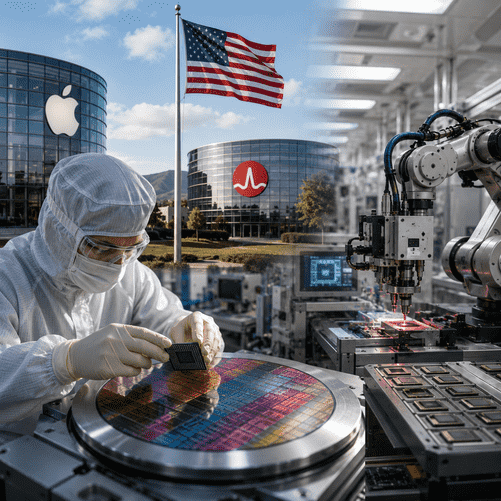
The agreement will expand domestic semiconductor production while preserving Broadcom’s crucial role in the wireless technology powering future Apple devices.

CUPERTINO, California — Apple has committed more than $30 billion to a multiyear partnership with Broadcom that will produce over 15 billion semiconductor components in the United States, marking one of the technology company’s largest efforts to move critical parts of its supply chain closer to home.
The agreement covers the development and production of custom silicon and advanced wireless-connectivity components for a wide range of Apple products. Broadcom’s chips support functions that allow devices such as iPhones, iPads and Apple Watches to connect reliably to mobile and wireless networks.
The partnership is expected to continue through 2031 and will include a major expansion of Broadcom’s manufacturing facility in Fort Collins, Colorado. Broadcom plans to invest approximately $1.5 billion in the site, where specialised radio-frequency components known as FBAR filters will be produced.
Apple said the agreement would support hundreds of American jobs and substantially increase the number of domestically manufactured components used across its product portfolio. The company described the Fort Collins technologies as essential to the performance and connectivity expected from its devices.
The deal strengthens a relationship that has become strategically important to both companies. Broadcom is a major Apple supplier, while Apple represents a significant source of revenue for the chipmaker. The extended contract also reduces concerns among investors that Apple could rapidly replace Broadcom’s components with internally designed alternatives.
Apple has spent years developing more of its own semiconductor technology. Its custom processors now power the iPhone, Mac, iPad and other devices, giving the company greater control over performance, energy efficiency and product design. It has also been working to develop more wireless technology internally.
The latest agreement, however, demonstrates that even the world’s most valuable consumer-electronics companies remain dependent on specialist suppliers for particularly complex semiconductor components. Wireless systems must manage multiple frequencies, signals and network standards while consuming minimal power and fitting inside increasingly compact devices.
For Apple, the partnership offers greater certainty over the supply of components needed for future product generations. Semiconductor shortages and geopolitical tensions have exposed the risks of depending heavily on factories concentrated in a small number of Asian markets.
Although much of Apple’s final product assembly remains outside the United States, the company has been increasing domestic spending on chips, glass, data centres and advanced manufacturing. The Broadcom agreement forms part of a wider commitment to invest hundreds of billions of dollars in the American economy over several years.
The announcement also reflects a broader shift within the global technology industry. Governments in the United States and Europe have sought to rebuild domestic semiconductor capacity after pandemic-era shortages disrupted industries ranging from smartphones to automobiles.
Washington has placed particular emphasis on reducing dependence on overseas chip production, viewing semiconductors as essential not only to consumer technology but also to artificial intelligence, communications infrastructure and national security.
Broadcom’s Fort Collins facility produces highly specialised components rather than the advanced central processors associated with companies such as TSMC, Intel or Samsung. Nevertheless, these smaller chips remain indispensable because they filter and manage radio signals, helping devices communicate without interference.
The commercial importance of the agreement was immediately visible in financial markets. Broadcom shares rose following the announcement as investors welcomed the long-term revenue provided by one of the world’s largest technology companies.
The partnership may also influence the design of future Apple products. More sophisticated wireless components could support faster connections, improved efficiency and better coordination among smartphones, watches, computers, headphones and emerging wearable devices.
Neither company disclosed which specific products would use the new components. Apple traditionally keeps details of unreleased hardware confidential, but the scale of the order suggests the chips will be deployed across several product generations and device categories.
The agreement highlights the changing meaning of technological independence. Apple continues to design more of its own processors, yet it is also securing deeper, longer-term partnerships with companies possessing expertise that would be difficult and expensive to reproduce internally.
Rather than completely replacing outside suppliers, Apple appears to be building a more controlled and geographically diversified network around them. The Broadcom deal therefore represents both an industrial investment and a strategic safeguard as competition over chips, artificial intelligence and connected devices intensifies.