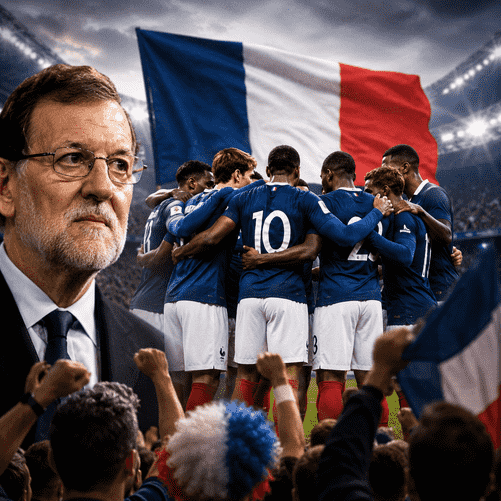
French and Spanish politicians denounced the former prime minister’s comments as racist and xenophobic ahead of the World Cup semifinal between France and Spain.

MADRID — Former Spanish prime minister Mariano Rajoy has drawn widespread criticism after suggesting that France’s national football team contains no French players, reigniting a long-running controversy over race, immigration and national identity in European sport.
Rajoy made the remark in a newspaper column published after Spain’s 2-1 World Cup quarterfinal victory over Belgium. Looking ahead to Tuesday’s semifinal against France, he praised Didier Deschamps’ squad as a team of the highest standard that played excellent football, before adding that it was supposedly playing “without Frenchmen.”
The statement was widely interpreted as a reference to the ethnic backgrounds of several French players, many of whom are Black or have family connections to former French colonies. Critics said the comment denied the nationality of French-born citizens on the basis of their ancestry or appearance.
French MP Pierre-Alexandre Anglade described the remarks as a grave insult to both the national team and France. Other political figures also condemned Rajoy, who led Spain’s conservative People’s Party government from 2011 until 2018.
Aurore Bergé, France’s minister responsible for combating discrimination, said repeated racist attacks against footballers had become intolerable and called for sport to remain a place where athletes were judged by their talent rather than their background. French Communist Party leader Fabien Roussel also demanded that Rajoy’s words be condemned.
In Spain, Socialist member of the European Parliament José Cepeda called the former prime minister’s comments racist, xenophobic and shameful. Rajoy had not issued a public apology or clarification at the time of the initial backlash.
The controversy is particularly striking because almost the entire French World Cup squad was born in France. Of the 26 players selected for the tournament, only three were born abroad, and two of those were born overseas while their French parents were living or working in other European countries.
The dispute erupted days before France and Spain were due to meet in the World Cup semifinal, adding a political and cultural dimension to one of the tournament’s most anticipated matches. Spain reached the last four after defeating Belgium, while France advanced with a victory over Morocco.
Rajoy’s intervention also followed a series of racist attacks directed at France and its captain, Kylian Mbappé, during the tournament. A Paraguayan senator recently faced condemnation and a French legal complaint after publishing offensive comments about Mbappé following France’s victory over Paraguay.
France’s diverse national team has frequently become a focus of political debate. The country’s 1998 World Cup-winning squad, featuring players including Zinedine Zidane, Lilian Thuram, Marcel Desailly and Patrick Vieira, was celebrated by many as a symbol of multicultural France.
However, far-right politicians have repeatedly questioned whether players from immigrant families genuinely represent the country. Similar arguments have resurfaced around subsequent French teams, despite the players holding French citizenship and, in most cases, having been born and raised in France.
The latest dispute highlights how football’s global stage can amplify broader arguments about citizenship and belonging. For Rajoy’s critics, his comment was not merely an observation about the composition of a sporting squad, but an attempt to define French identity according to ethnicity.
As France and Spain prepare to meet on the pitch, officials on both sides are attempting to keep the focus on football. Yet the backlash has ensured that the semifinal will unfold against a wider debate over who is considered entitled to represent a nation—and whether sporting success can escape the political tensions surrounding race and immigration.