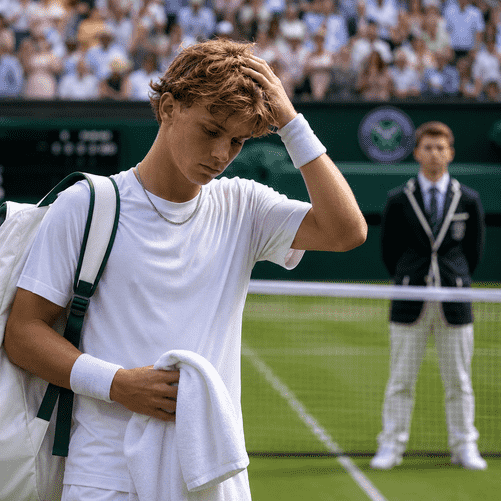
The 17-year-old Australian surrendered a third-set lead against American Jordan Lee in the boys’ final, ending his junior career with disappointment but also with the clearest evidence yet that he may be ready for professional tennis.

Cruz Hewitt’s final appearance in junior tennis ended in heartbreak at Wimbledon, but the teenager left the All England Club with renewed belief that his next visit could come as a senior player rather than as the son of a former champion.
The 17-year-old Australian was beaten by American prospect Jordan Lee in a tense boys’ singles final, losing 4-6, 6-4, 7-5 after holding a 4-2 advantage in the deciding set. Hewitt had moved within sight of becoming the first Australian to win the Wimbledon boys’ title since Luke Saville in 2011, only for Lee to recover and take five of the final six games.
The defeat was particularly painful because Hewitt had controlled significant portions of the match. He won the opening set, remained competitive throughout the second and appeared to have regained the initiative when he broke serve in the third. Lee, however, responded with greater consistency during the closing stages and converted the decisive opportunity at 6-5.
Hewitt had arrived in the final without dropping a set during the tournament. His run included victories over four seeded opponents and a composed 6-4, 6-4 semifinal win against Dutch player Thijs Boogaard. Before Wimbledon, he had never progressed beyond the second round of a junior Grand Slam event.
That contrast made his performance one of the most significant breakthroughs of his young career. Over the course of the fortnight, Hewitt demonstrated a powerful serve, an aggressive forehand and a willingness to compete from the baseline without allowing the attention surrounding his family name to dominate his tennis.
His father, Lleyton Hewitt, watched from courtside throughout the tournament. The former world No. 1 won the Wimbledon men’s singles title in 2002, defeating Argentina’s David Nalbandian in straight sets and becoming the first Australian men’s champion at the tournament since Pat Cash in 1987.
The comparison between father and son was unavoidable. Cruz was attempting to win at the same venue 24 years after Lleyton’s greatest grass-court triumph, while displaying some of the same visible intensity and emotional energy that characterised his father’s career.
Yet the younger Hewitt has repeatedly emphasised that he is trying to build his own identity. His junior achievements have already followed a different path. Lleyton never reached the Wimbledon boys’ final, while Cruz’s 2026 run made him the first Australian to reach that stage since Alex de Minaur in 2016.
Hewitt said the loss was difficult to accept but described the tournament as a special week and expressed pride in reaching the final. He also reflected on old footage of himself as a child dreaming of competing at Wimbledon, saying that the younger version of himself would have been pleased with what he had achieved.
The result is expected to mark the end of his junior career. Hewitt now intends to concentrate on professional tournaments, improve his ranking and pursue opportunities in senior Grand Slam events. At the time of the Wimbledon final, he was ranked around No. 606 in the world, leaving considerable ground to make up before he can enter major qualifying draws directly.
His immediate ambition is to secure a place in the men’s main draw at the Australian Open. A wildcard would provide the most direct route, although such invitations are intensely competitive and normally depend on rankings, recent results and the judgement of national selectors.
Hewitt acknowledged that playing in the Australian Open main draw would be a dream. His performance at Wimbledon strengthened his case by showing that he can compete under pressure and against some of the strongest players of his generation.
The transition from junior success to professional relevance, however, is rarely straightforward. Junior Grand Slam finalists often face opponents who are older, physically stronger and more experienced in the tactical demands of senior tennis. Ranking points must be accumulated at lower-level professional events, where travel, scheduling and limited prize money can present challenges very different from those found at Wimbledon.
Hewitt has already gained experience on the professional circuit and has trained with established players. His game appears particularly well suited to grass, where his serve and first-strike forehand can shorten points. Developing greater consistency, physical resilience and variety will become increasingly important as he faces opponents capable of defending more effectively and exploiting small technical weaknesses.
The attention surrounding his surname will remain another challenge. Lleyton Hewitt was one of the most successful Australian players of his generation, winning the 2001 US Open, the 2002 Wimbledon title and reaching world No. 1. Cruz will inevitably be measured against that career, even though the two players have developed in different eras and under different competitive conditions.
The teenager’s response at Wimbledon suggested that he understands the pressure without appearing overwhelmed by it. He remained composed during interviews, credited his father’s support and focused on the progress made during the tournament rather than presenting the loss as a defining failure.
That attitude may prove as important as any technical improvement. A junior Grand Slam final can provide confidence, but it can also create unrealistic expectations. The next stage of Hewitt’s career will require patience as he moves through professional events where victories may be harder to earn and public attention may exceed his ranking.
Lee’s victory should not be reduced to Hewitt’s missed opportunity. The 16-year-old American showed considerable determination after losing the opening set and falling behind in the third. His ability to recover under pressure ultimately separated the two players in a match lasting approximately two hours.
For Hewitt, the final was both an ending and an introduction. It closed a junior career that had included multiple ITF titles and a gradual rise through the rankings, but it also introduced him to a broader international audience as a player with genuine potential rather than simply a famous surname.
His path back to Wimbledon will now become more difficult. He must raise his professional ranking sufficiently to enter qualifying or persuade organisers that his development merits a wildcard. Reaching the men’s main draw would represent a substantial achievement in itself.
The loss to Lee denied Hewitt a fairytale conclusion, but it did not diminish the significance of his fortnight. He arrived at Wimbledon without a deep junior Grand Slam run and left as a finalist who had defeated a series of highly rated opponents without losing a set until the championship match.
Twenty-four years after his father lifted the men’s trophy, Cruz Hewitt came within a few games of adding another family title at the All England Club. The trophy escaped him, but the tournament offered something potentially more valuable: evidence that his ambitions in senior tennis are no longer based solely on heritage or expectation.
His junior career may have ended in disappointment, yet his Wimbledon story appears to have only begun.