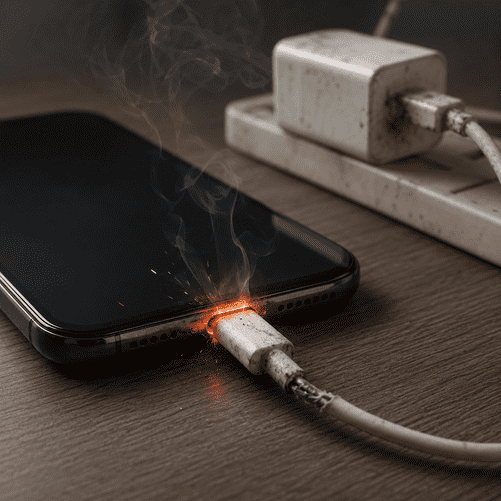
The universal charging standard is designed to protect devices from excessive power, but damaged, counterfeit and poorly manufactured accessories can still cause overheating, battery degradation and expensive hardware failures.

USB-C was supposed to simplify the increasingly complicated world of consumer electronics. One compact connector can now charge phones, tablets, headphones, laptops and other devices, allowing travellers to carry fewer adapters and consumers to reuse accessories across different brands.
That convenience, however, has created a new problem: almost every USB-C cable looks broadly identical from the outside, even though the quality, power capacity and internal safety protections can vary considerably.
A well-made USB-C charger should not damage a phone merely because its advertised wattage is higher than the handset requires. Under the USB Power Delivery system, the charger and connected device communicate before higher levels of power are supplied. The phone requests an appropriate voltage and current, while a compliant power source is expected to remain within the negotiated limits. A 100-watt or even 240-watt charger can therefore be safe for a much lower-powered phone when the charger, cable and device properly follow the standard.
The real danger lies not in using a powerful charger, but in using equipment that is defective, damaged or falsely presented as compliant.
Cheap accessories may reduce costs by using thinner conductors, weak insulation, poorly assembled connectors or inadequate protection against excessive current and heat. Others may contain electronics that incorrectly communicate the cable’s capabilities to the charger and device. When that communication fails, the result can range from slow or intermittent charging to excessive temperatures, damaged ports and electrical failure.
USB-C cables designed to carry higher levels of power may include an electronic marker, commonly known as an e-marker, which communicates information such as the cable’s current-handling capacity. USB compliance procedures specifically test these components because the charger and device need accurate information about what the cable can safely support.
Modern phones contain multiple layers of protection, including charging controllers, temperature sensors and software that can reduce or stop charging when unsafe conditions are detected. Those systems significantly lower the risk of catastrophic failure, but they cannot guarantee protection against every badly manufactured accessory, damaged connector or internal short circuit.
Manufacturers consequently warn users against treating charging cables as disposable items. Apple states that using damaged cables or chargers—or charging while moisture is present—can cause fire, electric shock, injury or damage to an iPhone and surrounding property. Google issues similar warnings, advising users not to charge with damaged equipment and to keep chargers ventilated and away from moisture.
Physical deterioration is one of the easiest hazards to overlook. A cable may continue working after its outer covering has split, its connector has become loose or its internal wiring has been repeatedly bent. Yet continued operation does not mean the accessory remains safe. Exposed or weakened conductors can create resistance, unstable connections and localised heating near the plug.
Discolouration around the connector, a burning smell, visible corrosion, unexplained charging interruptions or a plug that becomes unusually hot should all be treated as warning signs. A cable that must be twisted or held at a particular angle to work should also be replaced rather than repeatedly forced into the device.
Heat is particularly important because its effects can accumulate even when a phone does not suffer an immediate failure. Apple notes that batteries naturally warm while charging and that excessive temperature can shorten their lifespan. Its devices may reduce charging current or temporarily limit charging above 80 percent when temperatures become too high. Google similarly recommends charging compatible Pixel phones in a cool environment and notes that sustained charging under high temperatures can trigger protective limits.
A poor-quality cable may also charge a phone inefficiently. Electrical resistance can cause more of the incoming energy to be converted into heat before it reaches the battery. The user may notice that the phone charges slowly, that the connector becomes warm or that fast charging repeatedly starts and stops.
The charger itself presents another layer of risk. A reputable power adapter normally contains protections intended to manage overheating, short circuits, voltage instability and excessive current. An inadequately designed imitation may omit some of those safeguards or use components that cannot reliably tolerate the advertised output.
Weight, price and appearance alone cannot prove that an accessory is safe. A heavy charger is not automatically well constructed, and a braided cable is not necessarily electrically superior. Counterfeit products can also reproduce logos, packaging and certification symbols. The most reliable approach is to buy from an established manufacturer or authorised retailer and verify that the product clearly identifies its power specification and applicable safety certifications.
The USB Implementers Forum, the organisation responsible for promoting and testing USB standards, operates a compliance programme for cables, chargers and other products. USB-IF-certified USB-C-to-USB-C cables are required to display a 60-watt or 240-watt power rating, helping consumers identify how much power the cable is designed to carry. Products using the protected certification logos must pass specified compliance testing.
The wattage marking does not describe data-transfer speed. A cable may support 240-watt charging while transferring data only at basic USB speeds, while another may offer much faster data performance but a lower power rating. Consumers should therefore check both specifications when buying a cable for laptops, external drives or monitors rather than assuming that every USB-C product provides the same features.
The need for clearer information has become more pressing as USB-C expands across the European market. European Union common-charger rules have required a range of portable electronics—including mobile phones, tablets, digital cameras and headphones—to use USB-C since December 28, 2024. The requirements were extended to laptops on April 28, 2026. The initiative is intended to improve interoperability, reduce unnecessary charger purchases and cut electronic waste.
Greater compatibility does not mean that every accessory is interchangeable in performance or quality. A basic phone cable may not provide enough power for a laptop. A laptop cable may charge a phone safely but fail to support high-speed video or data. A charger without the appropriate Power Delivery profile may work only at a slower rate.
Consumers should begin by checking the device manufacturer’s charging requirements. A phone that supports USB Power Delivery should ideally be paired with a compliant USB-PD charger. Some devices also support Programmable Power Supply technology, which allows voltage and current to be adjusted more precisely during charging. Using a charger without the fastest supported protocol is not necessarily dangerous, but it may reduce charging speed or efficiency.
The condition of the charging port is equally important. Dust, pocket lint and moisture can prevent a connector from sitting correctly or interfere with its electrical contacts. A metal object should never be pushed into the port to remove debris, and charging should stop immediately when a phone displays a liquid-detection warning.
Charging on beds, sofas or beneath pillows can also trap heat around the phone and adapter. Google advises charging devices on a hard surface rather than on soft furniture and warns that restricted ventilation, moisture and damaged accessories can create risks of fire, electric shock and property damage.
Fast charging itself is not automatically harmful. Phones are designed to regulate the amount of power they accept, and charging normally slows as the battery approaches full capacity. The more important long-term concern is excessive heat, whether it is produced by the environment, intensive phone use during charging or inefficient accessories.
The cheapest cable may therefore prove expensive in ways that are not immediately visible. A replacement charging port, damaged battery or failed circuit board can cost far more than a properly certified accessory. In severe cases, electrical failure can also create a fire risk.
USB-C remains a major improvement in convenience and interoperability. Its universal shape, however, can create a false sense that all cables and chargers are technically equivalent. They are not.
The safest approach is not to buy the most powerful or most expensive accessory available, but to choose one from a reliable source, confirm that it supports the required charging standard and replace it as soon as it shows physical damage or abnormal heating. A quality cable may appear to be a minor purchase, but it functions as the electrical connection between a high-powered charger and a device worth hundreds—or thousands—of euros.