Rare demonstrations erupted in Kyiv and other cities after President Volodymyr Zelensky removed reformist minister Mykhailo Fedorov amid a damaging dispute over military command and battlefield modernisation.

KYIV — President Volodymyr Zelensky’s decision to remove Ukraine’s popular defence minister has triggered rare public protests and exposed a widening dispute at the centre of the country’s wartime leadership.
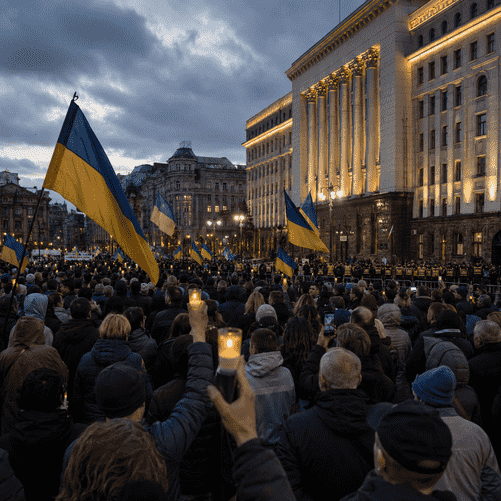
More than 1,000 demonstrators gathered in central Kyiv on Thursday, July 16, demanding the reinstatement of Mykhailo Fedorov, the 35-year-old technology specialist credited with accelerating the Ukrainian military’s use of drones, digital systems and more transparent procurement procedures. Smaller demonstrations were also reported in other Ukrainian cities.
Protesters waved Ukrainian and European Union flags, sang the national anthem and accused the government of weakening the country’s defence at a critical stage of the war with Russia. The demonstrations were unusual for wartime Ukraine, where political disagreements have generally been contained in the interest of national unity.
Fedorov had served as defence minister for only six months but had developed a reputation as one of the government’s most energetic reformers. Previously responsible for Ukraine’s digital transformation, he brought the same technology-driven approach to the defence ministry, promoting drones, artificial intelligence and simplified military purchasing systems.
His supporters argue that those reforms helped Ukraine compensate for Russia’s advantages in troop numbers and conventional weaponry. Fedorov also claimed credit for efforts to prevent Russian forces from using Starlink satellite terminals and for introducing competitive procurement procedures covering equipment ranging from drones and ammunition to military vehicles.
The dismissal followed an increasingly public conflict between Fedorov and General Oleksandr Syrskyi, commander-in-chief of the Ukrainian armed forces. Fedorov accused the military leadership of resisting technological and organisational reforms, arguing that nearly every proposed change encountered institutional opposition.
According to multiple reports, Fedorov urged Zelensky to replace Syrskyi. The president instead removed the defence minister, confirming that relations between the ministry and the country’s senior military command had broken down.
Zelensky defended his decision as part of a broader government renewal and said he had not taken sides in the dispute. However, critics interpreted the move as a victory for Ukraine’s more traditional military establishment over officials seeking to transform the armed forces for a technology-intensive war.
The controversy deepened when a senior air force commander resigned in response to Fedorov’s departure. Military personnel and defence volunteers also praised the former minister’s efforts to combat corruption and reduce the influence of Ukraine’s Soviet-era command culture.
Fedorov rejected an offer to remain in government as an adviser. In public remarks following his removal, he said Ukraine could not win the war without fundamental changes to its military organisation and suggested that resistance from the senior command had slowed urgently needed reforms.
Syrskyi has defended his record as commander-in-chief, pointing to the immense operational pressures facing Ukraine and the need to maintain discipline across a military fighting a larger opponent. He has not directly addressed all of Fedorov’s accusations.
The confrontation comes as Ukraine attempts to maintain battlefield momentum while defending its cities and energy infrastructure from sustained Russian attacks. Frequent changes in the country’s defence leadership risk unsettling troops, international partners and weapons suppliers at a time when continuity is considered essential.
Fedorov was Ukraine’s fifth defence minister since Russia launched its full-scale invasion in February 2022. His departure formed part of a wider cabinet reshuffle that also brought changes to the office of prime minister and other senior government positions.
The appointment of state energy executive Sergii Koretskyi as prime minister reflected the growing importance of protecting Ukraine’s power network from Russian strikes. Yet the upheaval surrounding the defence ministry quickly overshadowed the rest of the restructuring.
The political consequences could be significant for Zelensky. Fedorov’s youth, public profile and association with military innovation made him particularly popular among younger Ukrainians, technology workers, volunteers and members of the armed forces. His removal has reinforced criticism that the presidential administration prioritises political loyalty and centralised control over independent and effective leadership.
Zelensky has remained Ukraine’s dominant political figure throughout the war, but his personnel decisions have periodically provoked criticism. The latest protests indicate that public tolerance for unexplained wartime reshuffles may be diminishing, especially when they involve officials widely regarded as successful.
The dispute also highlights a deeper question facing Ukraine’s military: whether it can modernise rapidly enough while continuing to fight an exhausting conventional war. Fedorov’s supporters view technological innovation, decentralised decision-making and institutional reform as essential to overcoming Russia’s numerical superiority. Traditional commanders emphasise discipline, cohesion and clear lines of authority.
Both approaches may be necessary, but the public rupture between their leading advocates has exposed divisions that Ukraine would have preferred to resolve privately.
For Zelensky, removing the defence minister may have settled an immediate confrontation within the government. The protests on Ukraine’s streets suggest that it has created a much broader political crisis instead.