Millions of holiday journeys, unfinished biometric technology and growing demand for British staycations are converging in a major test for the Channel crossing.

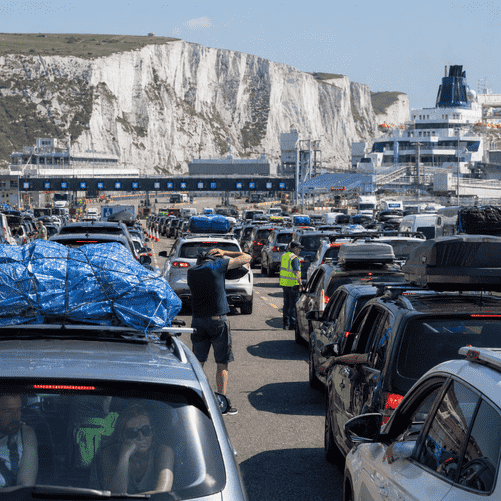
The Port of Dover is preparing for one of the most difficult weekends of the summer as thousands of families begin their holidays amid fears that malfunctioning European Union border technology could produce lengthy queues at Britain’s busiest ferry gateway.
Around 7,500 cars are expected to travel through Dover to France on Friday, July 17, followed by approximately 10,000 on Saturday. The surge coincides with the closure of many schools for the summer and an estimated 14 million leisure journeys on British roads over the weekend.
At the centre of the concern is the EU’s Entry/Exit System, known as EES, which was introduced to register non-EU visitors entering the Schengen area. The system is intended to replace manual passport stamping with digital records, facial photographs and fingerprints.
At Dover, however, a newly constructed automated processing facility costing about £40 million cannot yet be used as intended because of software and connectivity problems involving the French system. French border officers stationed at the port must therefore create traveller records manually, adding time to each inspection even when the full biometric process is not being completed.
The weakness of the technology has already caused disruption. During the May holiday period, enhanced EES checks were temporarily suspended after passengers endured hours of delays in hot weather. That episode involved about 8,000 booked vehicles and provided an early warning of the pressure that could emerge when substantially larger summer volumes arrive.
Dover officials have urged passengers to follow designated main roads and not to reach the port more than two hours before their scheduled departure. Arriving too early, they warn, could worsen congestion around the terminal and create additional pressure on local roads.
The British and French governments have attempted to reduce the risk by increasing the number of French border officers working at Dover, Folkestone and London St Pancras. The UK has also announced £20 million in additional funding to expand processing capacity and strengthen traffic-management arrangements.
Nevertheless, the opening weekend of the peak season will test whether additional staffing can compensate for technology that remains only partially functional. The challenge is especially acute at Dover because travellers are processed while they remain inside their vehicles, often with several passengers requiring registration at the same time.
The consequences could extend well beyond the port. Heavy traffic is expected around the M25, particularly on routes connecting London with the M3 and the south-west. Other major roads serving coastal destinations, Wales, Scotland and popular holiday regions are also likely to experience congestion as families begin their summer breaks.
The RAC has advised motorists to prepare for delays in potentially very hot conditions by carrying water and ensuring that vehicles are properly maintained. Cars without effective air conditioning may be particularly vulnerable during prolonged traffic jams.
The border difficulties are also influencing where British travellers choose to spend their holidays. Domestic breaks have reportedly reached their highest level since the Covid period, when international travel restrictions produced an exceptional rise in staycations.
This year’s increase is being driven by a combination of factors. Some travellers are seeking to avoid uncertain queues at European borders, while others remain cautious about air travel following geopolitical tensions and disruption linked to the conflict involving Iran. Persistent heatwaves in parts of continental Europe have added another reason for families to reconsider overseas plans.
The result is likely to benefit hotels, holiday parks and coastal businesses across Britain, although it will also place greater pressure on domestic roads and tourism infrastructure. Higher fuel prices may increase the cost of travelling, but they have so far done little to suppress demand for summer road trips.
Eurotunnel, which operates LeShuttle through the Channel tunnel, has said it does not expect the same level of disruption. Yet its automated EES equipment also remains unavailable, meaning passengers may still encounter manual procedures at the border.
For Dover, the weekend represents more than a seasonal traffic challenge. It is an important test of whether Britain and France can manage the practical consequences of new post-Brexit border requirements while the infrastructure intended to support them remains unreliable.
The immediate priority will be keeping vehicles moving and preventing congestion from spreading into Dover and the surrounding road network. The broader question is whether Europe’s new digital border regime can be made fast enough to handle peak travel without transforming routine holiday journeys into hours of uncertainty.