The French president and German chancellor have unveiled an ambitious programme on defence, artificial intelligence and industrial competitiveness, but the approach of France’s 2027 election is casting doubt over the durability of their renewed partnership.

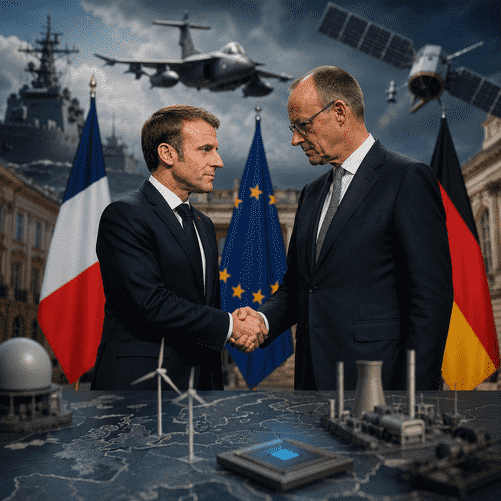
French President Emmanuel Macron and German Chancellor Friedrich Merz have sought to reassert the influence of Europe’s traditional power couple, promising closer cooperation across defence, technology and industry at a moment when political uncertainty in France threatens to weaken the continent’s most important bilateral relationship.
Meeting with ministers near Cologne on July 16 and 17, the two leaders presented the Franco-German partnership as an essential instrument for strengthening Europe’s security and economic independence. Their discussions covered nuclear deterrence, missile defence, long-range weapons, artificial intelligence, satellite infrastructure, trade policy and the integration of European capital markets.
The breadth of the agenda reflected a desire to demonstrate that Paris and Berlin can still provide strategic direction for the European Union. For decades, major advances in European integration have depended on agreements between France and Germany, even when the two countries began negotiations from sharply different positions.
That model has recently come under increasing strain. Industrial rivalries, differing defence priorities and disagreements over Europe’s relationship with the United States have complicated cooperation between the EU’s two largest economies. The collapse of the proposed Future Combat Air System, a vast project intended to produce a new generation of European combat aircraft, became the clearest symbol of those tensions.
The programme reportedly unravelled after prolonged disputes involving France’s Dassault Aviation and the German division of Airbus over leadership, responsibility and access to sensitive technology. Estimated at roughly €100 billion, the project had been promoted as a cornerstone of Europe’s future military autonomy. Germany ultimately concluded that the programme no longer met its armed forces’ requirements.
Macron and Merz have nevertheless attempted to preserve parts of the cooperation, including the development of a digital “combat cloud” capable of connecting aircraft, sensors and other military platforms through secure data networks. Their governments are also exploring closer work on early-warning systems, air and missile defence, space capabilities and long-range strike technology.
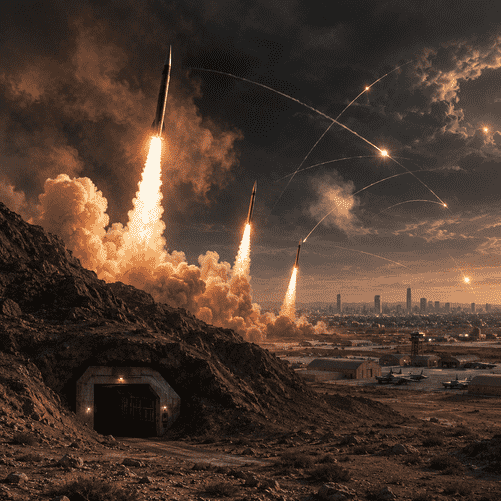
Nuclear deterrence has become another prominent area of discussion. France possesses the European Union’s only independent nuclear arsenal, and Macron has argued that it could play a wider role in protecting European allies. France and Germany agreed earlier in 2026 to deepen consultations on deterrence, while German forces are expected to participate in a French nuclear exercise later in the year.
The security debate is being driven partly by Russia’s continuing war against Ukraine and partly by uncertainty over the reliability of the transatlantic alliance. Macron has repeatedly called for greater European strategic autonomy, warning against national defence policies that fragment procurement and leave the continent dependent on foreign suppliers.
Germany, however, remains more willing to purchase American weapons and preserve close military links with Washington. Berlin’s approach reflects its immediate need to modernise the Bundeswehr quickly, while France has traditionally placed greater emphasis on developing and protecting Europe’s domestic defence industry.
Those differences also extend into space. Paris has pushed for stronger support for the European Union’s IRIS² satellite network, while Germany has pursued elements of a separate national initiative. The disagreement illustrates the tension between European cooperation and the desire of governments to secure contracts, jobs and technological influence for their own industries.
Beyond defence, Macron and Merz promised closer coordination on artificial intelligence, digital regulation, advanced manufacturing and investment. Both governments want Europe to compete more effectively with the United States and China, whose technology companies benefit from larger domestic markets, deeper capital pools and, in many cases, less fragmented regulation.
France and Germany have previously committed themselves to a broader economic agenda involving industrial competitiveness, energy policy, labour mobility and European financial integration. The latest meeting was intended to show that those ambitions remain intact despite sluggish growth and political pressure in both countries.
Yet the approaching end of Macron’s presidency has created an unavoidable question: whether agreements reached now can survive the French election scheduled for 2027.
Macron is constitutionally barred from seeking a third consecutive term. Marine Le Pen, the leading figure of the National Rally, has launched another presidential campaign after an appeals court decision left her able to compete while she continues to challenge her conviction in a European Parliament funds case.
A Le Pen victory could substantially alter France’s approach to Germany and the European Union. Although the National Rally has softened some of its earlier positions on EU membership and the euro, it continues to emphasise national sovereignty, stricter immigration controls and the primacy of French interests over deeper European integration.
For Berlin, that possibility creates uncertainty over projects requiring years of sustained political commitment. Defence programmes, satellite systems and industrial partnerships cannot be completed within a single electoral cycle. They depend on governments accepting shared costs, compromises over technology and a division of industrial leadership that may be politically unpopular at home.
Merz therefore has a strong incentive to institutionalise as many agreements as possible while Macron remains in office. Macron, meanwhile, is seeking to ensure that his vision of a more powerful and independent Europe outlasts his presidency.
The personal relationship between the two leaders appears considerably warmer than the strained partnership Macron maintained with Merz’s predecessor. Since the German chancellor took office, both sides have spoken of resetting bilateral relations and restoring the habit of close consultation before major European decisions.
Goodwill alone, however, cannot eliminate the economic and strategic conflicts that have repeatedly delayed joint projects. France wants Europe to favour European weapons and technology. Germany is often more focused on speed, affordability and military compatibility with NATO allies. Paris supports stronger centralised European programmes, while Berlin sometimes prefers national initiatives or broader coalitions.
The summit near Cologne was therefore as much a display of political determination as a collection of concrete policy measures. Macron and Merz wanted to show that the Franco-German engine remains capable of functioning even after the failure of one of its most prestigious defence ventures.
Whether that message convinces Europe will depend on implementation. New declarations will carry little weight unless they produce functioning technologies, coordinated procurement and visible economic benefits.
For now, the two leaders have placed defence, industry and innovation at the centre of a renewed partnership. But with France entering an unpredictable presidential campaign, they are also working against the clock.
The Franco-German relationship may still possess considerable influence. Its future, however, increasingly depends on whether the institutions and projects being constructed today can withstand the political transformation that may follow Macron’s departure.