Repeated grid failures, fuel shortages and intensifying American pressure are disrupting essential services across the island, exposing the fragility of its infrastructure and widening public discontent.

When Cuba’s national electricity system collapsed again on Tuesday, the blackout carried a significance far beyond another night without lights. It was the third complete grid failure in nine days and the fifth nationwide outage recorded in 2026—a sequence that has intensified fears that the island’s deteriorating power network is approaching a point from which recovery may become increasingly difficult.
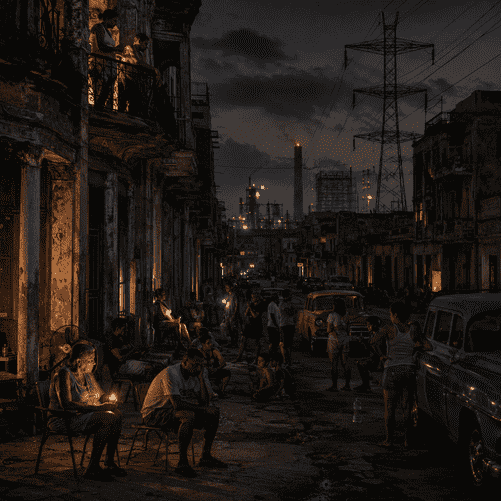
Across Havana and other major cities, the failure brought familiar scenes of disruption. Traffic lights stopped working, businesses suspended operations and the noise of private generators filled streets otherwise left in darkness. Electricity began returning gradually to some areas, but millions of Cubans were once again forced to navigate extreme summer heat without reliable refrigeration, ventilation, communications or running water.
The immediate cause of the latest collapse was linked to a frequency failure at a power facility in the eastern province of Holguín. Yet the broader emergency is rooted in years of inadequate maintenance, obsolete generating equipment and chronic shortages of fuel and replacement components. Many of Cuba’s thermoelectric plants were built decades ago and now operate unpredictably, frequently shutting down for repairs that the government lacks the resources to complete properly.
The country’s electricity crisis has worsened sharply since the beginning of 2026, when the United States intensified restrictions on oil supplies reaching the island. Washington has pressured foreign governments and companies involved in delivering fuel to Cuba, further limiting imports from traditional suppliers. The loss of Venezuelan shipments and the interruption of deliveries from Mexico have left the country struggling to obtain enough oil to operate its power stations and transportation system.
Cuba produces only about 40 per cent of the fuel it consumes, leaving the economy highly dependent on imports. Without sufficient supplies, even functional generating units cannot operate at full capacity. The result is a cycle in which fuel shortages cause prolonged blackouts, sudden grid imbalances trigger wider failures and repeated shutdowns place additional stress on machinery already close to exhaustion.
For ordinary Cubans, the consequences extend into nearly every aspect of daily life. Water pumps stop functioning when power disappears, leaving apartment buildings without running water. Food spoils rapidly in refrigerators, while electric stoves become unusable. Mobile-phone networks and internet services weaken, public transport is interrupted and hospitals must rely on limited emergency generators.
In some overcrowded Havana buildings, residents have begun sleeping on rooftops to escape the heat trapped inside their apartments. Others avoid keeping food at home because they cannot predict when refrigeration will fail. Families with relatives abroad increasingly depend on imported solar panels, batteries and rechargeable appliances, but such solutions remain unaffordable for much of the population.
The hardship is particularly severe for elderly residents, people with disabilities and patients requiring electrically powered medical equipment. Hospitals have received priority during restoration attempts, but fuel shortages and unstable service have still led to postponed procedures and interruptions to medical care.
The breakdown of the power system is unfolding alongside Cuba’s wider economic deterioration. Food, medicine and fuel remain scarce, while inflation has eroded wages and pensions. Tourism—historically one of the government’s most important sources of foreign currency—has struggled amid deteriorating services, empty resorts, transportation problems and international concerns over the reliability of basic infrastructure.
Private businesses, once promoted as a limited source of growth and employment, are also finding it increasingly difficult to operate. Restaurants cannot preserve ingredients, workshops lack power for equipment and transport companies face severe fuel restrictions. Even firms able to generate their own electricity must contend with the high cost and limited availability of diesel.
Public frustration is becoming more visible. After an earlier grid failure in July, residents in parts of Havana gathered in the streets, banging pots, sounding car horns and demanding electricity. Although the demonstrations remained relatively small, they represented a significant expression of anger in a country where open opposition carries substantial risks.
Many participants have directed their criticism at both the Cuban government and the United States. The authorities in Havana are blamed for decades of underinvestment, economic mismanagement and the slow implementation of reforms. Washington, meanwhile, is accused of deliberately intensifying civilian suffering through restrictions intended to weaken the Communist government.
The Trump administration argues that economic pressure is necessary to force political reform and hold Cuba’s leadership accountable for repression. Cuban officials describe the American measures as an effort to provoke social collapse and regime change. The United Nations and other international critics have also questioned the humanitarian consequences and legality of sanctions that restrict access to energy, finance and essential goods.
Neither explanation alone fully accounts for the scale of the crisis. American pressure has severely restricted Cuba’s ability to purchase fuel and equipment, but the power system’s vulnerability also reflects longstanding domestic failures. Successive governments postponed major investments, tolerated inefficient state institutions and failed to modernise an electricity network that had been deteriorating for years.
The result is a crisis in which external coercion and internal weakness reinforce one another. Sanctions make infrastructure repairs more difficult, while the poor condition of that infrastructure increases the effectiveness of sanctions. The burden falls overwhelmingly on ordinary citizens, who have little influence over either government’s decisions.
Authorities are attempting to restore power by constructing small, isolated electrical networks around functioning generators. These “micro-islands” are designed to supply hospitals, food-production facilities and other essential services before the systems are gradually reconnected. The process is delicate, however, because an imbalance or unexpected plant failure can cause the grid to collapse again.
Even when the national network is technically restored, Cuba continues to face enormous electricity deficits. Officials have at times forecast that more than two-thirds of demand will go unmet during peak hours, meaning that controlled blackouts remain unavoidable even when the grid is functioning.
The question is no longer simply when electricity will return after each failure. It is whether Cuba can secure enough fuel, financing and technical equipment to prevent the next collapse—and whether the population can continue absorbing the social consequences of an emergency with no clear end.
For decades, Cubans have endured scarcity through improvisation, family networks and a powerful sense of communal resilience. But resilience cannot repair turbines, import oil or replace a national grid. As outages become longer and more frequent, the gap between surviving the crisis and resolving it is growing increasingly difficult to ignore.