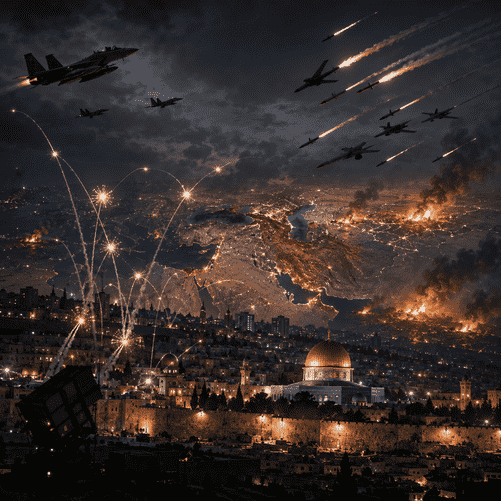
Missile attacks near Israel’s border, renewed American airstrikes and the collapse of a fragile truce have pushed the Middle East closer to another phase of unrestricted regional warfare.

JERUSALEM — Israel has warned that it will respond with its “full force” if Iran directs missile attacks toward Israeli territory, as an intensifying exchange of strikes between Tehran and Washington threatens to draw the region back into a broader and potentially more destructive war.
The warning followed the detection of Iranian missiles launched toward Aqaba, the Jordanian port city situated close to Israel’s southern border. Jordanian forces said they intercepted three missiles, while sirens sounded across parts of the country. Israel’s military said it was monitoring the launches and remained prepared to act both defensively and offensively.
Although the missiles were reportedly aimed at Jordan rather than Israel, their trajectory brought the confrontation dangerously close to Israeli territory. Israeli officials made clear that any attack crossing the border would trigger a powerful response, raising the possibility that a conflict currently centred on Iran, the United States and Gulf countries could again become a direct Iran-Israel war.
The threat comes after the collapse of an interim arrangement intended to reduce hostilities and reopen the Strait of Hormuz. Instead of producing a durable diplomatic settlement, the agreement has given way to renewed American strikes inside Iran and expanding Iranian attacks against US forces and Washington’s regional allies.
The latest escalation accelerated after an Iranian attack on a military installation in Jordan killed two American service members and left another missing. The United States responded with additional strikes against Iranian military facilities, extending an air campaign that has targeted missile-storage sites, coastal surveillance systems, air defences and Revolutionary Guard infrastructure.
Iran, meanwhile, has widened its retaliation beyond American bases. Missile and drone attacks have struck or threatened Jordan, Bahrain, Kuwait and other US-aligned states in the Gulf. Kuwaiti authorities reported damage to power and water-desalination facilities, while Bahrain said its air defences intercepted an Iranian attack.
The expansion of the target list has transformed the confrontation from a bilateral US-Iran conflict into a regional security crisis. Governments that had attempted to avoid direct participation now face attacks on their territory, critical infrastructure and military installations.
For Israel, the central concern is that Iran may deliberately or accidentally extend its campaign westward. Israeli forces remain on heightened alert, particularly around the country’s southern approaches, where missile activity toward Jordan could rapidly become a direct threat.
A senior Israeli warning that any incoming attack would be met with overwhelming force appears intended to reinforce deterrence. Yet it also narrows the room for restraint. Once missiles enter Israeli airspace, domestic political and military pressure for retaliation would probably be immediate.
Israel and Iran have already exchanged direct strikes during earlier phases of the conflict. A previous ceasefire was placed under severe strain when Iran fired missiles at Israeli targets and Israel subsequently attacked locations in central and western Iran. Those exchanges demonstrated how quickly isolated incidents could escalate into sustained operations.
The United States is simultaneously increasing its military presence in Israel. Additional American aerial-refuelling aircraft are expected to arrive, supplementing a substantial deployment already operating from Israeli bases and other facilities. Such aircraft allow combat jets to remain airborne longer and conduct operations at greater distances, making them particularly important in any extended campaign involving Iran.
American officials have described the reinforcement as part of a broader adjustment to the deteriorating security environment. However, the deployment may also be interpreted in Tehran as preparation for a larger US or Israeli offensive.
President Donald Trump has intensified the pressure with increasingly threatening language. He has warned that the United States possesses large numbers of missiles ready for use if Iran attacks him or escalates further against American interests. In other statements, he has suggested that Washington is prepared to strike a wider range of Iranian targets.
Trump’s rhetoric appears designed to deter Tehran, but it has also contributed to a cycle in which each side presents escalation as the only credible response to the actions of the other.
Iran’s leadership has accused Washington of repeatedly violating its commitments and has declared that the credibility of American agreements has been destroyed. Tehran argues that its attacks are legitimate retaliation for US strikes on Iranian territory and infrastructure.
The United States says its operations are directed at Iranian military capabilities and are intended to protect American personnel, allied countries and international shipping. But reports that strikes have disrupted power, water and other civilian services have increased criticism of the campaign and raised concerns about its humanitarian consequences.
Iran has itself been accused of attacking civilian infrastructure. Strikes on Gulf desalination and electricity facilities are especially alarming because the region depends heavily on such plants for drinking water and power, particularly during periods of extreme summer heat.
The humanitarian risks therefore extend well beyond the immediate casualties from missiles and airstrikes. Damage to desalination systems, ports, electricity networks and transport routes could affect millions of people across several countries.
The confrontation is also threatening the Strait of Hormuz, one of the world’s most important energy corridors. Iran has warned vessels against travelling through routes it has not authorised, while shipping activity has been disrupted by attacks, blockades and growing uncertainty.
Any prolonged closure or severe restriction of the strait would have consequences far beyond the Middle East. Oil and liquefied-natural-gas shipments passing through the waterway supply markets across Asia, Europe and the rest of the world.
The economic effects are already becoming part of the strategic calculation. Rising energy prices, higher shipping costs and delays in maritime transport could place renewed inflationary pressure on the global economy.
Diplomatic efforts have continued through regional intermediaries, but the prospects of restoring the interim agreement appear increasingly remote. Each round of retaliation has produced new casualties, new demands and deeper mistrust.
The deaths of American troops are likely to make restraint politically more difficult for Washington. At the same time, Iran’s leadership faces pressure to demonstrate that attacks on its territory will not go unanswered.
Israel occupies a particularly sensitive position. It is Washington’s closest regional military partner and views Iran’s missile and nuclear capabilities as direct national-security threats. Yet Israeli entry into the current exchange could prompt Tehran to attack Israeli cities and strategic installations, reopening another front in a conflict that is already spreading across the Gulf.
The danger is not limited to a deliberate decision to begin a wider war. A navigation error, failed interception or missile landing in the wrong territory could produce the same outcome.
Jordan’s location makes it especially vulnerable. The country hosts American forces, maintains relations with Israel and lies beneath possible missile routes connecting Iran with targets farther west. Its attempt to defend its airspace could become increasingly difficult if the intensity of the exchanges rises.
The latest Israeli warning is therefore both a statement of military readiness and an acknowledgment of how close the conflict has moved to its borders.
All three principal actors say their actions are defensive. Iran describes its attacks as retaliation. The United States says its strikes protect its forces and allies. Israel argues that a severe response is necessary to deter missiles from being fired toward its territory.
Together, however, those positions are creating an escalatory system in which every strike becomes the justification for another.
The remaining diplomatic space is rapidly shrinking. Unless Washington and Tehran find a way to restore communication and establish enforceable limits, Israel’s promise of a full-force response may soon be tested.
At that point, the region could move from an expanding confrontation to the all-out war its governments publicly insist they are still trying to prevent.