A power-unit problem left the British driver vulnerable before his first-lap collision with Lewis Hamilton, while teammate Kimi Antonelli’s victory delivered a major blow to Russell’s championship hopes.

SPA-FRANCORCHAMPS — Mercedes team principal Toto Wolff has accepted full responsibility for the technical problems that contributed to George Russell’s retirement from the Belgian Grand Prix, admitting that the team failed to provide its driver with a car capable of defending his position at one of Formula One’s fastest circuits.
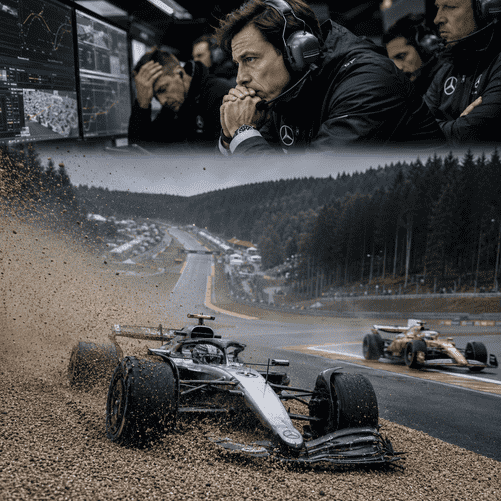
Russell’s race ended after an opening-lap collision with former Mercedes teammate Lewis Hamilton, now driving for Ferrari. Hamilton was penalised for causing the incident, but Russell directed much of his frustration toward the severe loss of power that had already left him exposed on the run through Eau Rouge and along the Kemmel Straight.
The British driver reported that the turbo and electrical energy-deployment systems were not functioning correctly, leaving him with almost no battery assistance at a critical point of the lap. He lost several positions before reaching the braking zone at Les Combes, where contact with Hamilton sent his Mercedes into the gravel and ended his race.
Russell described the situation as dangerous, arguing that his lack of acceleration had placed him among cars that would not otherwise have been close enough to challenge him. Although the collision ultimately caused his retirement, he suggested that the underlying technical failure created the circumstances in which the accident became possible.
Wolff agreed that Mercedes had let its driver down.
The team principal said the responsibility for the car’s performance problems was “100%” with Mercedes and acknowledged that Russell should never have been placed in such a vulnerable position. He also promised to support the visibly disappointed driver after a weekend that caused significant damage to his championship campaign.
The result was particularly painful because Russell had begun the race near the front and entered the weekend as one of the leading contenders for the drivers’ title. Instead of collecting another substantial points finish, he left Belgium empty-handed while teammate Andrea Kimi Antonelli won the race.
Antonelli’s victory dramatically strengthened his position at the top of the championship. The young Italian recovered from temporarily losing the lead to Ferrari’s Charles Leclerc and secured his sixth Formula One victory, with Leclerc finishing second and Max Verstappen taking third.
Hamilton recovered to finish fourth despite receiving a five-second penalty for the collision with Russell. The stewards concluded that the Ferrari driver was predominantly responsible for the contact, although Hamilton characterised it as a racing incident and indicated that he intended to speak with Russell.
The clash carried added significance because Hamilton and Russell spent three seasons together at Mercedes. Their partnership produced occasional tension but was generally managed without a sustained public breakdown in relations.
At Spa, however, the two drivers arrived at Les Combes under very different circumstances. Hamilton was attempting to recover positions, while Russell was struggling to maintain speed because of his car’s impaired power delivery.
As the field compressed into the braking zone, Hamilton’s Ferrari made contact with the Mercedes and forced Russell off the circuit. The incident became the defining image of a race in which the British driver’s title ambitions suffered one of their most serious setbacks of the season.
Russell’s frustration was evident in his post-race comments. He appeared close to tears while describing the loss of performance and the feeling that the retirement could have been avoided had the car operated normally.
His disappointment was not limited to the crash. Throughout the weekend, he had complained about the Mercedes car’s weakness on the straights and difficulties with the new-generation energy-management system.
Formula One’s 2026 technical regulations have placed far greater emphasis on electrical power and energy deployment. Drivers must carefully manage battery charge while teams attempt to balance regeneration, acceleration and straight-line speed.
At Spa, where the long climb from Eau Rouge to the Kemmel Straight places exceptional demands on a car’s power unit, any failure in electrical deployment can have immediate consequences. A driver emerging from the corner without sufficient battery assistance becomes highly vulnerable to cars behind.
Russell said he reached the top of Eau Rouge with virtually no usable electrical energy. By the time the field approached Les Combes, several competitors had already passed him or were attempting to do so.
Mercedes’ problems were apparently not isolated to Russell’s car. Other Mercedes-powered cars experienced performance issues during the Belgian weekend, raising questions about whether the team had encountered a broader weakness in its power-unit operation or energy-management settings.
The contrast between the two factory Mercedes drivers made the situation more complicated. Antonelli was able to win the race, demonstrating that the car remained capable of exceptional performance when functioning correctly.
That success may offer encouragement to the team, but it also intensifies the consequences for Russell. Every point lost through unreliability carries greater weight when the other Mercedes driver is converting opportunities into victories.
Wolff attempted to balance accountability with support for both sides of the garage. He acknowledged that drivers sometimes make mistakes and teams sometimes fail to deliver, arguing that the organisation must respond collectively rather than search for an individual to blame.
In this case, however, he made clear that Russell’s technical difficulties were a team failure.
Mercedes will now have to determine why the power and energy-deployment systems did not operate as expected. Engineers are likely to examine the turbo, battery, control software and the settings governing when electrical energy was released.
The investigation will be especially important because the same technology will remain central throughout the season. A problem that repeatedly leaves a driver without electrical assistance would represent not only a performance disadvantage but also a potential safety concern.
At high-speed circuits, sudden reductions in acceleration can create large closing speeds between cars. Drivers approaching from behind may not immediately realise that the vehicle ahead is experiencing a technical problem.
Russell’s description of the incident as dangerous reflects that concern. He was not simply slower than expected; he was losing speed relative to surrounding cars at a point where the field was tightly grouped and travelling at high velocity.
The Belgian retirement also threatens to alter the internal championship dynamic at Mercedes. Russell entered the season as an established race winner and one of the team’s most experienced figures, while Antonelli continued his rapid development into a genuine title contender.
Antonelli’s win at Spa reinforced the impression that the Italian is capable of leading Mercedes’ championship campaign. Russell, by contrast, must recover from a weekend in which both technical misfortune and an on-track collision cost him heavily.
That does not necessarily indicate a shift in the team’s support. Wolff’s public defence of Russell suggested that Mercedes remains determined to protect its driver from unfair criticism and to acknowledge the role of the machinery in his result.
Nevertheless, Formula One championships are often decided by moments in which one contender scores heavily while another fails to finish. Spa represented precisely that kind of turning point.
Russell can reasonably argue that the final collision was not solely the product of his own driving. Hamilton received a penalty, and Mercedes has accepted responsibility for the performance loss that placed Russell under pressure.
But the championship standings record only the result: Antonelli won, while Russell scored nothing.
Mercedes must therefore solve the technical issue quickly and restore Russell’s confidence before the next race. The team has demonstrated that it possesses a winning car, yet reliability and consistent energy deployment will be essential if both drivers are to remain in the title fight.
For Russell, the Belgian Grand Prix was more than an unfortunate collision. It was a reminder that even a front-running driver can become powerless when the most sophisticated systems in the car fail at the worst possible moment.
Wolff’s admission removes any doubt about where Mercedes believes the fundamental responsibility lies. The challenge now is to ensure that the same failure does not decide another race—or ultimately the championship.