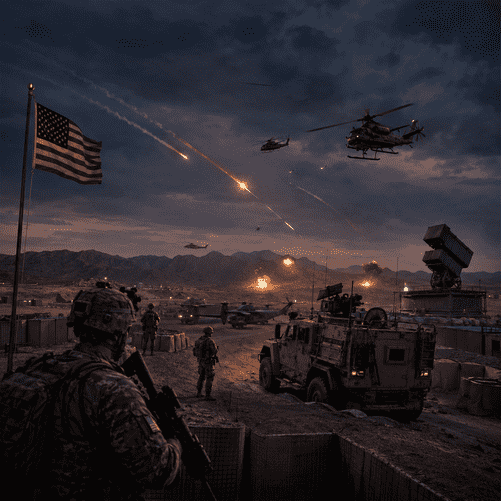
Iranian attacks on American military positions have transformed the strategically important kingdom into a frontline hub, raising fears of wider regional escalation.

Jordan has emerged as one of the most dangerous new fronts in the widening conflict between the United States and Iran, as Tehran intensifies attacks against American forces stationed inside the close U.S. ally.
The escalation has placed the kingdom—long regarded as a comparatively stable partner of Washington—at the centre of a confrontation increasingly spreading across the Middle East. Iranian missiles and drones have targeted several locations used by American personnel, including King Faisal Air Base and another airfield where U.S. Army Black Hawk helicopters were reportedly damaged.
The attacks represent a significant strategic shift. Rather than confining its retaliation to direct strikes against U.S. forces in Iraq or the Gulf, Iran appears to be targeting the network of countries supporting Washington’s military operations. Jordan’s proximity to Israel, Iraq, Syria and Saudi Arabia—and its longstanding defence relationship with the United States—makes it particularly important to American regional strategy.
Two U.S. service members were killed during an Iranian missile and drone assault in Jordan, while another was initially reported missing and several others were wounded. The attack was among the deadliest incidents involving American forces since the conflict began and prompted further U.S. strikes against Iranian military infrastructure.
Across the broader theatre, the official American military death toll has risen to at least 17 personnel. The casualties include troops killed by drone and missile attacks, aircraft accidents and incidents involving unexploded Iranian ordnance. More than 400 American personnel have also reportedly been wounded, many suffering traumatic brain injuries.
Jordan now faces the consequences of hosting an expanding American military presence. Although the locations and scale of recent deployments remain closely guarded, military analysts widely view Jordan as an important base for aircraft, air-defence systems, logistics and intelligence operations supporting the U.S. campaign.
For Washington, the country offers access to several strategically important areas without the political and operational constraints associated with some Gulf bases. For Tehran, however, that cooperation makes Jordan part of the infrastructure sustaining American military pressure against Iran.
Iranian officials have portrayed attacks on U.S. facilities across the region as legitimate retaliation for Washington’s expanding air campaign. The Trump administration, meanwhile, has broadened its targets inside Iran beyond missile installations and military facilities to include bridges, communications networks and other infrastructure.
The increasingly direct confrontation presents an acute dilemma for Jordan’s leadership. The kingdom depends heavily on American military assistance and economic support, but it must also manage domestic opposition to U.S. and Israeli policies. A visibly expanded role in the war could deepen public frustration and expose the government to accusations that it is allowing Jordanian territory to be used against another regional state.
Jordanian forces have attempted to intercept incoming missiles and drones, describing their actions as necessary to protect the country’s sovereignty and population. Nevertheless, every interception carries the risk of drawing Amman further into the conflict, particularly if falling debris, failed defensive systems or Iranian strikes cause civilian casualties.
The danger extends beyond Jordan. Iran has also attacked or threatened American-linked targets in Kuwait, Bahrain and Iraq, while the United States has continued air and naval operations intended to weaken Tehran’s ability to disrupt shipping through the Strait of Hormuz.
The waterway remains central to the confrontation because it handles a significant share of global oil shipments. Disruption to tanker traffic has already contributed to higher energy prices and growing concern that a prolonged war could generate a wider economic shock.
Washington maintains that its military campaign is necessary to reduce Iran’s nuclear and missile capabilities and protect regional shipping. Critics argue that the objectives of the operation have expanded and that every new deployment increases the likelihood of further American casualties.
Jordan’s transformation from supporting ally to active battlefield illustrates how rapidly the conflict’s geography is changing. What began as a campaign focused primarily on targets inside Iran has developed into a regional contest involving military bases, airspace, shipping lanes and allied governments across the Middle East.
With American forces continuing to concentrate in Jordan and Tehran showing its willingness to strike them, the kingdom may remain one of the conflict’s most vulnerable pressure points. Each new attack risks forcing Jordan into a deeper military role—and bringing the United States and Iran closer to an even broader regional war.