Fast-track courts fail to calm the youth-led “Cockroach” movement, as protesters demand ministerial resignations and deeper reform of the country’s high-stakes examination system.

Indian Prime Minister Narendra Modi has promised severe punishment for those responsible for leaking examination papers, responding publicly for the first time to a rapidly expanding youth protest movement that has placed his government under intense political pressure.
Modi said special fast-track courts would be established to prosecute people involved in examination fraud and assured students that the government was working to make the testing system more secure. “Those who try to harm the future of our youth will not be spared,” he said, presenting the measures as evidence of a zero-tolerance approach to corruption.
The announcement followed weeks of demonstrations over alleged leaks affecting major entrance and recruitment examinations, including tests that determine admission to medical schools and access to government employment. Around two million candidates have reportedly been affected by the latest controversy, transforming what began as an education dispute into one of the largest youth-led challenges Modi has faced since becoming prime minister in 2014.
The protests are being coordinated by the Cockroach Janta Party, or CJP, a satirical online initiative that has developed into a nationwide political movement.
Its unusual name emerged after a senior judge reportedly compared unemployed young people to cockroaches. Activists adopted the insult as a symbol of survival and resistance, arguing that India’s young generation was being treated as disposable despite spending years preparing for highly competitive examinations.
The movement’s supporters say repeated paper leaks have destroyed confidence in institutions that control access to education and public-sector employment. For millions of Indian families, examination preparation requires considerable financial and personal sacrifice. Candidates frequently spend years studying, paying for coaching courses and postponing employment while competing for a limited number of university places or government jobs.
When an examination paper is leaked, protesters argue, the damage goes far beyond the cancellation of a single test. Honest candidates may lose months or years of preparation, while those able to purchase leaked questions or exploit corrupt networks receive an unfair advantage.
Anger has also been intensified by reports of student suicides associated with the pressure and disappointment surrounding the examinations. Protest organisers are demanding compensation for affected families, an independent investigation and fundamental changes to the agencies responsible for administering national tests.
Modi’s promise of fast-track courts has not satisfied demonstrators. The CJP and opposition parties continue to demand the resignation of Education Minister Dharmendra Pradhan, whom they accuse of failing to protect the integrity of the examination system.
Rahul Gandhi, a leading figure in the opposition Congress party, has called on Modi to apologise to students and dismiss Pradhan. Gandhi has alleged that India experienced 152 examination paper leaks during the previous decade without securing a conviction. The government has rejected accusations that it ignored the problem and has accused opposition politicians of exploiting student anger for political purposes.
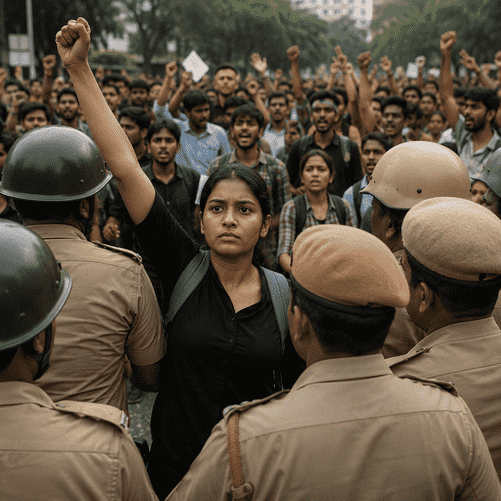
The confrontation has increasingly moved from university campuses and social media into the streets. Tens of thousands of people marched in New Delhi despite restrictions on public gatherings, while solidarity demonstrations were reported in Mumbai, Chennai, Hyderabad, Indore and other cities.
In the capital, protesters clashed with police near barricades as they attempted to advance towards government buildings. Authorities detained demonstrators and temporarily closed 16 metro stations as part of an effort to control the crowds. Police said some participants had become aggressive, attacked officers and damaged public property, allegations disputed by protest supporters.
Images of officers dragging protesters towards police vehicles have circulated widely, strengthening public anger and expanding the movement beyond the original examination controversy. A photograph of a young woman standing in front of a police van in Mumbai became an especially powerful representation of the demonstrations after she demanded legal justification for the detention of fellow protesters.
The unrest has also reached parliament, where opposition lawmakers have repeatedly disrupted proceedings while demanding accountability from the government. Modi’s administration has opened discussions with representatives of the protest movement, but activists have said negotiations must produce concrete commitments rather than general promises.
Although the government has reported arrests connected to the examination fraud and arranged for at least one affected test to be administered again, protesters say individual prosecutions will not resolve the institutional weaknesses that allow leaks to recur.
The scandal has become particularly dangerous for Modi because it connects several sources of frustration among younger Indians: unemployment, intense academic competition, corruption and the belief that public institutions do not provide equal opportunities.
Government employment remains highly attractive because it offers greater security than much of India’s private labour market. Yet the number of applicants often vastly exceeds the positions available. Delays, cancelled examinations and allegations of fraud therefore generate an especially powerful sense of injustice.
The Cockroach movement has successfully turned that frustration into a common political identity. Its deliberately mocking name allows young activists to reject the language used against them while portraying themselves as resilient, numerous and impossible to ignore.
Modi’s fast-track courts could deliver more rapid prosecutions and demonstrate that the government is willing to act against organised examination fraud. Their political impact, however, will depend on whether investigations reach officials and institutions rather than stopping with intermediaries and individual suspects.
The prime minister must now decide whether to sacrifice senior officials, introduce more extensive reforms or risk allowing the movement to expand into a broader campaign against his government.
For the protesters, the dispute is no longer simply about a leaked examination paper. It has become a struggle over whether India’s young people can trust the institutions that determine their futures—and whether those institutions can be held accountable when that trust is broken.