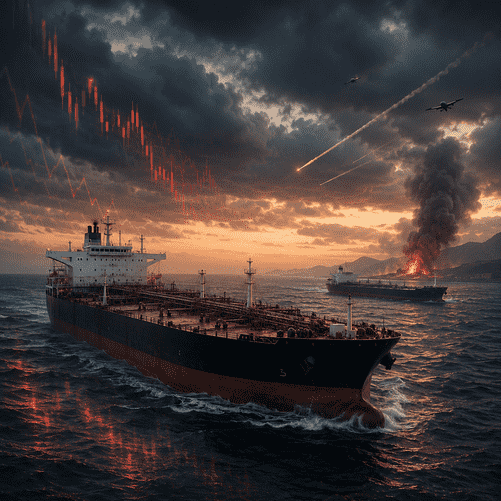
Attacks claimed by Yemen’s Houthis threaten a second strategic shipping route, pushing crude prices higher, lifting bond yields and unsettling global equity markets.

Global financial markets came under renewed pressure on Thursday as escalating security threats in the Red Sea sent oil prices racing toward the psychologically important threshold of $100 a barrel.
Brent crude, the international oil benchmark, climbed more than 4% and briefly traded above $98 a barrel after Yemen’s Iran-aligned Houthi movement claimed responsibility for attacks on two Saudi oil tankers. West Texas Intermediate, the principal US benchmark, advanced to around $90 a barrel as traders rapidly added a larger geopolitical risk premium to energy prices.
The Houthis said the Saudi-flagged tankers Encelia and Layla had violated a newly declared naval blockade on Saudi Arabia. One vessel reportedly sustained damage and issued a distress call, while the condition of the second tanker remained uncertain. The claims added to concerns that the expanding Middle East conflict could disrupt shipping not only through the Strait of Hormuz but also through the Bab al-Mandab Strait at the southern entrance to the Red Sea.
Together, the two waterways represent vital arteries for global energy trade. Saudi Arabia has increasingly relied on its Red Sea export infrastructure as an alternative route when Gulf shipping is threatened. A sustained Houthi campaign against vessels using that corridor could weaken one of the kingdom’s most important methods of bypassing instability around the Strait of Hormuz.
Two tankers carrying Saudi crude toward Asian markets had already reversed course in the Red Sea earlier in the week following Houthi threats. Analysts have warned that a prolonged blockade could force additional ships to sail around Africa, increasing delivery times, fuel consumption, freight charges and maritime insurance costs.
The market reaction reflected fears that the world could be confronting simultaneous disruptions at two major maritime chokepoints. Oil prices had already been rising because of reduced traffic and repeated attacks around the Strait of Hormuz. The latest Red Sea escalation has introduced another layer of uncertainty at a time when energy supplies are becoming increasingly difficult and expensive to transport.
The surge in crude prices quickly spread across other financial markets. US stock futures moved lower, with technology shares facing some of the heaviest pressure. Futures linked to the S&P 500 fell approximately 0.5%, while Nasdaq futures declined around 0.7% as investors considered the combined effects of higher energy costs, corporate spending and persistently elevated interest rates.
European markets also weakened. Germany’s DAX and France’s CAC 40 declined as energy-sensitive industries, consumer companies and technology stocks came under pressure. Asian trading was more resilient, with South Korea’s Kospi recording strong gains supported by semiconductor and artificial-intelligence companies.
Bond markets provided another warning signal. Government yields hovered near their highest levels of 2026 as investors assessed whether rising oil prices could revive inflation and delay monetary-policy easing. More expensive fuel raises transportation, manufacturing and household costs, creating the risk that inflation could spread through the wider economy.
That possibility presents central banks with a difficult choice. Policymakers may be reluctant to cut interest rates while energy prices are climbing sharply, even if higher borrowing costs are already slowing economic activity. Investors are therefore beginning to reconsider expectations that monetary authorities will be able to provide significant support to markets later in the year.
The immediate economic impact will depend on whether the tanker attacks represent an isolated escalation or the beginning of a sustained campaign against Saudi shipping. Alternative pipelines and longer maritime routes may prevent a complete halt in exports, but those solutions would still increase costs and reduce efficiency.
Some analysts have suggested that Brent could rise above $115 or even $120 a barrel if Red Sea traffic is seriously disrupted and restrictions around the Strait of Hormuz continue. Such forecasts remain dependent on the duration and severity of the conflict, but they demonstrate how quickly market expectations have shifted.
For investors, the return of oil toward $100 changes the broader market calculation. Energy producers may benefit from higher crude prices, but airlines, transport companies, manufacturers and consumers face rising expenses. Technology and other growth-oriented shares are also vulnerable because persistent inflation could keep bond yields and interest rates elevated.
The next phase will be determined less by corporate earnings than by developments along some of the world’s most strategically important shipping lanes. Until vessels can move safely through both the Red Sea and the Gulf, oil markets are likely to remain volatile—and global stocks will continue to trade under the shadow of a widening regional conflict.