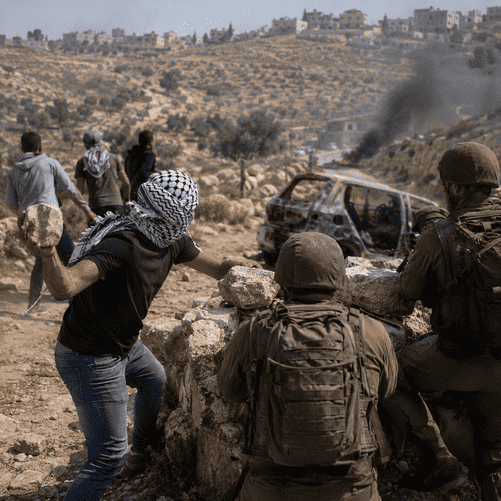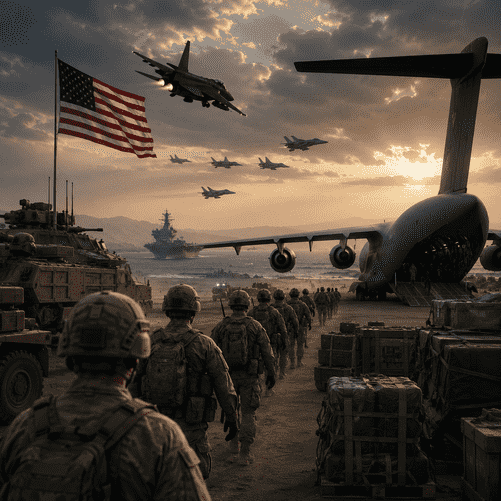
The United States is reinforcing its regional military presence after deadly attacks on American forces, giving President Donald Trump greater flexibility as Washington weighs its next moves against Iran.

The United States has begun a significant military buildup across the Middle East, deploying additional troops, combat aircraft, medical personnel and support assets as President Donald Trump considers whether to broaden military operations against Iran following the deaths of American service members in a missile attack on a U.S. base in Jordan.
According to U.S. officials, the latest deployments are designed to provide the White House with a wider range of military options rather than signal an immediate decision to escalate the conflict. Special operations forces have been repositioned from bases in the United States, fighter aircraft have been distributed across the region, and long-range bombers stationed in both the United States and the United Kingdom have been placed on heightened readiness. More than 150 additional medical personnel have also been deployed to Germany’s Landstuhl Regional Medical Center, the principal treatment facility for wounded American troops evacuated from the Middle East.
The military reinforcement follows one of the deadliest attacks on U.S. forces since fighting intensified earlier this year. Iranian strikes against a military installation in Jordan killed several American service members and injured many others, prompting renewed calls in Washington for a stronger response. The Pentagon has since acknowledged that nearly one hundred U.S. personnel have been wounded during the latest phase of the conflict, underlining the growing human cost of the campaign.
President Trump has vowed that Iran will face severe consequences for attacks on American personnel. In recent public statements, he warned that every strike against U.S. forces would be met with overwhelming retaliation and indicated that critical Iranian infrastructure could become legitimate military targets should Tehran continue its attacks on regional bases or commercial shipping.
The troop surge comes as U.S. Central Command continues an extensive air campaign against Iranian military facilities. Officials say the strikes are intended to degrade Tehran’s missile capabilities, weaken Revolutionary Guard infrastructure and reduce threats to international shipping lanes in both the Strait of Hormuz and the Red Sea. Military operations have now continued for nearly two weeks without interruption, reflecting Washington’s determination to maintain pressure on Iran despite mounting financial and political costs.
Strategically, the additional forces provide the Pentagon with greater operational flexibility. Extra fighter squadrons strengthen air superiority, special operations units expand the range of precision missions that could be undertaken, while additional medical resources prepare for the possibility of higher casualty levels should the conflict intensify further.
Military analysts note that such deployments are often intended as both a deterrent and a contingency measure. By positioning forces before a political decision is made, commanders ensure that the president has multiple options available, ranging from limited retaliatory strikes to broader campaigns targeting military infrastructure, missile launch sites or naval assets.
The reinforcement also reflects growing concern over Iran’s expanding regional activities. Alongside direct attacks on American installations, Iranian-backed groups have continued operations against commercial shipping, while Houthi forces in Yemen have threatened maritime traffic through the Red Sea. Together with continuing instability around the Strait of Hormuz, these developments have heightened fears of prolonged disruptions to global energy supplies and international trade.
The economic implications are becoming increasingly significant. Rising oil prices, higher shipping costs and renewed uncertainty across financial markets have accompanied the military escalation. Energy traders remain particularly concerned that further conflict could disrupt one of the world’s most important maritime oil corridors, placing additional upward pressure on inflation and global fuel prices.
Inside Washington, however, questions are emerging over the long-term strategy. Members of Congress from both parties have raised concerns about the financial burden of the operation, which has already cost tens of billions of dollars, as well as the legal basis for continued military action without broader congressional authorization. Critics argue that sustained air strikes alone may not fundamentally alter Iran’s strategic calculations, while supporters contend that failing to respond forcefully would encourage additional attacks on American personnel.
The military buildup also carries broader geopolitical consequences. Several allied nations have increased logistical support for U.S. operations, including Bulgaria, whose parliament recently approved the temporary deployment of American aerial refueling aircraft to support missions connected to Middle East operations. Officials in Sofia stressed that the aircraft would conduct logistical support rather than offensive combat missions, reflecting the delicate balance many allies are attempting to maintain.
Despite the growing concentration of American military power, defense specialists caution that additional troops do not necessarily indicate an imminent ground invasion. Instead, the deployments appear designed to provide credible military leverage while preserving strategic flexibility as diplomatic and military options continue to evolve.
Whether the reinforced posture ultimately deters Iran or leads to a broader regional confrontation will depend largely on developments in the coming days. Any further attacks on American personnel or international shipping could rapidly increase pressure on the White House to authorize a more expansive military campaign.
For now, Washington’s message is clear: the United States intends to maintain overwhelming military readiness while preserving the ability to escalate rapidly if the conflict continues to widen. As additional forces arrive across the region, the Middle East enters another period of heightened uncertainty in which every new attack carries the potential to trigger a far larger confrontation between the United States and Iran.