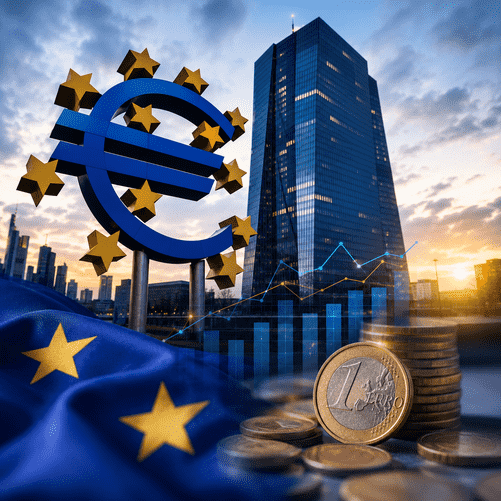
Falling inflation offers relief, but policymakers remain cautious as energy costs and geopolitical uncertainty continue to cloud the eurozone’s economic outlook.

The European Central Bank (ECB) has decided to leave its three key interest rates unchanged, opting for a cautious approach as policymakers assess the impact of volatile energy markets and slowing economic activity across the eurozone. The decision follows the ECB’s first interest-rate increase in nearly three years in June and underscores the institution’s determination to return inflation to its long-term 2% target without unnecessarily damaging economic growth.
The ECB maintained its deposit facility rate at 2.25%, the main refinancing rate at 2.40%, and the marginal lending facility at 2.65%. While no further tightening was announced, President Christine Lagarde and the Governing Council emphasized that monetary policy will remain entirely data-dependent, with no commitment to a predefined path for future interest-rate decisions.
Recent economic data have provided encouraging signals. Eurozone inflation slowed to 2.8% in June, down from 3.2% in May, marking the first meaningful decline this year. Core inflation—which excludes volatile food and energy prices—also eased, suggesting that underlying price pressures may finally be moderating after months of persistent increases.
A separate ECB consumer expectations survey released this week indicates that households increasingly believe inflation will continue to decline over the coming years. The central bank projects average inflation at 2.7% in 2026, falling further toward its 2% objective by 2028. These improving expectations are considered essential because they reduce the risk of workers demanding significantly higher wages and businesses continuously increasing prices.
Nevertheless, ECB officials caution that inflation remains above target and that the battle is far from over. They are particularly concerned about “second-round effects,” where temporary increases in energy prices eventually spread throughout the wider economy via wages, transportation costs, manufacturing, and consumer services.
The principal risk confronting European policymakers is the resurgence of energy prices following renewed instability in the Middle East. Oil prices have climbed sharply in recent weeks, while European natural gas prices have also risen substantially amid concerns over global supply disruptions.
Although energy costs have not yet translated into a broad acceleration in consumer inflation, the ECB warned that the current environment remains highly uncertain. The institution noted that the full economic consequences of the recent energy shock have not yet materialized and may continue to affect inflation throughout the second half of the year.
Higher fuel prices have already begun increasing production and transportation costs for European manufacturers. Businesses across sectors ranging from chemicals to logistics report rising operational expenses, while retailers remain reluctant to fully pass those costs on to consumers because household demand remains weak.
While inflation appears to be easing, the eurozone economy continues to struggle with sluggish growth. The ECB has revised its 2026 growth forecast downward to 0.6%, reflecting weaker industrial production, soft consumer spending, and reduced business investment. Germany, Europe’s largest economy, continues to face particular difficulties as its export-oriented manufacturing sector grapples with weaker global demand and elevated financing costs.
Business surveys indicate that many companies are delaying investment decisions because borrowing costs remain elevated and uncertainty surrounding international trade and geopolitical tensions persists. Small and medium-sized enterprises are especially affected, as tighter credit conditions limit access to financing for expansion projects.
Consumer spending has also remained cautious. Although wage growth has improved in several eurozone countries, many households continue to prioritize savings over discretionary purchases after enduring several years of high inflation and increased living costs.
An ECB survey of major European companies highlights the increasingly difficult operating environment. Approximately 40% of firms reported higher sector-specific costs, yet competitive pressures have prevented many from increasing retail prices. Instead, businesses are absorbing part of the higher costs through lower profit margins.
Food retailers report that consumers are increasingly shifting toward lower-cost private-label products, while manufacturers indicate that competition from lower-cost imports, particularly from China, has further constrained pricing power. Meanwhile, investment continues to flow into artificial intelligence, automation, and digital transformation as companies seek productivity gains to offset higher operating expenses.
Although the ECB paused this month, investors generally do not believe the tightening cycle has ended. Financial markets increasingly expect another interest-rate increase as early as September, particularly if energy prices continue rising or inflation stabilizes above the ECB’s target.
Eurozone government bond yields have climbed in anticipation of tighter monetary policy, while the euro has remained relatively stable against the U.S. dollar. Investors are now closely monitoring incoming inflation data, wage settlements, and developments in global energy markets before the ECB’s next policy meeting.
Attention is also turning toward other major central banks, including the U.S. Federal Reserve and the Bank of England, whose upcoming policy decisions may influence global financial conditions and capital flows into European markets.
The ECB’s latest decision illustrates the increasingly complex environment confronting European policymakers. Inflation is easing but remains above target. Economic growth is weak, yet renewed energy price shocks threaten to reverse recent progress. Raising interest rates too aggressively could deepen the slowdown, while waiting too long risks allowing inflationary pressures to become entrenched.
For now, the Governing Council has chosen patience over immediate action. Whether that cautious stance can successfully balance price stability with economic recovery will largely depend on developments in global energy markets, geopolitical tensions, and the resilience of Europe’s businesses and consumers during the months ahead.