Beyond Pickaxe Mountain, U.S. planners could look at damaged or disputed facilities tied to Tehran’s nuclear infrastructure, raising the stakes of any expanded air campaign.

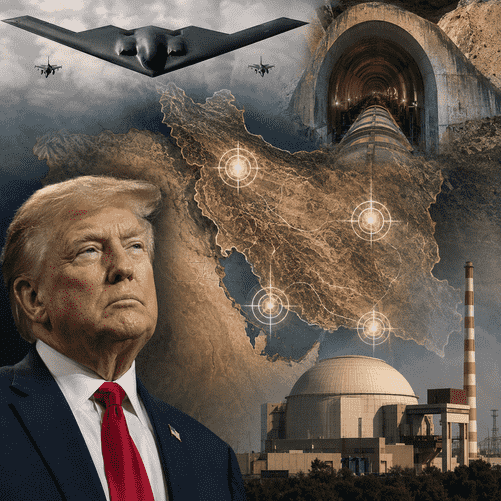
The possibility of a broader U.S. air campaign against Iran has returned the country’s nuclear infrastructure to the center of international concern, after President Donald Trump repeatedly suggested that Washington could strike Pickaxe Mountain, a deeply buried facility near Natanz that Western and Israeli analysts have monitored for years.
Pickaxe Mountain, known in Iran as Mount Kolang, has drawn particular attention because Israeli intelligence believes Iran may have moved thousands of uranium-enrichment centrifuges into tunnels there after earlier strikes damaged other nuclear facilities. The site sits near Natanz, one of Iran’s most important enrichment centers and one of the locations targeted in previous U.S. and Israeli attacks.
But Pickaxe is not the only possible focus if the United States decides to widen its campaign. Former officials and nuclear experts say Washington could also consider other sites connected to Iran’s nuclear program, including remnants of facilities at Fordow, Isfahan and Natanz, as well as the Taleghan 2 site within the Parchin military complex. Many of those locations have already been damaged, but analysts warn that some may still contain infrastructure, support buildings or materials relevant to any future Iranian effort to rebuild nuclear capacity.
The strategic question for Washington is no longer simply whether Iran’s main nuclear sites were damaged, but whether Tehran can reconstitute parts of the program under more protected conditions. The U.S. and Israel have previously hit declared enrichment sites, and Trump has claimed Iran’s nuclear program was “obliterated.” Yet experts quoted by The Wall Street Journal argue that intelligence on remaining or rebuilt facilities could drive further targeting decisions.
Fordow remains one of the most sensitive sites because of its underground design and its history as a uranium-enrichment facility. Although U.S. strikes reportedly caused severe damage to the underground plant, analysts say surrounding support facilities could still attract attention if Washington concludes that Iran is trying to preserve or repurpose parts of the site.
Isfahan, Iran’s largest nuclear research complex, is another potential concern. The facility was struck during earlier U.S. operations, and satellite imagery cited by experts indicates that tunnel entrances have remained sealed while some aboveground activity has continued. Outside analysts have cautioned that such activity may involve recovery operations rather than a full rebuilding effort, but uncertainty over enriched material and access has kept the site under scrutiny.
Natanz, long central to Iran’s enrichment program, also remains part of the wider calculation. It has been hit multiple times, but experts say remaining structures or rebuilt components could still matter if Iran seeks to restore enrichment capacity. The nearby Pickaxe facility is viewed as especially important because it may represent a more hardened alternative to vulnerable aboveground or previously damaged plants.
The debate is complicated by the limits of international monitoring. The International Atomic Energy Agency has struggled to maintain full visibility over Iran’s nuclear infrastructure after years of conflict, disrupted inspections and restricted access. IAEA chief Rafael Grossi has warned that access to bombed or disputed facilities is essential to determining what remains of Iran’s program and where nuclear material may be located.
For Tehran, any expanded U.S. attack would almost certainly be treated as a major escalation. Iran has repeatedly denied seeking nuclear weapons and says its nuclear program is for civilian purposes. But Western governments and nuclear watchdogs remain concerned about the scale of Iran’s past enrichment activity, the location of enriched uranium and the possibility that military pressure could push hard-liners in Tehran toward a more confrontational nuclear posture.
The immediate risk is that military action meant to slow Iran’s nuclear recovery could instead widen the conflict. Strikes on additional nuclear-linked sites would test regional stability, affect energy markets and put U.S. forces and allies on higher alert across the Middle East.
For now, Pickaxe Mountain has become the symbol of the next phase of the confrontation. But the broader issue is larger than one underground facility. If Washington expands its campaign, it would be targeting not only physical infrastructure, but also Iran’s ability to preserve, rebuild or conceal the remaining elements of a nuclear program that remains deeply contested and dangerously opaque.