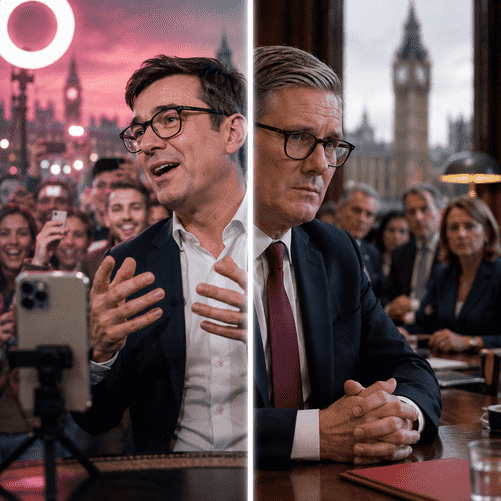
In his first week as prime minister, Andy Burnham has moved away from Keir Starmer’s controlled style, trading caution and discipline for visibility, informality and rapid policy signals.

Andy Burnham’s first week in Downing Street has made one thing clear: the new prime minister wants voters to feel the change before they measure it.
After replacing Keir Starmer as Labour leader and prime minister, Burnham has used his opening days in office to present a dramatically different political personality. Where Starmer favored caution, restraint and tightly managed public appearances, Burnham has leaned into speed, informality and direct communication — especially online.
The contrast has been visible from the start. Burnham’s early media strategy has relied less on traditional interviews and more on social platforms, including Reddit, X and TikTok. He has appeared alongside viral online figures such as Bus Aunty and Max Klymenko, while his team has promoted a looser, more conversational image designed to break from Starmer’s buttoned-up operation.
The approach has already generated attention. Searches for Burnham on TikTok reportedly surged by more than 2,000 percent in the UK after he became prime minister, while one video announcing plans to cut VAT on energy bills passed one million views.
Burnham’s policy style has been just as striking. In his first week, he moved quickly on eye-catching proposals, including measures aimed at energy bills, pubs, transport costs and everyday household pressures. ITV reported that he became the UK’s seventh prime minister in a decade after forcing out Starmer following his Makerfield by-election victory, immediately facing pressure to show that his government could move faster than its predecessor.
Supporters see this as necessary political energy after a Starmer premiership widely criticized for caution and over-management. Burnham’s allies argue that his northern mayoral experience taught him the value of plain language, local symbolism and public visibility. His style is designed to make politics feel less remote and more emotionally connected to voters who felt Labour had become too technocratic.
Critics, however, warn that the new prime minister risks confusing activity with strategy. Some have described the early burst of policies as a “sugar rush” — popular, attention-grabbing and politically useful, but potentially difficult to fund or sustain. The Times argued that, despite the new tone, much of Burnham’s policy agenda so far remains closer to continuity with Starmer than a full break from him.
That tension now defines the comparison between the two Labour leaders. Starmer’s strength was discipline. He preferred message control, legalistic precision and gradual change, but that often made him appear distant and slow. Burnham’s strength is connection. He appears more comfortable with spontaneity, emotional language and modern media rhythms, but that same informality can create risk when off-the-cuff remarks become policy headlines.
The early signs suggest Burnham wants to govern through momentum. His first week has been built around visibility: quick announcements, viral content, symbolic gestures and attempts to show immediate relief for voters. Starmer governed as if credibility came from restraint. Burnham is betting that credibility now comes from movement.
Whether that bet succeeds will depend on what happens after the opening spectacle fades. Social media can introduce a prime minister, but it cannot solve fiscal constraints, public-service pressures or foreign-policy crises. Energy-bill cuts, transport promises and support for pubs may win attention, but the harder test will be whether Burnham can turn rapid announcements into durable policy.
For now, the new prime minister has achieved his first objective: he has made his government feel different. The question is whether difference can become delivery — and whether Burnham’s political theatre can survive the discipline required by power.