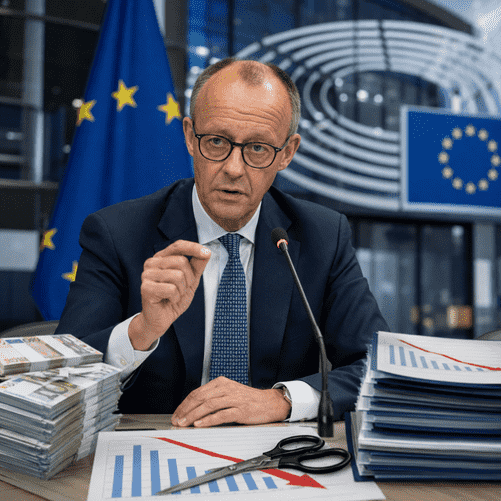
Germany’s chancellor rejects Brussels’ spending plans, arguing that the next EU budget must be reduced by hundreds of billions of euros and that new institutional hiring is politically indefensible.

German Chancellor Friedrich Merz has sharpened his criticism of the European Union’s next long-term budget, calling for cuts worth “several hundred billion” euros and warning that Brussels must show far greater restraint at a time when national governments are under pressure to control public spending.
Speaking during a meeting with Irish Prime Minister Micheál Martin in Dublin, Merz said the European Commission’s proposed budget for 2028 to 2034 was too high and would need reductions across all major spending areas. The Commission has proposed a multiannual budget of about €1.76 trillion in 2025 prices, covering priorities such as defence procurement, agricultural support, regional development, infrastructure, research, and programmes including Erasmus.
Merz described the proposal as unbalanced and argued that the EU could not simply expand spending while asking member states to accept tighter domestic budgets. His remarks place Germany, the bloc’s largest net contributor, at the centre of what is expected to become a difficult negotiation over Europe’s financial priorities for the next seven years.
The chancellor also criticised plans by European institutions to add around 2,500 new jobs, calling the move “unacceptable.” For Berlin, the staffing proposal has become a symbol of what Merz sees as a broader problem: EU institutions demanding more money and more personnel at a moment when many European governments are being forced to justify every major line of expenditure.
The dispute reflects a wider divide inside the EU. Some member states and EU officials argue that Europe needs a larger budget to respond to geopolitical instability, strengthen defence capacity, support Ukraine, accelerate industrial competitiveness, and fund the green and digital transitions. Others, led by fiscally cautious governments, insist that Brussels should reprioritise existing spending rather than seek a major increase.
Merz has repeatedly opposed both a larger EU budget and new common EU borrowing. At a previous European Council meeting, he said proposals reaching €1.6 trillion or €1.7 trillion for the next seven-year framework were not politically justifiable from Germany’s perspective. He has also argued that Germany will not support new European debt instruments, even as EU leaders debate how to finance defence and competitiveness needs in a more unstable global environment.
The budget fight comes as the EU faces competing demands. Defence spending has moved sharply up the agenda after Russia’s war against Ukraine, while traditional budget pillars such as agriculture and regional development remain politically sensitive in many member states. Any final agreement will require extensive negotiations among national capitals, the Commission, and the European Parliament.
Merz’s intervention signals that Germany intends to push hard for a leaner EU financial framework. But cutting “several hundred billion” euros from the Commission’s proposal would require difficult trade-offs and would almost certainly face resistance from countries that rely heavily on EU funds, as well as from lawmakers who argue that Europe cannot meet its strategic ambitions with a smaller budget.
For now, the German chancellor’s message is clear: Brussels must spend less, hire less, and prove that Europe’s priorities can be financed without asking taxpayers for an ever-larger bill.