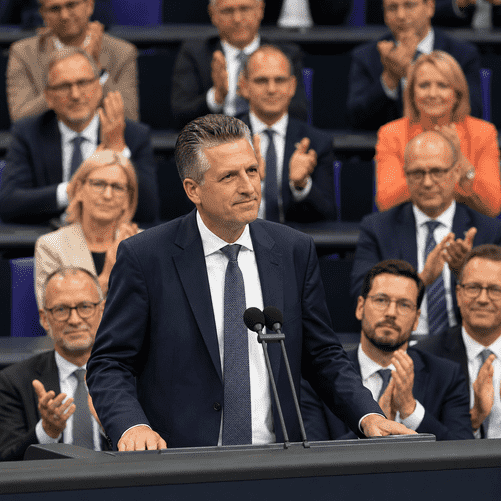
Thorsten Frei wins 91.9% backing from CDU and CSU lawmakers as Germany’s chancellor seeks to restore discipline following a contentious government reshuffle.

BERLIN — German conservative lawmakers have elected Thorsten Frei as the new leader of their parliamentary group, handing one of Chancellor Friedrich Merz’s closest allies a commanding mandate at a moment of mounting tension within the governing bloc.
Frei secured 91.9% of the votes cast during a closed-door meeting of legislators from Merz’s Christian Democratic Union and its Bavarian sister party, the Christian Social Union. The strong result gives the former head of the Federal Chancellery formal authority over the conservative group in the Bundestag and offers Merz a measure of stability after several days of internal dispute.
The 52-year-old succeeds Jens Spahn, whose resignation created an unexpected vacancy at the top of the parliamentary faction. Merz and CSU leader Markus Söder subsequently proposed Frei for the position, making his election likely even before lawmakers were recalled for the special meeting.
Although the result demonstrated substantial support for Frei personally, it came against a far more unsettled political background. A broader reshuffle intended to refresh Merz’s administration instead provoked criticism from within the CDU, particularly over the handling of ministerial dismissals and the apparent lack of consultation with regional party organisations and parliamentary figures.
Frei’s appointment is therefore about more than replacing one parliamentary leader. He will be expected to restore cohesion among conservative legislators, manage relations with the centre-left Social Democrats and ensure that government proposals can pass through parliament without repeated rebellions or delays.
The parliamentary group leader is one of the most influential positions in German federal politics. While the chancellor directs the government, the faction chief must organise legislative majorities, negotiate compromises and maintain discipline among lawmakers who may be under conflicting pressure from ministers, party officials and voters in their constituencies.
Frei arrives with extensive experience in precisely that type of political management. A Bundestag member since 2013, he served as deputy leader of the CDU/CSU parliamentary group on legal and domestic-affairs policy before becoming its chief parliamentary manager in 2021. He moved into the Chancellery when Merz formed his government in May 2025, serving as federal minister for special affairs and coordinating the work of government departments.
His return to parliament places a trusted Merz associate at the centre of the government’s legislative operation. Frei will act as the principal conservative negotiator with the SPD parliamentary leadership as the coalition attempts to deliver reforms intended to revive economic growth, modernise public administration and address public concern over migration and security.
That relationship with the chancellor is both an advantage and a potential constraint. Frei’s familiarity with Merz should make communication between the Chancellery and the Bundestag more efficient. At the same time, he will need to demonstrate that he represents the interests of CDU and CSU legislators rather than merely transmitting instructions from the government.
The distinction could become increasingly important if Merz’s political difficulties continue. The chancellor’s approval ratings have fallen sharply, while polling cited in the latest reporting showed the far-right Alternative for Germany ahead of the conservative bloc nationally and gaining ground on perceptions of political competence.
The pressure is particularly acute ahead of regional elections in eastern Germany, where the AfD hopes to convert national dissatisfaction into control of a state government. Conservative officials fear that visible conflict within the CDU could reinforce the AfD’s argument that Germany’s traditional parties are unable to govern effectively.
Merz had presented his personnel changes as part of an effort to give the administration greater energy after a difficult first year in office. Germany’s economic recovery has remained slow, promised reforms have taken time to materialise and relations between the conservative bloc and the SPD have frequently appeared strained.
Instead of producing an immediate political reset, however, the reshuffle exposed dissatisfaction with Merz’s leadership style. Party figures complained that some decisions appeared improvised and were communicated poorly. The abrupt dismissal of Transport Minister Patrick Schnieder generated particular anger among CDU politicians in his home state of Rhineland-Palatinate.
Against that backdrop, Frei’s 91.9% result serves as an important display of unity. It indicates that lawmakers were unwilling to transform the leadership election into an open revolt against the chancellor or his preferred candidate. Nevertheless, the vote does not automatically resolve the political disagreements that produced the recent unrest.
Frei must now translate his broad internal endorsement into legislative results. That will require balancing the priorities of the CDU and CSU, accommodating the SPD where necessary and persuading potentially rebellious lawmakers that coalition compromises are politically defensible.
SPD parliamentary leader Matthias Miersch has expressed hope that Frei’s appointment will help stabilise the government and return attention to its reform programme. The two faction leaders will play a central role in determining whether the coalition can move beyond its personnel disputes and demonstrate practical progress when the Bundestag returns from its summer recess.
For Merz, the election provides temporary relief rather than a complete political recovery. He has secured a dependable ally in one of parliament’s most powerful positions, but the success of that decision will ultimately be measured not by Frei’s election percentage, but by whether he can impose order on an increasingly restless governing majority.
Frei begins the job with an unusually strong mandate. His immediate challenge will be to use it without appearing either too dependent on the chancellor or insufficiently responsive to the lawmakers he has been elected to lead.