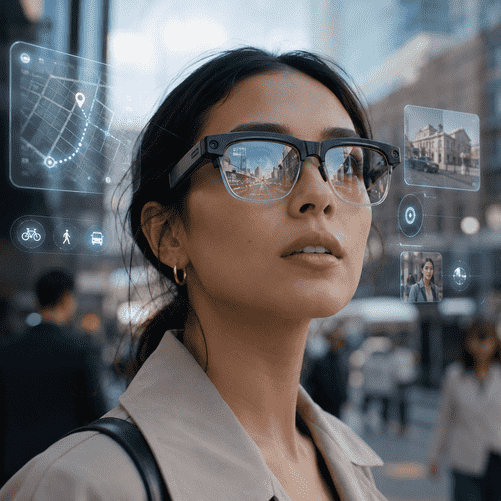
Developed with Google, Gentle Monster and Warby Parker, the company’s intelligent eyewear promises hands-free assistance, translation and visual understanding—but its discreet camera could make privacy the decisive test.

LONDON — Samsung is preparing to move artificial intelligence out of the smartphone screen and into an object millions of people already wear every day: a pair of glasses.
The South Korean technology group unveiled its new intelligent eyewear at its Galaxy Unpacked event in London on July 22, presenting the device alongside the Galaxy Z Fold8 series and its latest smartwatches. Created with Google and eyewear brands Gentle Monster and Warby Parker, the glasses represent Samsung’s most significant attempt yet to make generative AI a continuous companion rather than a service users deliberately open on a phone or computer.
Unlike bulky virtual-reality headsets, the first models are designed to resemble conventional fashion eyewear. They are lightweight, relatively slim and available in styles developed by established glasses manufacturers rather than by Samsung alone. This emphasis on appearance reflects a lesson learned from earlier wearable-computing experiments: a device worn on the face must succeed as clothing before it can succeed as technology.
Inside the frames, however, is a compact network of cameras, microphones, speakers, touch controls and artificial-intelligence software. The glasses use Qualcomm’s Snapdragon AR1 Gen 1 platform and run on Google’s Android XR system, with Gemini serving as the principal AI assistant. Samsung says the device can operate for as long as nine hours on one charge, while its case can provide up to seven additional full charges.
The central idea is that the AI can understand not only what the wearer says, but also what the wearer is looking at.
A user could ask the glasses to identify a building, explain an unfamiliar object, translate a menu or provide information about a nearby business. The system can deliver spoken navigation, summarize messages, place calls, send texts and interact with supported smartphone applications without requiring the user to take a handset from a pocket.
The camera also allows the glasses to record photographs and video from the wearer’s perspective. Samsung demonstrated professional uses in which the device captures a whiteboard or meeting discussion, organizes the material into notes and prepares it for later review. During video calls, users can share what they are seeing directly, creating a hands-free viewpoint that could prove useful for technical support, remote training, healthcare, travel and industrial work.
Google has described two broad categories of Android XR eyewear: audio glasses that provide assistance through speakers, and more advanced display glasses capable of placing visual information directly in the wearer’s field of view. The screen-free audio models are due to arrive first, with an initial release planned for the autumn. They are expected to work with both Android phones and Apple’s iPhone, potentially giving Google’s Gemini assistant access to users outside the traditional Android ecosystem.
Samsung has not yet announced the final price or full international availability of the eyewear. Those decisions will be critical because the company is entering a market where Meta has already established a powerful lead through its partnerships with Ray-Ban and Oakley.
Meta introduced a new collection of AI glasses in June with prices beginning at $299. IDC estimated that Meta controlled 69.2% of the global smart-glasses market during the first quarter of 2026, giving it an advantage in consumer recognition, real-world usage data and developer experience.
The wider market is nevertheless expanding quickly enough to attract competitors. IDC reported that shipments of display-free smart glasses increased by 167% year over year during the first quarter of 2026, reaching approximately 2.25 million units. It forecasts that annual shipments in the category will reach 13.6 million units this year and more than double to 27.3 million by 2030.
Those figures remain small compared with the global smartphone market, but they suggest that smart glasses are moving beyond the experimental stage. The strongest demand is currently for products that resemble ordinary eyewear and offer practical functions—photography, audio, messaging and AI assistance—rather than attempting to create a fully immersive digital world.
Samsung’s entry could accelerate that transition. The company can connect the glasses to an extensive ecosystem of smartphones, watches, tablets, televisions and household devices. In theory, information gathered by each product could help Gemini respond more intelligently: a watch could supply health and activity data, a phone could provide location and communications, and the glasses could add visual context from the wearer’s immediate surroundings. Samsung presents that combination as a more personal and responsive form of AI.
Yet the same contextual awareness that makes the device useful also creates its most difficult problem.
A camera built into normal-looking glasses can record people who may not realize they are being filmed. Critics argue that small indicator lights are not always noticeable and may provide insufficient warning in crowded streets, workplaces, schools or private social settings. The more successfully manufacturers conceal the technology inside fashionable frames, the harder it may become for bystanders to distinguish ordinary eyewear from a recording device.
Samsung says the glasses include controls and safeguards intended to encourage responsible use. However, public acceptance will depend on more than hardware indicators. Consumers and regulators will want to know when images and audio are transmitted to cloud servers, how long information is retained, whether recordings can be used to improve AI models and how reliably the device communicates that its camera is active.
The challenge is not unique to Samsung. Privacy, comfort and price have repeatedly slowed the adoption of smart glasses, even as consumer interest has increased. Earlier products demonstrated impressive technical capabilities but struggled to overcome the unease created by a camera that follows its owner throughout the day.
Battery life will present another test. Nine hours may cover much of a working day under favourable conditions, but intensive use of cameras, navigation, wireless connections and AI processing could reduce practical endurance. The glasses must also remain comfortable despite carrying processors, microphones, speakers and a battery inside their frame.
Artificial intelligence adds further uncertainty. For the device to become genuinely valuable, Gemini must interpret the wearer’s environment accurately and respond quickly enough to feel more convenient than using a smartphone. Incorrect directions, mistranslations or mistaken descriptions could turn an apparently seamless assistant into a distraction—or, in some situations, a safety risk.
The commercial battle will therefore be fought on several fronts at once. Meta has the market lead and a strong relationship with the world’s largest eyewear company. Google brings its search services, Android platform and Gemini models. Samsung contributes global hardware distribution and a vast consumer-device ecosystem. Gentle Monster and Warby Parker provide something technology companies have often lacked: credibility in fashion and eyewear design.
Apple remains the conspicuous potential entrant. Its control of the iPhone, custom processors and consumer ecosystem would make it an influential competitor, although developing socially acceptable glasses may prove more difficult than building another premium headset.
For Samsung and Google, the immediate goal is not necessarily to replace the smartphone. The first generation of intelligent eyewear will still depend heavily on a connected handset for communications, applications and computing resources. Its role is instead to reduce the number of moments in which users must look down at a screen.
That apparently modest change could have enormous consequences. The smartphone transformed technology by placing the internet in a pocket. AI glasses seek to make digital assistance ambient—available through sight and speech, responding to the world as the wearer encounters it.
Whether consumers regard that development as liberation from screens or an expansion of everyday surveillance will determine far more than the success of Samsung’s newest wearable. It may decide whether intelligent glasses become the next major personal-computing platform or remain an impressive technology that society never becomes entirely comfortable wearing.