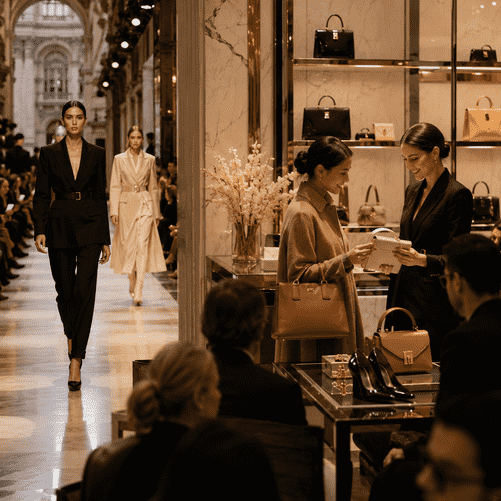
The Italian group reported higher first-half revenue despite pressure on profits, showing how brand strength, disciplined retail execution and U.S. demand are reshaping the luxury market.

MILAN — Prada has delivered one of the luxury sector’s clearest signs of resilience, reporting stronger first-half revenue at a time when many fashion houses are struggling with slower spending, geopolitical instability and a more cautious high-end consumer.
The Italian luxury group said net revenue rose 16 per cent in the first half of 2026 to €3.05 billion, supported by strong demand in the Americas and continued momentum at its core Prada brand. The result stood out in a market where several major luxury companies have faced weaker sales, especially in regions affected by reduced tourism, conflict and uncertainty over consumer confidence.
The Americas were the strongest regional driver, with sales rising 17 per cent. That performance underlines a broader shift in the luxury industry: after years in which China powered much of the sector’s expansion, wealthy American consumers have become increasingly important to growth strategies. Reuters reported earlier this year that luxury brands were seeking to attract America’s new technology and AI wealth as China’s recovery remained fragile.
Prada’s latest figures also point to a more selective luxury consumer. Shoppers are not abandoning high-end fashion altogether, but they are becoming more careful about which brands justify premium prices. That trend has rewarded companies with strong identities, clear creative direction and products perceived as lasting rather than merely seasonal.
The core Prada label performed solidly, with growth accelerating in the second quarter. Vogue Business reported that Prada retail sales rose 6.3 per cent in the quarter, while Miu Miu continued to expand more slowly after an exceptional surge in 2025. Miu Miu’s softer pace was not necessarily viewed as a failure, but as a normalization after a period of unusually rapid growth.
The group’s newly acquired Versace business is also becoming central to its future. Prada completed its acquisition of Versace in 2025, bringing one of Italy’s most recognizable fashion houses into a portfolio already defined by two powerful but distinct brands. Reuters reported that Versace contributed to first-half revenue but weighed on profitability, while the company begins the longer process of repositioning the label.
That turnaround effort will be closely watched. Pieter Mulier, who became Versace’s creative director in July, is expected to lead a new creative chapter for the house. Investors will be looking for evidence that Prada can preserve Versace’s bold identity while improving execution, product discipline and commercial performance.
Profitability, however, remains under pressure. Prada’s adjusted operating profit fell 14 per cent in the first half, partly reflecting the costs and complexity of integrating Versace. The group’s results therefore tell a more nuanced story: revenue is growing, but the luxury market is no longer forgiving enough for expansion alone to satisfy investors.
The regional picture was also mixed. Europe showed signs of recovery in the second quarter but remained weaker overall, while the Middle East suffered a sharp decline linked to regional conflict. Vogue Business reported that Europe fell 4 per cent and the Middle East dropped 24 per cent, illustrating how luxury demand remains highly exposed to tourism flows, security concerns and the spending habits of international clients.
The wider industry is undergoing a strategic reset. Bain has forecast that China’s personal luxury goods market could return to modest growth in 2026, but warned that the recovery would be uneven across brands and categories. After a difficult period in which the mainland market shrank, luxury companies can no longer rely on broad Chinese demand to lift all major houses equally.
At the same time, years of aggressive price increases have changed consumer expectations. Bain previously warned that luxury brands risked alienating younger shoppers and creating a gap in the more accessible luxury segment. That has made product value, brand credibility and emotional connection more important than ever.
Prada appears better positioned than many rivals because it has avoided depending solely on logo-driven demand. Its appeal rests on a mix of intellectual minimalism, strong leather goods, fashion credibility and carefully managed scarcity. Miu Miu, meanwhile, has become one of the industry’s most influential trend-setting labels, particularly among younger luxury consumers.
The latest results suggest that the luxury winners of 2026 will be those able to combine creativity with discipline. Brands must maintain desirability while resisting the temptation to over-expand, overprice or chase short-term trends at the expense of identity.
For Prada, the challenge is now execution. Its revenue momentum gives the group room to invest, but Versace’s integration, uneven regional demand and weaker profitability will test management’s ability to turn scale into sustainable earnings.
Still, in a difficult luxury cycle, Prada has sent a clear message: the market is not collapsing, but it is becoming more demanding. Consumers are still spending on fashion and status, but increasingly only where the product, story and brand promise feel worth the price.