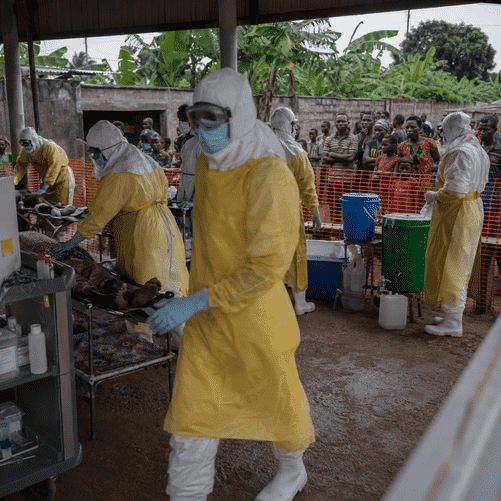
The record-speed spread of the Bundibugyo virus has pushed the outbreak beyond 3,500 confirmed cases, while conflict, displacement and the absence of an approved vaccine complicate efforts to contain it.

The Democratic Republic of the Congo is confronting an Ebola emergency of unprecedented speed, as health teams struggle to keep pace with a rapidly expanding outbreak across the country’s conflict-affected east.
Government data released on July 31 showed 3,532 confirmed infections and 1,556 deaths, making it the world’s second-largest recorded Ebola outbreak. It has already surpassed the 2018–2020 epidemic in eastern Congo by number of cases, although it remains far smaller than the 2014–2016 West African crisis, which infected more than 28,000 people.
The current epidemic is caused by the Bundibugyo virus, a less common species of ebolavirus for which there is no approved vaccine or specifically authorised treatment. Unlike the Zaire species responsible for most previous Congolese outbreaks, Bundibugyo has left responders without the established pharmaceutical tools that helped control more recent epidemics.
Congolese authorities officially declared the outbreak on May 15. Within its first month, it had produced more confirmed infections than any previous Ebola outbreak during the same period, leading health officials to describe it as the fastest-growing Ebola epidemic on record. Experts believe the virus had already been circulating for months before it was detected, allowing transmission chains to become deeply established before emergency measures began.
The disease has spread through several eastern provinces, including densely populated urban areas and mining communities where people frequently travel for work and trade. Cases have also been reported in neighbouring Uganda, intensifying concerns that the outbreak could expand further across national borders.
Eastern Congo presents an exceptionally difficult environment for epidemic control. Armed conflict, damaged infrastructure and the displacement of millions of people have restricted access to affected communities. Health teams have also faced shortages of supplies, attacks on workers and distrust among residents, all of which have weakened contact tracing, isolation and safe-burial programmes.
Contact tracing is particularly important because Ebola spreads through direct contact with the bodily fluids of an infected person, contaminated objects or the body of someone who has died from the disease. Patients commonly experience fever, severe weakness, vomiting and diarrhoea, while some develop internal or external bleeding. Early supportive treatment, including rehydration and management of symptoms, can significantly improve the chance of survival.
The outbreak’s estimated fatality rate has risen to approximately 44%, meaning that almost one in every two confirmed patients has died. The increasing death toll is placing additional pressure on treatment centres and local health systems that were already weakened by years of violence and humanitarian emergencies.
Scientists are racing to develop medical countermeasures. Clinical trials involving experimental treatments have begun in Congo, while several vaccine candidates are being prepared for testing. A partnership involving Merck, Wellcome and the Coalition for Epidemic Preparedness Innovations aims to manufacture tens of thousands of experimental Bundibugyo vaccine doses for early-stage trials, although large-scale availability may still be months away.
Until an effective vaccine becomes available, containment will depend largely on traditional public-health measures: rapidly identifying cases, isolating patients, tracing and monitoring contacts, improving laboratory testing and working with communities to ensure that burials are conducted safely.
The World Health Organization has classified the outbreak as a Public Health Emergency of International Concern, calling for stronger international coordination and financial support. Earlier assessments described the risk within Congo as very high and the regional risk as high, although the immediate global risk remained comparatively low.
Health officials warn that the trajectory of the epidemic will depend on whether the response can expand faster than the virus. Without improved security, sustained funding and greater community cooperation, treatment centres may continue receiving patients more quickly than surveillance teams can identify the people exposed to them.
The crisis is therefore becoming not only a test of medical science but also of international preparedness. The tools required to limit Ebola transmission are well understood, yet their effectiveness depends on reaching communities quickly, maintaining public trust and supporting frontline workers operating under dangerous conditions.
With infections still rising, the coming weeks will be decisive. Every delay creates new opportunities for the virus to cross provincial and national borders, increasing the danger that the fastest-growing Ebola outbreak in history could also become one of its deadliest.