U.S.-supported negotiations are intended to rebuild democratic institutions and prepare the country for elections, but María Corina Machado’s exclusion is raising doubts about the process’s legitimacy

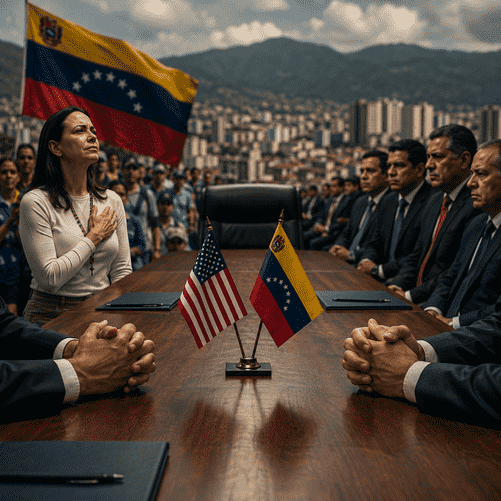
Venezuela has begun a new, United States-backed attempt to negotiate a democratic transition, bringing representatives of the interim government and parts of the opposition into dialogue while leaving the country’s most prominent opposition leader outside the process.
The negotiations are expected to address electoral guarantees, political rights and institutional reforms that could eventually clear the way for a presidential election. Yet María Corina Machado, the Nobel Peace Prize laureate whose movement became the dominant force within Venezuela’s opposition, has not been included in the negotiating delegation.
Her absence has immediately placed the credibility of the talks under scrutiny. Supporters argue that no durable political settlement can be reached without Machado or the millions of Venezuelans who rallied behind the opposition movement she led during the disputed 2024 presidential election.
Machado was prohibited from standing in that election despite winning the opposition’s 2023 primary by a large margin. She subsequently supported former diplomat Edmundo González Urrutia as the opposition candidate. The electoral authorities declared Nicolás Maduro the winner, but the opposition published voting records that it said demonstrated a decisive González victory.
The latest dialogue is being led on the opposition side by Dinorah Figuera, the head of the National Assembly elected in 2015 and still regarded by Washington as a legitimate democratic institution. Figuera and other opposition representatives are expected to seek changes to the National Electoral Council and the Supreme Tribunal of Justice, the legalisation of restricted political parties and stronger protections for candidates and voters.
The process formally began more modestly than anticipated. Talks scheduled to start on August 1 opened with a telephone conversation between Figuera and Jorge Rodríguez, a leading representative of the governing movement. A face-to-face meeting in Caracas was expected to follow, with discussions covering democratic guarantees as well as assistance for communities affected by the devastating earthquakes of June 24.
Venezuela’s interim administration is headed by Delcy Rodríguez, who assumed power following the removal of Maduro in January 2026. Washington has since pursued a phased strategy focused on political stability, economic recovery and an eventual restoration of democratic government.
That approach has produced an unusual relationship between the United States and officials who served at the highest levels of Maduro’s government. Rodríguez was previously one of the former president’s closest allies, but her administration has reopened relations with Washington, introduced economic changes and cooperated with efforts to restore Venezuela’s oil production.
The government is expected to seek further sanctions relief and international recognition during the negotiations. Opposition representatives, in return, are demanding credible electoral institutions, civil liberties and a timetable for competitive elections.
Washington has described its role as that of a facilitator rather than a direct manager of Venezuela’s political future. U.S. officials have argued that democratic institutions cannot be rebuilt immediately after years of authoritarian rule and that elections should occur only after basic legal and political guarantees are in place.
Critics fear, however, that the emphasis on gradual stability could allow Venezuela’s existing power structures to survive with only limited changes. They also question whether Washington is placing economic cooperation and access to the country’s enormous oil reserves ahead of a rapid democratic transition.
Machado’s exclusion reinforces those concerns. Although U.S. officials have suggested that she could later become involved if she gains sufficient domestic support for participation, her allies maintain that her electoral mandate and national prominence already make her indispensable.
Machado has repeatedly said that she intends to return from exile and compete in a free presidential election. She has demanded the release of political prisoners, the restoration of political rights and an independent electoral authority before endorsing any transition agreement.
Her relationship with Washington has become increasingly complicated. While she was once viewed as the United States’ principal democratic partner in Venezuela, American policymakers have more recently prioritised cooperation with Rodríguez’s interim government and opposition figures associated with the 2015 National Assembly.
The shift reflects a broader dilemma facing the United States. Machado possesses substantial popular support but remains a deeply polarising figure among Chavista officials and sections of the political establishment. Washington appears concerned that attempting to place her immediately at the centre of the transition could provoke instability or resistance from institutions still controlled by the former ruling movement.
Supporters of Machado reject that argument, saying that excluding the opposition’s strongest leader risks rewarding the same political forces responsible for dismantling Venezuelan democracy.
The talks are also burdened by a long history of unsuccessful negotiations. Previous agreements between the government and opposition repeatedly collapsed after promised electoral reforms were delayed, weakened or abandoned. Sanctions relief granted in exchange for democratic commitments often failed to produce lasting institutional change.
The political landscape in 2026 is nevertheless different. Maduro is no longer in power, Washington has greater influence over the transition and Venezuela’s governing coalition is showing signs of internal division. Parts of the opposition are also more willing to negotiate directly with former Chavista officials if doing so creates a credible route to elections.
For ordinary Venezuelans, the immediate priorities extend beyond political representation. Years of economic collapse, mass migration, deteriorating public services and repression have left the country exhausted. The June earthquakes added a major humanitarian emergency, increasing pressure on political leaders to cooperate.
The new dialogue therefore carries both considerable promise and considerable risk. It could begin the slow reconstruction of institutions capable of organising a competitive election. It could also legitimise an interim government without securing meaningful democratic change.
Its success will depend on measurable results: the release of remaining political prisoners, freedom for journalists and civil-society organisations, an impartial electoral authority, equal access to the media and a clear election timetable.
Without those guarantees—and without a credible mechanism for including Machado and her supporters—the negotiations may struggle to persuade Venezuelans that they represent a genuine transition rather than another political arrangement negotiated above their heads.