President Donald Trump holds back planned strikes while Saudi Arabia presses for de-escalation and Tehran warns that regional energy infrastructure could face retaliation

President Donald Trump has postponed a new wave of American military strikes against Iran, giving regional governments additional time to pursue an agreement intended to reopen the Strait of Hormuz and contain Tehran’s nuclear programme.
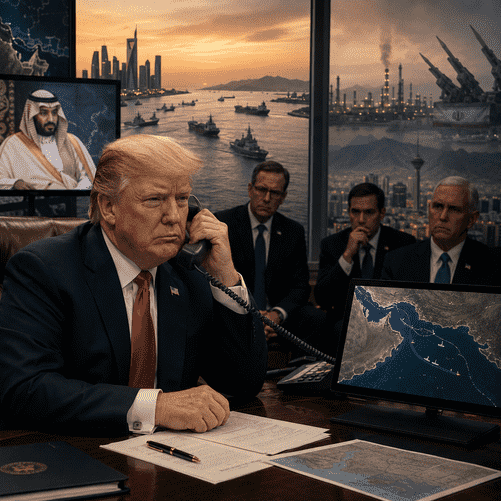
Trump said the delay depended on whether negotiators could rapidly secure a deal, leaving open the possibility that military action could resume if diplomacy failed. His decision followed a telephone conversation with Saudi Crown Prince Mohammed bin Salman, who urged Washington to avoid an escalation that could expose Gulf states and their energy infrastructure to further Iranian attacks.
The pause represents a significant shift after days of increasingly forceful warnings from the White House. The United States had been preparing additional operations against Iranian targets as pressure mounted on Tehran to end disruptions to commercial shipping and accept restrictions on its nuclear activities.
Trump said Middle Eastern governments had requested an opportunity to negotiate an arrangement providing for the full reopening of the Strait of Hormuz, one of the world’s most important energy corridors. He also claimed that Israel supported efforts to reach an agreement, although Iran had not publicly accepted the proposed terms at the time of his announcement.
The intervention by Saudi Arabia illustrates the growing concern among Washington’s regional partners that another major American assault could trigger retaliation across the Gulf. Saudi officials fear that oilfields, refineries, export terminals and desalination facilities could become targets if the conflict expands.
Although Riyadh has supported efforts to contain Iran’s military influence, it also has a strong interest in preventing a broader war. Saudi Arabia’s economic development plans depend on political stability, uninterrupted energy exports and continued foreign investment—each of which could be threatened by a prolonged confrontation.
Iran has reinforced those concerns by warning neighbouring countries against allowing their territory, airspace or military installations to be used for attacks. Iranian officials said Tehran remained on high alert and would respond forcefully to further American or Israeli action.
Foreign Minister Abbas Araqchi indicated that countries assisting an offensive against Iran could face consequences, raising fears that American bases and strategic facilities throughout the region might be drawn into the confrontation.
The threats place Gulf governments in an increasingly difficult position. Several depend heavily on the United States for military protection but also lie within range of Iranian missiles and drones. Even countries that formally oppose Tehran may therefore prefer negotiations to an operation that could transform their territory into a battlefield.
Energy security remains at the centre of the crisis. The disruption of shipping through the Strait of Hormuz has placed upward pressure on oil prices and increased transportation and insurance costs. Crude prices have risen sharply since the collapse of an earlier ceasefire in April, intensifying inflationary concerns and threatening economic growth beyond the Middle East.
Any sustained interruption to the strait could affect consumers and industries worldwide. A substantial share of internationally traded oil and liquefied natural gas normally passes through the narrow waterway connecting the Persian Gulf with the Arabian Sea.
Trump’s decision may also reflect mounting domestic pressure to limit American involvement. The administration faces questions over the conflict’s objectives, financial cost and potential duration, while approaching congressional midterm elections make another escalation politically risky.
The president has attempted to present the postponement not as a retreat but as leverage. By maintaining the threat of rapid military action, the White House hopes to persuade Iran that an agreement offers the only alternative to heavier strikes.
That strategy carries considerable danger. Tehran could interpret repeated delays as evidence that Washington is reluctant to accept the consequences of a wider war. Conversely, Iran’s continued attacks and threats could convince the United States that diplomacy is being used merely to gain time.
The proposed agreement appears to concentrate on two immediate priorities: restoring unrestricted navigation through the Strait of Hormuz and addressing Iran’s nuclear capabilities. Reaching a durable settlement, however, would require resolving deeper disputes concerning sanctions, missile programmes, regional armed groups and security guarantees.
Israel’s position will also be decisive. Although Trump said the Israeli government supported the diplomatic initiative, Israeli leaders have historically demanded strict and verifiable limits on Iran’s nuclear and military infrastructure. Any agreement perceived as leaving Tehran capable of rebuilding those programmes could face strong resistance.
The current pause therefore remains fragile. American forces are still positioned across the region, Iran says its military is prepared for further conflict, and recent drone and missile incidents have demonstrated how quickly a local confrontation can spread.
For Saudi Arabia and other Gulf states, the immediate objective is to transform Trump’s temporary delay into a broader process of de-escalation. Their influence may be considerable: Washington needs regional cooperation, while Iran has an economic interest in restoring shipping and reducing pressure on its already strained economy.
The next stage will depend on whether negotiators can convert informal proposals into enforceable commitments. That would require Iran to guarantee safe passage through the strait and accept meaningful nuclear restrictions, while the United States would likely need to offer sanctions relief or other political concessions.
Trump has created a narrow diplomatic opening, but he has not removed the threat of war. Should negotiations fail or Iran launch another major attack, the postponed American operation could return with little warning.
For now, the Saudi intervention has helped pull Washington back from immediate escalation. Whether that restraint becomes the foundation of an agreement—or merely a brief pause before renewed strikes—will be determined by the negotiations now unfolding across the region.