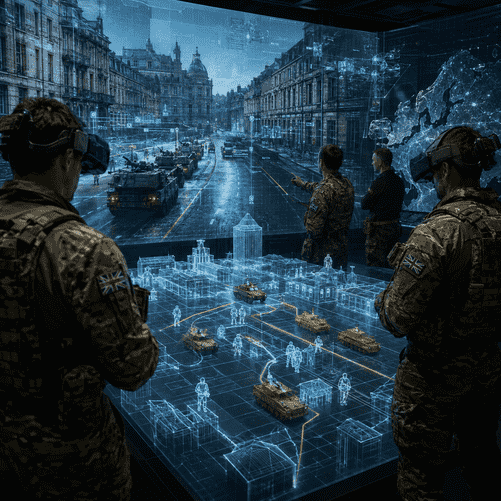
Under a £2 billion Ministry of Defence programme, advanced simulations developed by Skyral will allow troops and commanders to test battlefield decisions inside virtual replicas of cities, infrastructure networks and civilian populations.

A British technology company is helping transform military training by building vast digital environments in which soldiers can rehearse operations, commanders can test strategy and defence planners can examine the consequences of decisions before they are made in the real world.
Skyral, a UK-based modelling and simulation business, is part of a consortium awarded a £2 billion Ministry of Defence contract to support the training of the British Army. Its technology goes significantly beyond the conventional combat simulators long used to teach troops how to operate vehicles, aircraft or weapons systems.
Instead, the company creates detailed virtual representations of real locations, combining geography, infrastructure, demographics and models of human behaviour. These environments are designed to show not only the immediate result of a military action but also the broader consequences that may follow.
One demonstration recreates streets in Riga, Latvia, where a NATO convoy comes under attack at a city intersection. Buildings, shops and roads reflect the real urban landscape, while the simulated civilians are modelled according to characteristics of the local population, including age and attitudes toward foreign forces.
The objective is not simply to recreate an explosion or an exchange of fire. The system is intended to show how people, transport routes, public services and critical infrastructure respond to a crisis.
A strike on a city street, for example, could cause civilians to flee into surrounding districts. An attack that also disables a power station during winter could produce an entirely different pattern of movement, as residents search for heat, electricity and shelter.
This ability to model indirect effects is central to the technology’s military value. Modern operations rarely take place on an isolated battlefield. Decisions can disrupt electricity supplies, hospitals, communications networks, fuel distribution and civilian transport, potentially changing both the humanitarian situation and the course of a conflict.
Skyral describes its virtual environments as “digital twins”: computer-based models of real places or systems that can be altered to examine possible outcomes. The company says its platform combines data visualisation, artificial intelligence, simulations and behavioural modelling to help decision-makers explore different futures.
Digital twins were initially associated with engineering, where manufacturers could create virtual versions of machines and predict when components might fail. The concept is now being extended to cities, military operations and national infrastructure.
By combining multiple models within a single environment, military planners can examine how an intervention in one system produces consequences elsewhere. Damage to a bridge could interrupt supply lines. A telecommunications failure could complicate an evacuation. The loss of electricity could affect hospitals, public confidence and the behaviour of the local population.
Naomi Hulme, Skyral’s co-chief executive, has compared the visual experience to an intensified version of a large-scale commercial game. The company’s roots lie partly in technology originally developed by Improbable Worlds for gaming engines and virtual environments, although the platform has since evolved into a specialist defence and decision-support system.
The comparison with popular games, however, can be misleading. Entertainment titles are principally designed to create engaging experiences for players. Military simulations must instead incorporate operational constraints, credible data and measurable training objectives.
They also allow commanders to repeat complicated scenarios without the expense and logistical burden of deploying thousands of personnel, vehicles and aircraft for a physical exercise. A virtual operation can be stopped, adjusted and replayed, enabling participants to compare different decisions and identify mistakes.
Such systems may become increasingly attractive as Britain seeks to improve military readiness while facing constraints on personnel, equipment and training areas. Organising live exercises can require extensive preparation, fuel, transport and international coordination, while simulations offer a safer and potentially less expensive way to practise repeatedly.
The technology could also be used before operations begin. Planners may create a virtual version of an area, add intelligence about local infrastructure and population patterns, and then examine how different strategies might unfold.
A commander could test whether a convoy should take one route rather than another, how an evacuation might be organised or how damage to essential services could influence civilian behaviour. The system would not predict the future with certainty, but it could expose risks that might otherwise be overlooked.
Other companies are applying similar methods to military energy systems. Virtual models can be used to examine how batteries, solar panels, generators or hybrid vehicles would perform under operational conditions before governments commit to expensive procurement programmes.
Supporters believe this approach could improve decision-making in a sector where equipment is costly, development cycles are long and mistakes may have serious consequences. Testing an unconventional vehicle, power system or battlefield concept digitally is easier than producing a physical prototype and deploying it during an exercise.
Yet the growing reliance on virtual training also presents limitations.
No simulation can fully reproduce the fear, confusion, exhaustion and unpredictability of combat. Human communities are particularly difficult to model, and assumptions about how civilians will behave may prove inaccurate when exposed to real political, cultural and emotional pressures.
There is also limited evidence showing precisely how much complex digital-twin technology improves the performance of ground forces. Research involving flight simulators has demonstrated clear training benefits, but transferring those findings to complicated urban operations is not straightforward.
The quality of the exercise ultimately depends on the quality of the information and assumptions placed inside the model. Incomplete data could produce misleading conclusions, while excessive confidence in a simulated result might encourage commanders to underestimate circumstances the software cannot capture.
Military planners must therefore treat such systems as decision-support tools rather than machines capable of providing definitive answers. Their value lies in allowing participants to explore possibilities, challenge plans and recognise cascading consequences—not in eliminating uncertainty.
The technology also raises questions about data security. Detailed digital replicas of cities, infrastructure and military operations could become valuable targets for hostile intelligence services. Protecting the models, the underlying information and the networks used to operate them will be essential.
Despite these concerns, the Ministry of Defence’s investment indicates that simulated environments are moving closer to the centre of British military preparation. The £2 billion contract reflects a wider belief that future forces will require not only advanced weapons but also sophisticated tools for understanding increasingly complex operational environments.
The battlefield represented by Skyral is therefore much larger than the terrain visible to an individual soldier. It includes power grids, supply chains, communications systems, civilian attitudes and the political consequences of military action.
For Britain’s armed forces, these virtual worlds offer an opportunity to make mistakes without causing real casualties—and to study decisions whose consequences might otherwise become apparent only after an operation has begun.
The result is a new form of military rehearsal: part computer game, part strategic laboratory and part digital reconstruction of society itself.