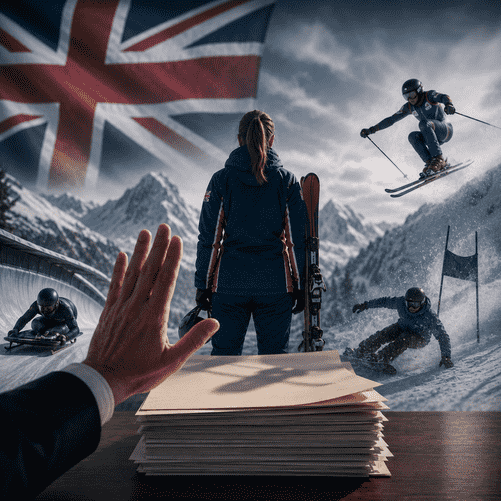
UK Sport will bypass GB Snowsport when distributing £12.5 million for the Alpes 2030 cycle, protecting athlete support while an independent review examines the governing body’s leadership and governance.

British skiing and snowboarding are heading into a period of major institutional change after UK Sport decided that no funding for the next Winter Olympic and Paralympic cycle would be channelled through GB Snowsport.
The decision does not amount to the withdrawal of public support from British snowsport athletes. UK Sport has guaranteed £12.5 million for ski, snowboard and associated Paralympic programmes during the four years leading to the Alpes 2030 Games. However, the money will be administered through a new structure rather than the national governing body that has overseen the programmes during the current cycle.
UK Sport said its board had decided not to route the investment through GB Snowsport once funding for the Milano Cortina cycle ends. It has also commissioned an independent review into the organisation’s governance, although the precise concerns that prompted the intervention have not yet been made public.
The funding agency has written directly to supported athletes to reassure them that grants will continue to be paid as the new cycle begins. A replacement delivery mechanism is expected to be announced before the end of 2026.
The intervention is especially striking because it comes alongside a record £33 million commitment to Britain’s winter Olympic and Paralympic sports. The total exceeds the approximately £30 million invested during the previous cycle and reflects the confidence generated by Britain’s strongest Winter Olympic performance to date at Milano Cortina 2026.
British athletes won five medals at those Games, including a record three golds. Matt Weston triumphed in the men’s skeleton, Weston and Tabitha Stoecker won the mixed-team skeleton event, and Charlotte Bankes and Huw Nightingale secured gold in mixed snowboard cross.
The results strengthened the argument for sustained investment in disciplines that have historically operated with smaller budgets and fewer domestic training facilities than Britain’s leading summer sports. Yet UK Sport’s decision indicates that competitive success alone has not resolved concerns over how the snowsport programme is governed.
GB Snowsport has experienced notable changes at board level. The organisation has had two changes of chair in three years, with non-executive director Michael Osterlin currently serving in the position on an interim basis.
The governing body expressed disappointment at UK Sport’s announcement and said it would continue working with the funding agency on governance matters. It also maintained that it already had strong systems in place, referring to its own recent independent governance review.
GB Snowsport warned that it would keep its options open to ensure that the progress made over the past four years was not lost. The response suggests that the organisation may challenge elements of the decision or seek a significant role in whatever system replaces the current arrangement.
The immediate question is how elite programmes will operate once the existing funding cycle concludes. GB Snowsport currently manages the development of British athletes across a wide range of Olympic and Paralympic disciplines, including alpine skiing, freestyle skiing, snowboarding and para snowsport.
During the Milano Cortina cycle, the organisation received a funding settlement of £11.9 million, divided between its ski and snowboard programme and its para programme.
Under the new arrangement, the £12.5 million allocation remains the largest individual share of Britain’s winter-sport package. Bobsleigh and skeleton have been guaranteed approximately £10.1 million, while curling will receive about £6 million.
UK Sport has increasingly explored centralised or specialist structures for managing high-performance programmes. A body known as Sport Org is expected to oversee selected sports and is already involved with curling. Its remit is also set to expand to bobsleigh and skeleton in a later Olympic cycle.
A similar approach could be considered for skiing and snowboarding, allowing UK Sport to fund coaches, performance staff, training camps and competition programmes without transferring the money directly to GB Snowsport.
Supporters of the model may argue that it offers closer financial oversight, more consistent performance management and reduced exposure to governance problems within individual sporting bodies.
However, bypassing a recognised governing organisation also creates risks. Elite sport programmes depend on established relationships among athletes, coaches, medical teams, international federations, sponsors and domestic clubs. A poorly managed transition could disrupt training plans and create uncertainty at the beginning of a demanding four-year Olympic cycle.
Many British winter athletes already face unusually complicated logistical and financial challenges. With limited reliable snow and few elite-standard facilities at home, they often spend long periods training and competing in continental Europe or North America. Stable administration is therefore essential to arranging travel, accommodation, coaching and access to international competition.
The controversy also raises questions about accountability. Because the independent review has only just been commissioned, neither athletes nor the public have yet been given a full explanation of the governance deficiencies UK Sport believes must be addressed.
Transparency will be important if confidence in the process is to be maintained. A decision to remove an entire organisation from the funding chain is a substantial intervention, particularly when that organisation has recently overseen some of Britain’s most successful winter-sport results.
At the same time, public funding bodies have a responsibility to ensure that lottery and government money is managed effectively. Sporting success cannot eliminate the need for stable leadership, strong financial controls, athlete welfare protections and clear board accountability.
The timing leaves UK Sport with a delicate balancing act. It must reform the structure without weakening the programmes responsible for Britain’s recent achievements. It must also reassure athletes that the governance dispute will not interfere with coaching, competition schedules or preparations for Alpes 2030.
Direct athlete grants will continue, providing some immediate security. Yet grants represent only one part of a high-performance system. The longer-term question concerns who will employ staff, manage technical programmes, negotiate with international organisations and make selection and investment decisions.
The record funding announcement shows that UK Sport remains committed to winning winter medals. Its dispute is not with the value of skiing and snowboarding but with the organisation currently entrusted to deliver them.
That distinction is critical. British snowsport has not been financially abandoned; instead, it is being placed under a new and still undefined model of supervision.
The success of that transition will be judged not only by the conclusions of the governance review, but by whether athletes can continue preparing without interruption. After Britain’s breakthrough in Milano Cortina, the challenge is to reform the system without dismantling the momentum it helped create.