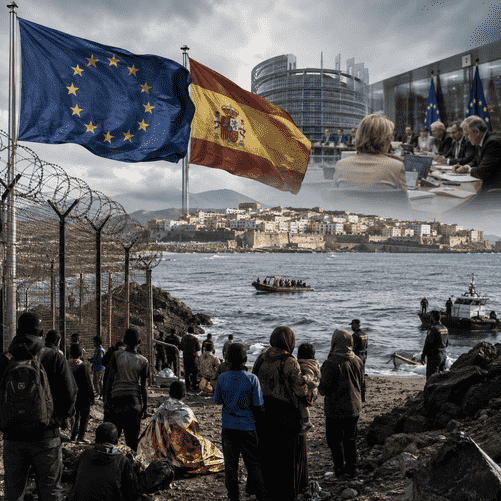
The European Commission has warned that Madrid’s plan to grant legal status to about 500,000 undocumented residents could encourage further migration, even as Spanish authorities insist the measure did not cause the deadly rush at the North African border.

A confrontation over migration policy has intensified within the European Union after the bloc’s migration commissioner criticised Spain’s plan to regularise hundreds of thousands of undocumented people, arguing that the initiative sends the wrong message at a moment of heightened pressure on Europe’s borders.
Magnus Brunner, the European commissioner responsible for migration and home affairs, said Spain’s programme was “not a good signal” for the rest of Europe. His comments followed an emergency meeting of EU interior ministers convened after an extraordinary surge of migrants entered Ceuta, the Spanish enclave on the northern coast of Africa.
Approximately 72,000 people reportedly crossed into Ceuta during the crisis, overwhelming local authorities and border infrastructure. Spanish officials said that about 70,000 had subsequently returned or been repatriated to Morocco, while thousands remained in the territory, including an estimated 1,000 unaccompanied minors. At least 88 people were reported to have died during the crossings.
The scale of the episode has reignited one of the EU’s most politically sensitive debates: whether national programmes offering legal status to undocumented residents act as humanitarian and economic tools or become incentives for further irregular migration.
Spain’s regularisation scheme is expected to provide residency and employment rights to roughly 500,000 undocumented people who were already living in the country. Madrid argues that the measure will bring workers out of the informal economy, improve access to public services and allow migrants with established lives in Spain to contribute more fully through taxation and social-security payments.
The programme does not apply to people who arrived during the recent Ceuta crisis. Eligibility is limited to migrants who had been living in Spain since at least 1 January 2026 and who meet specified residency requirements. Nevertheless, misleading online posts reportedly presented the policy as evidence that Spain had opened its borders or would automatically grant legal status to new arrivals.
Videos, false claims and instructions circulated rapidly through TikTok, Facebook and Instagram, encouraging people to travel toward the Moroccan border town of Fnideq and attempt the dangerous journey into Ceuta. Some posts allegedly mapped swimming routes or claimed that border controls had been relaxed.
The distinction between the actual programme and the rumours surrounding it has become central to Spain’s defence. The government maintains that the regularisation was designed for people already embedded in Spanish society and could not legally benefit those who entered Ceuta during the crisis.
Brunner acknowledged that immigration regularisation remains a matter of national authority. However, he warned that decisions taken by one member state can have consequences across the Schengen area, where internal borders are generally open and migrants granted legal status may eventually acquire greater freedom of movement.
His criticism was supported by a group of 22 EU governments, led by Italy and Denmark, which expressed concern that Spain’s policy could become a “pull factor.” The dispute reflects a broader shift toward tougher migration policies across Europe, including stronger external border controls, faster returns and closer cooperation with countries of origin and transit.
Italy temporarily restored border checks with Spain during the crisis, while some political leaders called for even more severe restrictions. The measures raised fresh questions about the future of the Schengen system and the extent to which national responses to migration can disrupt the EU’s principle of free movement.
At the emergency meeting, EU ministers endorsed a five-point proposal associated with European Commission President Ursula von der Leyen. The plan included strengthening the bloc’s external borders, expanding surveillance, targeting smuggling networks and improving the return of people who do not qualify for protection.
Despite the criticism of its regularisation programme, Spain received support for its immediate handling of the Ceuta emergency. Several ministers described the defence of the EU’s external frontier as a shared European responsibility rather than a burden Madrid should manage alone.
Spain has announced €25 million in emergency assistance to help Ceuta care for migrant children and support facilities struggling with overcrowding. The presence of unaccompanied minors presents an especially difficult legal and humanitarian challenge because they are entitled to protection and cannot automatically be returned without assessments of their individual circumstances.
The crisis has also drawn attention to the economic conditions driving migration from Morocco. High youth unemployment, limited opportunities and frustration over living standards reportedly contributed to the willingness of thousands of predominantly young people to risk dangerous sea crossings.
European officials are also examining whether the online campaign was deliberately manipulated. The EU is investigating possible foreign interference, although no conclusive evidence has publicly established that another government organised the misinformation. Authorities have also blamed trafficking networks, while some migrants have said they acted independently after seeing posts on social media.
The controversy comes as overall irregular crossings into the European Union have fallen significantly. Yet the Ceuta episode demonstrated how quickly a local border emergency can overwhelm authorities, provoke unilateral restrictions and reopen political divisions between member states.
For Spain, the regularisation programme reflects a belief that undocumented migrants already living and working in the country should be incorporated into the legal economy. For its critics, the policy risks weakening the deterrent message that European governments are attempting to establish.
The dispute is therefore about more than the status of 500,000 people. It exposes a fundamental disagreement over the direction of European migration policy: whether integration and legalisation can provide stability, or whether such measures inevitably undermine efforts to control irregular arrivals.
As Ceuta recovers from the immediate emergency, Brussels and Madrid must now reconcile two competing realities. Europe requires stronger coordination to prevent chaotic and deadly border crossings, but it must also decide what to do with large communities of undocumented people who have already become part of its societies and economies.