Iran’s president has denied reports that he repeatedly threatened to leave office, while opposition from powerful conservative institutions exposes mounting tension over negotiations aimed at reopening the world’s most important oil-shipping route.

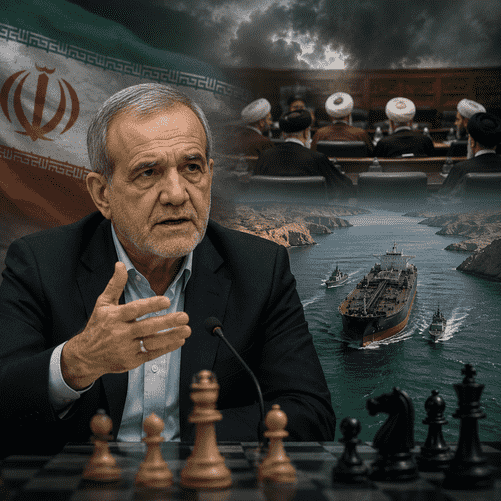
Iranian President Masoud Pezeshkian has firmly denied allegations that he threatened to resign during internal disputes over negotiations concerning the Strait of Hormuz, seeking to present a united government as pressure builds from conservative factions opposed to engagement with the United States.
Speaking in a televised interview, Pezeshkian said that any decision to step down would be announced publicly and insisted that he intended to remain in office. His intervention followed claims that he had repeatedly offered his resignation after being marginalised during discussions over the strategic waterway and Iran’s broader confrontation with Washington.
The controversy has emerged at a critical moment for Iran. International mediators are attempting to establish arrangements that would restore safer commercial navigation through the Strait of Hormuz, which remains severely disrupted by the continuing conflict involving Iran and the United States.
The narrow maritime passage is one of the most economically important routes in the world, carrying a substantial share of internationally traded oil and liquefied natural gas. Disruption in the strait has increased shipping risks, driven up insurance costs and contributed to volatility in global energy markets.
US officials have expressed optimism that an agreement could be reached, but Tehran has rejected Washington’s description of the diplomatic process. Iranian officials maintain that they are speaking with Oman about temporary navigation arrangements rather than conducting direct negotiations with the United States.
The proposed framework would reportedly create a safer shipping corridor through Iranian and Omani waters. However, the negotiations remain complicated by Iran’s demands for security guarantees, sanctions relief and recognition of a greater Iranian role in managing traffic through the strait.
Pezeshkian, who has generally advocated a more pragmatic foreign policy than Iran’s hardline establishment, appears to favour diplomacy as a means of limiting further economic and military damage. His critics argue that negotiations conducted under pressure would reward Washington and weaken Iran’s strategic position.
Those divisions became more visible after Iran’s Assembly of Experts, an influential body of senior clerics responsible for selecting and supervising the supreme leader, described negotiations with the United States as futile. Its intervention reflected continuing resistance from powerful conservative and religious institutions that view Washington as fundamentally untrustworthy.
For hardliners, the history of failed agreements, sanctions and military confrontation demonstrates that diplomatic concessions will not produce lasting security. They argue that Iran should instead use its control over the Strait of Hormuz and its regional military capabilities to compel the United States and its allies to change course.
Pezeshkian’s supporters contend that prolonged disruption would deepen Iran’s isolation, place further strain on its economy and expose the country to additional military action. They also warn that the closure of the strait damages relations with neighbouring Gulf states whose economies depend on uninterrupted maritime trade.
The resignation allegations originated with Mohammad-Bagher Kharrazi, a senior cleric with family connections to Iran’s ruling establishment. He claimed that Pezeshkian had threatened to resign numerous times but stopped after being warned that a future resignation could be accepted. The supreme leader’s office subsequently rejected the claim.
Pezeshkian’s denial was therefore intended not only to defend his personal position but also to counter perceptions of institutional instability. Public evidence of a serious dispute between the presidency, the military and the clerical leadership could weaken Iran’s negotiating position and encourage its adversaries to increase pressure.
Questions nevertheless remain over how much authority the president exercises. Iran’s political system distributes power among elected institutions, the supreme leader, the Revolutionary Guards and influential religious bodies. Decisions involving national security, military operations and relations with the United States are not controlled by the presidency alone.
The dispute over Hormuz illustrates those competing centres of power. A negotiated reopening could reduce international pressure and provide economic relief, but any arrangement perceived as limiting Iranian sovereignty or rewarding American military action would face fierce domestic opposition.
The conflicting public accounts from Washington and Tehran have added another layer of uncertainty. US President Donald Trump has claimed that negotiations are under way, while Iran’s foreign ministry has repeatedly denied that direct talks are taking place. Tehran says the current contacts are limited to Oman’s mediation over maritime safety.
Despite the denials, diplomatic activity appears to be intensifying. Qatar has reported progress in wider mediation efforts, and optimism over a possible agreement briefly reduced international oil prices. Yet recent attacks on commercial vessels have demonstrated that navigation through the region remains dangerous.
Any settlement would have implications far beyond Iran. Gulf exporters require the strait to move energy supplies to markets in Europe and Asia, while importing countries remain vulnerable to sudden price increases. Even limited disruption can affect fuel costs, inflation and economic growth across several continents.
For Iran, the negotiations also concern political survival. Sanctions, military pressure and the economic consequences of conflict have intensified public frustration, while disagreements within the ruling system risk creating an image of weakness.
Pezeshkian’s insistence that he will remain in office is designed to suppress that impression. But the dispute has revealed a deeper struggle over Iran’s direction: whether the country should pursue a negotiated reduction in tensions or continue using its control of the Strait of Hormuz as leverage against the United States.
The president may have rejected reports of his resignation, but the political conflict behind those rumours remains unresolved. As negotiations continue through regional intermediaries, Iran’s ability to present a coherent strategy may prove as important as the terms of any eventual agreement.