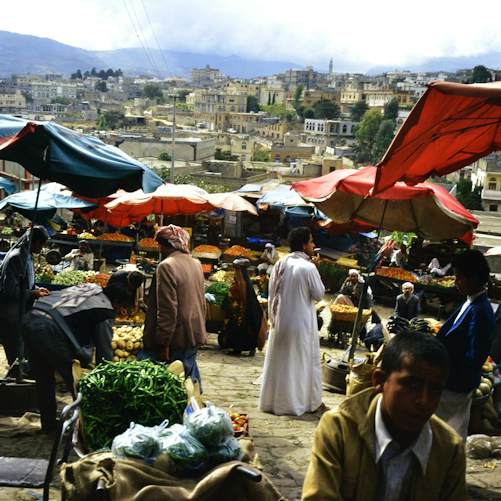
Houthi forces are trying to consolidate their seizure of Yemen’s Red Sea coast by taking strategic mountain positions in Taiz and Lahij, while Saudi airstrikes, limited British support and a reported last-minute U.S. reversal widen the regional stakes.

A new battle line above the Red Sea
The fighting in Yemen has entered a phase that may prove more consequential than the movement of a few front lines on a map. Houthi forces, after a rapid advance along the country’s Red Sea coast this month, are now pushing toward the high ground that separates those coastal gains from territory held by the internationally recognised, Saudi-backed government in the south. The struggle is centred on mountain positions in Taiz and Lahij provinces, terrain that military sources describe as crucial to whether the Houthis can secure what they have taken or whether their opponents can establish a platform for a counteroffensive.
Five Yemeni military sources told Reuters that Houthi forces were seeking control of the Kahboub Mountains, a chain of heights that forms a natural barrier between the Red Sea coast and government-held areas farther south. Fighting has also been reported around the outskirts of Al-Wazi’iyah district in Taiz and near Ras al-Ara on the Indian Ocean side of the southern approaches, between the Bab el-Mandeb Strait and Aden, the government’s main base. These areas are sparsely populated compared with Yemen’s major cities, but their military value comes from elevation, road access and control of the corridors linking the Red Sea to the south.
The Houthis have held the capital, Sanaa, since 2014 and have repeatedly demonstrated that control of elevated terrain can compensate for disadvantages in conventional air power. Mountain positions offer observation, concealment, protected supply routes and opportunities to threaten roads below. In the current offensive, those advantages matter because the movement’s new coastal holdings would be more difficult to defend if Saudi-backed forces retained high ground from which they could launch counterattacks or interdict supply lines.
Reuters reported that Saudi Arabia has carried out intensive airstrikes in recent days against Houthi positions in the highlands. The Houthis say hundreds of strikes have been launched, although that figure has not been independently verified. Saudi air power can impose heavy costs and slow movement, but the recent advance along the coast has already demonstrated the limits of airstrikes when defending forces on the ground are fragmented, retreating or unable to hold key junctions. The immediate contest is therefore not simply about firepower. It is about whether one side can turn battlefield momentum into a durable geographical advantage before the other can reorganise.
Why the Kahboub heights matter
The mountains now being contested sit close to one of the world’s most strategically important maritime corridors. Bab el-Mandeb, the narrow passage connecting the Red Sea with the Gulf of Aden and the wider Indian Ocean, is a gateway for trade moving between Asia, Europe and the Mediterranean through the Suez Canal. Control of the strait itself does not automatically follow from holding nearby land, and commercial shipping can still be protected or rerouted. But the ability of an armed movement to operate from both coastal and elevated positions around the approaches changes the risk calculation for navies, insurers, shipping companies and regional governments.
For the Houthis, consolidating the heights would reduce the vulnerability of their coastal advance. It could also make it harder for Saudi-backed Yemeni forces to isolate coastal units from the movement’s interior strongholds. The group has long combined territorial control with missile, drone and maritime capabilities. Its influence therefore extends beyond the ground it occupies. A defensible land bridge from the northern heartland toward the southern Red Sea would give it greater freedom to disperse launch systems, move supplies and complicate any effort to roll back its gains.
For the government side, holding the highlands offers one of the few obvious opportunities to prevent the coastal campaign from becoming permanent. Aden remains the government’s principal political and military base, while roads through Lahij and Taiz connect southern areas to the contested western front. If government-aligned forces lose the heights, they risk being pushed into a narrower defensive perimeter in the south and east. If they retain them, the Houthis’ coastal positions could remain exposed to pressure from inland directions.
The geography also explains why the battle is attracting international attention out of proportion to the size of the immediate combat zone. The Red Sea has already been a theatre of missile and drone attacks, naval interceptions and commercial disruption. The Houthis’ latest advance means that the same movement responsible for threatening shipping is also reshaping the land balance around the strait. That creates a link between Yemen’s civil war, the broader regional confrontation involving Iran and its adversaries, and the cost of moving energy and goods through two of the planet’s most important chokepoints.
From coastal breakthrough to mountain war
The current mountain fighting is the second act of an offensive that began with a rapid change along Yemen’s western edge. Earlier in September, Houthi forces broke through government lines and seized positions on the Red Sea coast, including the historic port area around Mokha, according to multiple international reports. The advance pushed government-aligned units away from parts of the shoreline and brought Houthi forces closer to the approaches to Bab el-Mandeb. That was strategically important, but the speed of the breakthrough also created a new problem for the attackers: newly occupied coastal territory is difficult to hold if the inland high ground remains in hostile hands.
The western coastal plain is narrow in places and rises sharply toward rugged mountains. Roads linking the shoreline to Yemen’s interior can be vulnerable to interdiction from higher terrain. An army or armed movement that controls the coast but not the ridges behind it may find supply convoys exposed and defensive positions difficult to reinforce. That is why the present push toward the Kahboub Mountains should be seen as an attempt to convert a breakthrough into a defensible front rather than simply another territorial grab.
For government forces, the same geography creates a potential opportunity. Even after losing coastal positions, units holding mountain roads can threaten Houthi logistics and preserve access between Aden, Lahij and Taiz. A counteroffensive launched from elevated terrain could force the Houthis to defend long supply lines and dispersed positions. But that opportunity exists only if government forces remain cohesive, supplied and capable of coordinating with Saudi air power.
The speed of the coastal collapse has raised questions about the effectiveness and unity of the anti-Houthi camp. Yemen’s internationally recognised government depends on a collection of military formations, local authorities and political factions whose priorities are not always identical. That complexity has repeatedly complicated command and control during the civil war. The Houthis, by contrast, have built a more centralised military apparatus in the territory they control, even though their forces also include local networks and tribal elements.
None of this means the outcome is predetermined. Rapid offensives can outrun logistics, and exposed attackers can become vulnerable once defenders regroup. But the sequence is clear: first came the coastal breakthrough, then the race for the heights. The side that controls both the shoreline and the terrain immediately behind it will be in a far stronger position to shape the next phase of the war.
A regional war presses into Yemen
Yemen’s renewed escalation cannot be understood as an isolated return to the civil war’s earlier pattern. The current offensive is unfolding inside a much wider Middle Eastern conflict that has already transformed shipping through the Strait of Hormuz and the Red Sea. The Houthis are aligned with Iran, but the degree of direct Iranian control over individual Houthi operations is often difficult to establish from public evidence. What is clear is that the movement has increasingly acted as a regional military actor rather than only a Yemeni insurgent force.
That wider context raises the stakes for Saudi Arabia. Riyadh spent years seeking to reduce its direct military exposure in Yemen after the destructive intervention that began in 2015. The latest Houthi offensive has again brought the kingdom into open confrontation. The Houthis said they fired missiles toward Riyadh over the weekend, after explosions were heard and smoke was seen near the capital’s airport. Saudi authorities had not publicly confirmed the Houthi account when Reuters reported the development, so the claim should be treated as an assertion by the group rather than an independently established description of the attack.
Saudi Arabia has nevertheless responded militarily inside Yemen and has sought help from partners. Britain’s Prime Minister Andy Burnham said London had agreed to provide limited defensive air-to-air refuelling support for Saudi forces. The measure is narrower than a direct combat role, but it can extend the endurance and reach of Saudi aircraft operating defensive or strike missions. France, according to a diplomatic source cited by Reuters, has also indicated a willingness to help secure Saudi energy infrastructure around Yanbu and the East-West pipeline corridor.
The involvement of European powers is significant because it demonstrates how quickly a local advance can activate alliance relationships. Britain has a long defence relationship with Saudi Arabia, while France has strong security and commercial ties across the Gulf. Their governments are trying to balance support for a partner with concern about being pulled deeper into a conflict whose military and political end state remains unclear. Defensive assistance may be easier to justify than participation in offensive operations, but even limited support can become part of the wider deterrence contest if Houthi attacks continue.
Trump’s reported last-minute reversal
The most politically sensitive question is whether the United States will re-enter direct combat against the Houthis. The New York Times reported that President Donald Trump’s administration had prepared airstrikes for Sunday after renewed Saudi requests for American intervention, but that Trump called off the operation at the last minute, when bombs were reportedly already being loaded onto aircraft. Reuters said it could not independently verify the Times account. U.S. Central Command referred questions to the White House, which did not immediately provide an on-the-record explanation.
The reported episode matters even if the operational details remain unconfirmed, because it captures the strategic dilemma facing Washington. The United States designated the Houthis as a terrorist organisation and has previously used major air campaigns against the group. Yet Trump ended a two-month U.S. bombing campaign in 2025 after announcing an understanding under which the Houthis would stop targeting American vessels. A renewed U.S. attack could destroy that arrangement and make American warships, bases or commercial shipping targets again.
Yemen’s internationally recognised president, Rashad al-Alimi, sought U.S. military support in a phone call with Trump on Sunday, according to four sources cited by Reuters. Two of those sources said Trump gave no direct pledge of support. That absence of a commitment is notable because the Saudi-backed government is fighting to prevent further territorial losses, while Riyadh is asking Washington to help contain a movement that can threaten both Saudi territory and maritime traffic.
For Trump, the calculation is complicated by the United States’ broader confrontation with Iran. Opening another sustained campaign in Yemen would require aircraft, munitions, intelligence, refuelling and naval resources at a time when American forces are already stretched across the region. It could also create a new escalation ladder with Tehran. At the same time, refusing to intervene directly risks raising doubts among Gulf partners about how much military support they can expect when a proxy or aligned group makes gains that affect their security.
The administration therefore faces a choice between imperfect options. Direct strikes could slow Houthi operations but may not reverse territorial gains without capable ground forces. Staying out preserves U.S. military flexibility and avoids reopening an expensive campaign, but leaves Saudi Arabia and Yemeni government forces to manage a deteriorating battlefield with more limited external support. The fact that such a decision was reportedly taken only hours before possible strikes underlines how fluid the policy remains.
The humanitarian emergency is accelerating
For Yemeni civilians, the debate over external intervention is secondary to the immediate cost of the renewed fighting. United Nations figures cited by Reuters put the death toll from the latest escalation at nearly 700, with thousands more injured. Close to 130,000 people have fled their homes inside Yemen, while more than 3,000 have crossed the Red Sea by boat toward Africa. Those numbers may change as access improves and agencies update their assessments, but they already show a displacement crisis expanding on top of one of the world’s longest-running humanitarian emergencies.
The World Food Programme says it is increasing its response. Acting Executive Director Carl Skau told Reuters at the United Nations General Assembly that the agency had supported around 60,000 people with hot meals and food commodities and was building a pipeline to reach hundreds of thousands more. The challenge is not only the number of newly displaced families but the condition of the communities receiving them. Camps and settlements that already lacked sufficient water, food, health care and shelter are being asked to absorb another surge of people.
The baseline was severe before the current offensive. WFP data indicate that more than 18 million people in Yemen face acute food insecurity and around 2.2 million children under five are acutely malnourished. The country imports roughly 90 percent of its food, which means disruptions to ports, airports, roads and commercial shipping have direct effects on household survival. A military campaign along the Red Sea coast is therefore not only a security problem; it can affect the physical routes through which food and fuel enter the country.
Humanitarian agencies also face political and operational constraints. WFP says its offices in Houthi-controlled northern areas have been occupied, assets confiscated and United Nations personnel detained. Those conditions restrict the agency’s ability to work in areas where need may be high. At the same time, insecurity on roads and around ports can make deliveries to government-held zones slower and more expensive.
Yemen’s crisis is often described in terms of strategic waterways and regional rivalry, but the humanitarian dimension is inseparable from those issues. Every disruption to a port or transport corridor can raise food prices. Every new displacement wave pushes families into informal camps where disease risk rises and livelihoods collapse. The renewed war is therefore being fought simultaneously over territory, maritime access and the basic systems that keep millions of civilians alive.
Oil routes become military objectives
The battle for Yemen’s western approaches also intersects directly with the global energy system. Saudi Arabia has relied on its East-West pipeline and Red Sea terminals as an alternative to the Strait of Hormuz, allowing crude to reach Yanbu without passing through the narrow Gulf chokepoint. In a period of conflict around Hormuz, that redundancy is strategically valuable. Houthi control or disruption near the Red Sea outlet weakens the very route designed to reduce Saudi dependence on the Persian Gulf.
Reuters reported that the Houthi advance along the Red Sea coast has forced Saudi Arabia to increase shipments through Hormuz, even as that waterway remains dangerous. Satellite and market data cited by Reuters showed Saudi exports through Hormuz rising sharply in recent days compared with August. Traders also described a growing use of shuttle tankers and ship-to-ship transfers off Oman, allowing crude to move through the strait in shorter, tightly managed legs before being transferred to vessels bound for Asia and other markets.
These workarounds keep oil moving, but at a price. War-risk premiums, tanker availability, insurance costs and security arrangements all become part of the delivered cost of energy. Crude prices have eased from recent highs near $110 a barrel, but some refined fuels remain exceptionally expensive. That is one reason governments far from Yemen are paying attention. A prolonged disruption would be transmitted through freight costs, refinery margins, airline fuel bills and consumer prices.
The maritime danger is not theoretical. The United Kingdom Maritime Trade Operations agency said a tanker entering the Strait of Hormuz on Monday was struck by an unknown projectile, leaving two crew members with minor injuries. The vessel remained manoeuvrable and continued toward its next port, according to the report. UKMTO did not attribute responsibility for the strike, and any claims assigning blame should therefore be treated cautiously until independently verified.
The strategic picture is unusual because pressure now exists at both ends of the Arabian Peninsula. Hormuz, to the east, is strained by the Iran conflict; Bab el-Mandeb and the Red Sea, to the west, are threatened by Houthi operations and renewed fighting in Yemen. Saudi Arabia’s geographic advantage has long been the ability to move energy toward either coast. Conflict on both sides erodes that flexibility and makes control of pipelines, ports and coastal approaches part of the battlefield.
What air power can — and cannot — decide
Saudi Arabia’s response is heavily dependent on air power because the kingdom wants to blunt the Houthi advance without committing large ground formations of its own. Aircraft can strike vehicles, weapons depots, command sites and concentrations of fighters, and the threat of surveillance can force Houthi units to disperse. Refuelling support from Britain, if used as announced, can extend sortie duration and reduce the time Saudi aircraft spend returning to base. Intelligence from partners can also improve targeting and warning.
But Yemen’s terrain has repeatedly shown the limits of bombing as a substitute for ground control. Fighters can use mountains, caves, villages and dispersed positions to reduce exposure. Roads can be damaged and repaired. Small mobile missile or drone teams can move between civilian and military areas, complicating targeting decisions. The risk of civilian casualties also increases when operations take place near populated districts, adding political and humanitarian costs to an already controversial campaign.
More fundamentally, aircraft cannot occupy a ridge, guard a road junction or administer a town. If Saudi-backed ground forces cannot hold positions after strikes, the tactical effect of bombing may be temporary. That was one of the central lessons of the earlier Saudi-led intervention: superior air power could punish Houthi forces and destroy infrastructure, but it did not produce a decisive political settlement or permanently remove the movement from the areas it controlled.
The same constraint would apply to a renewed American bombing campaign. U.S. aircraft and missiles could damage air defences, radar, drone facilities and launch sites. They could make movement more dangerous and impose costs on Houthi commanders. Yet reversing a territorial advance would still depend on Yemeni forces able to seize and retain ground. Without that, airstrikes risk becoming an open-ended effort to suppress capabilities that can be rebuilt, hidden or moved.
This distinction is central to the debate in Washington and Riyadh. Air power can change the tempo of the battle and protect critical infrastructure. It can also deter some forms of attack. What it cannot guarantee is a durable political or territorial outcome. The highlands are therefore a test not only of Houthi momentum but of whether the Saudi-backed coalition has enough effective ground capacity to translate external military support into a stable defensive line.
Europe’s Red Sea security dilemma
Europe has its own reasons to worry about the Houthi advance. The European Union’s Aspides naval mission was established to protect commercial shipping in the Red Sea from attacks. EU foreign policy chief Kaja Kallas said on Monday that the mission currently has six warships but needs more than ten as the threat environment worsens. Her appeal reflects a practical problem: escorting or protecting merchant traffic over a wide maritime area requires sustained presence, not occasional patrols.
The Houthis’ territorial gains complicate that task. Naval forces can intercept drones and missiles, but they cannot by themselves determine who controls the coastline or mountain routes feeding launch areas. If the movement can disperse assets across newly acquired territory, the surveillance and defensive burden on ships increases. More territory also creates more uncertainty about where launches may originate and where equipment may be stored.
European governments must decide how much naval and air capacity they are prepared to commit at a time when NATO is also focused on Russia and Ukraine. Every destroyer, frigate, surveillance aircraft or tanker assigned to the Red Sea is a platform unavailable somewhere else. That does not make deployment impossible, but it raises the political cost of sustaining operations over months rather than days.
There is also a distinction between protecting navigation and joining the Yemeni war. Aspides is designed as a defensive mission. Britain’s planned refuelling support to Saudi Arabia is also being presented as defensive. But the boundary can become difficult to maintain if Saudi aircraft strike Houthi positions while receiving allied logistical support, or if European ships intercept weapons launched from territory captured during the offensive. Governments will have to explain not only what they are doing, but what they are not doing.
For European economies, the incentive to keep the Red Sea open is strong. Disruption forces ships to take longer routes around southern Africa, adding time, fuel use and freight costs. Even when vessels continue through Bab el-Mandeb, higher insurance and security expenses can be passed through supply chains. Yemen’s highlands may be geographically remote from European consumers, but the battle there can affect the price and reliability of goods arriving at European ports.
What the battlefield claims do — and do not — establish
Reporting from Yemen requires particular caution because the conflict is saturated with claims from parties that have strong incentives to exaggerate successes, minimise losses and shape international intervention. The Houthis publish accounts of missile launches and Saudi airstrikes. Saudi and government-aligned sources describe defensive operations and battlefield positions. Independent access to front lines can be limited, and communications are often disrupted.
Several important facts in the current escalation are supported by multiple sources: the Houthis have made substantial territorial gains along the Red Sea coast; fighting is now focused on strategic high ground in Taiz and Lahij; Saudi Arabia is conducting air operations; large numbers of civilians have been displaced; and Western governments are considering or providing forms of support to Riyadh. Other details remain less certain. The Houthis’ claim to have attacked Riyadh has not been publicly confirmed by Saudi authorities. The exact scale of Saudi airstrikes comes from Houthi statements. The reported last-minute cancellation of U.S. strikes originates with the New York Times and was not independently verified by Reuters.
Casualty figures should be treated with similar care. The United Nations estimate of nearly 700 killed provides a credible benchmark, but in active conflicts such numbers can lag events and may not capture all deaths in inaccessible areas. They also do not necessarily distinguish combatants from civilians in every public summary. Responsible reporting should therefore avoid presenting a changing aggregate as a precise final toll.
The same discipline applies to strategic interpretation. Control of the Kahboub heights would strengthen the Houthis, but it would not automatically give them uncontested command of Bab el-Mandeb. Saudi air power remains formidable, government forces still hold significant territory, and external naval forces can influence maritime access. Conversely, airstrikes alone do not guarantee that Houthi advances can be reversed.
The most accurate assessment is that Yemen has entered a dangerous phase in which battlefield momentum, maritime insecurity and regional intervention are reinforcing one another. The direction of travel is clear even where individual claims are disputed: the conflict is broadening, the humanitarian burden is rising and more governments are being forced to decide how directly they are willing to become involved.
Diplomacy arrives in New York with little leverage
The timing of the escalation gives the United Nations General Assembly unusual importance. Iran’s President Masoud Pezeshkian is due in New York as leaders gather amid a wider regional crisis. In theory, the concentration of presidents, foreign ministers and senior diplomats creates opportunities for indirect contacts and de-escalation. In practice, the battlefield is moving faster than diplomacy.
The broader U.S.-Iran diplomatic track has been fragile. Reuters reported that an interim ceasefire arrangement reached in June collapsed within weeks, and the regional conflict has continued to produce threats, strikes and pressure on shipping. Yemen adds another layer because Washington’s choices toward the Houthis are tied to its relationship with Tehran, Riyadh and the Yemeni government at the same time.
Saudi Arabia has reasons to seek a rapid halt to Houthi advances but also strong incentives to avoid a return to an open-ended ground war. The kingdom’s previous intervention imposed high military, financial and reputational costs. A strategy based on air power and allied support may contain some threats but has historically struggled to produce a stable political settlement inside Yemen.
The Houthis, meanwhile, may calculate that battlefield success improves their bargaining position. If they can hold the Red Sea coast and key highlands, they could enter future negotiations from a stronger territorial base. That creates a classic problem for diplomacy: a party that believes time is improving its position has less incentive to stop immediately unless offered guarantees or faced with credible costs.
The internationally recognised government faces the opposite pressure. Further losses could weaken its leverage and deepen internal fragmentation among the anti-Houthi camp. It therefore has an incentive to seek rapid external military assistance while there is still territory to defend. These conflicting timelines make a ceasefire difficult. Diplomats may be discussing de-escalation in New York, but commanders in Yemen are making decisions based on roads, mountains and supply lines that could look very different within days.
The next decisions may determine whether the war widens
The immediate question is whether the Houthis can take and hold the mountain positions that secure their new coastal corridor. If they do, the Saudi-backed government’s options for a counteroffensive could narrow, and the movement would gain a stronger platform near the Red Sea and southern approaches. If government forces stabilise the front, the offensive could stall and expose Houthi units to sustained air pressure.
The second question is how Saudi Arabia chooses to respond. Riyadh can intensify airstrikes, reinforce Yemeni partners and seek more defensive support from allies. But any major escalation carries the risk of further missile and drone attacks on Saudi cities and energy infrastructure. The kingdom’s leaders must weigh the military value of pushing back against the Houthis against the economic and political cost of another prolonged campaign.
The third question concerns Washington. A U.S. decision to resume strikes would be a major escalation even if described as limited. It could improve Saudi confidence and damage Houthi military infrastructure, but it might also end the restraint that has kept the movement from directly targeting American shipping under the previous understanding. A decision to remain outside the fight would preserve U.S. resources but place more responsibility on regional and European partners.
Finally, there is the humanitarian clock. WFP and other agencies are already scaling up assistance, but funding and access are inadequate for the size of the need. If fighting spreads into additional districts or disrupts ports and roads for a sustained period, displacement and hunger could increase faster than aid operations can respond. The consequences would not remain contained within Yemen; more people could attempt dangerous sea crossings, while pressure on Djibouti and other nearby states would grow.
For now, the war’s trajectory is being decided in rugged terrain between the Red Sea and the government-held south. The strategic stakes reach far beyond those mountains. They include Saudi security, U.S. credibility, European naval commitments, Iranian influence, global shipping and the price of energy. That combination makes Yemen once again a place where a local battle can become a regional crisis with global consequences. The next few days will show whether the Kahboub heights become a line that stops the Houthi advance or the platform from which it consolidates a new order along one of the world’s most important maritime corridors.