Opening in May 2027, a major Costume Institute retrospective will examine four decades of theatrical fashion while directly addressing the racist and antisemitic conduct that shattered the designer’s career.

The Metropolitan Museum of Art will stage a major retrospective devoted to John Galliano, placing one of fashion’s most influential and controversial figures at the centre of its 2027 Costume Institute exhibition.
Titled John Galliano: Horizons, the exhibition will open to the public at the Met Fifth Avenue in New York on 9 May 2027 and continue until 9 January 2028. It will examine the designer’s career from his celebrated student collection at Central Saint Martins in 1984 through his work for his own label, Givenchy, Christian Dior and Maison Margiela.
The decision is historically significant. Galliano will become only the third living designer to receive a solo exhibition from the Costume Institute, following Yves Saint Laurent in 1983 and Rei Kawakubo in 2017. The distinction recognises his profound influence on modern fashion, but it also forces the museum to confront the scandal that brought his career to an abrupt collapse in 2011.
Galliano was dismissed from Dior after footage emerged of him making antisemitic remarks in a Paris bar. He was later convicted by a French court of making public insults based on race, religion or ethnicity and received a suspended fine. The episode transformed him from one of the industry’s most celebrated creative directors into a symbol of fashion’s difficult relationship with accountability, rehabilitation and institutional forgiveness.
The Met has made clear that the exhibition will not present an uncomplicated celebration. According to the museum, it will address the rupture caused by Galliano’s antisemitic, racist and anti-Asian conduct in 2010 and 2011, placing those events within a broader examination of his career and public legacy.
Curated by Andrew Bolton, the Costume Institute’s curator in charge, the show will be organised around three broad sections. “Bearings” will establish the historical, cultural and personal circumstances surrounding Galliano’s work, including the scandal and its consequences. “Horizons” will explore the geographic, literary and artistic references that informed his collections, while “Atlas of Transformation” will examine his design process through garments, sketches, research materials, fittings and technical experimentation.
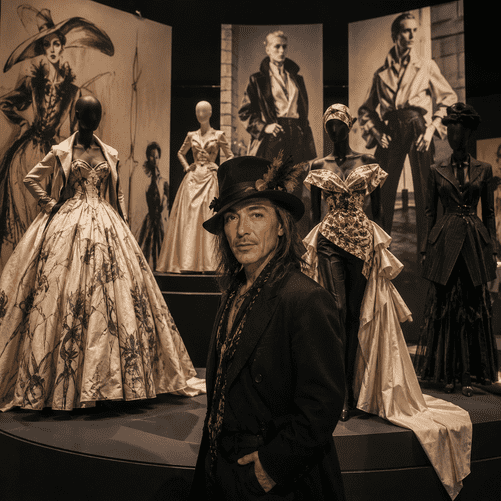
More than 200 ensembles are expected to appear alongside accessories, preliminary drawings, archival documents and toiles—the experimental fabric versions used to develop garments before final production. Together, the objects will trace how Galliano constructed the elaborate historical narratives and theatrical characters that became central to his work.
Galliano’s rise was unusually rapid. Born in Gibraltar and raised in Britain, he attracted international attention with his 1984 graduate collection, Les Incroyables, inspired by the extravagant figures of post-revolutionary France. His ability to transform historical research into emotionally charged runway spectacles soon established him as one of the defining designers of his generation.
After building his own label, Galliano became creative director of Givenchy in 1995 and moved to Dior the following year. At Dior, he combined the house’s couture traditions with elaborate storytelling, dramatic staging and references drawn from art, cinema, literature and global dress.
His runway presentations became productions in their own right. Models appeared as fictional aristocrats, explorers, revolutionaries, performers and displaced historical figures. The garments often displayed exceptional construction, particularly in bias cutting, tailoring, embroidery and the manipulation of fabric.
The Met’s collection includes examples demonstrating those abilities, including fluid bias-cut gowns and designs combining Western tailoring with forms associated with other clothing traditions. Such pieces illustrate both the technical sophistication of Galliano’s work and the cultural borrowing that has also generated criticism of some of his collections.
Galliano’s supporters consider him a transformative designer whose influence extends across fashion imagery, runway presentation and contemporary couture. They argue that his work changed expectations of what a fashion show could communicate, turning seasonal collections into immersive narratives rather than conventional commercial presentations.
His critics, however, question whether a prestigious museum retrospective can avoid becoming an act of rehabilitation, regardless of how openly it discusses his conduct. For them, the exhibition raises a larger ethical issue: whether cultural institutions can separate extraordinary artistic achievement from harmful personal behaviour.
That debate has intensified because the exhibition will be launched in connection with the Met Gala, one of the most visible and influential events in the global fashion calendar. The gala is scheduled for 3 May 2027, days before the public opening, ensuring that Galliano’s career and reputation will dominate international fashion coverage.
The Met and figures involved in the exhibition have sought to address the sensitivity of the project. Museum representatives and supporters of the show reportedly consulted Jewish community leaders during its development. The Anti-Defamation League has expressed support for the exhibition’s approach, citing Galliano’s efforts toward accountability, education and reconciliation.
After his dismissal from Dior, Galliano entered treatment for addiction and withdrew from public life. He later apologised and began engaging with members of the Jewish community. His gradual return to fashion culminated in his appointment as creative director of Maison Margiela in 2014.
At Margiela, he rebuilt his professional reputation through a quieter and more experimental phase of work. His collections focused on deconstruction, memory, altered identity and the transformation of familiar garments. His 2024 couture presentation for the house was widely praised and renewed attention to his influence among a younger generation of designers and fashion audiences.
Galliano has also discussed his downfall in the documentary High & Low – John Galliano, released in 2024. In the film, he reflects on addiction, professional pressure and the behaviour that led to his disgrace, while acknowledging the seriousness of his remarks.
The Met retrospective arrives at a moment when cultural institutions are increasingly expected to address the conduct of the artists they exhibit rather than treating biography as irrelevant to creative achievement. Museums now face pressure to provide historical context, acknowledge victims and avoid presenting redemption as automatic or complete.
For the Costume Institute, the challenge will be to preserve critical distance while examining work whose artistic importance is difficult to dismiss. An exhibition can recognise Galliano’s technical and creative contribution without excusing his conduct, but achieving that balance will depend on how clearly the museum presents the relationship between power, prejudice, accountability and institutional support.
The show may also examine the fashion industry’s own role in Galliano’s rise and collapse. His years at Dior were marked by enormous commercial expectations, relentless production schedules and a culture that frequently treated designers as irreplaceable creative geniuses. Galliano has linked his breakdown to addiction and pressure, although neither explains nor absolves the abuse for which he was convicted.
By presenting the scandal as part of the exhibition rather than a footnote, the Met appears to be arguing that Galliano’s work cannot be understood without the events of 2011. His dismissal, disappearance and eventual return form part of the same history as the celebrated gowns and theatrical collections.
That approach is likely to satisfy neither those who believe Galliano has been unfairly excluded from full recognition nor those who consider a solo Met exhibition an inappropriate honour. The resulting controversy may be unavoidable—and possibly essential to the show’s purpose.
John Galliano: Horizons will therefore function as more than a survey of clothing. It will become a public examination of how cultural institutions remember compromised figures, what genuine accountability requires and whether professional redemption can coexist with an honest record of harm.
The exhibition’s significance will ultimately depend not only on the garments placed in its galleries, but on whether the Met can resist transforming complexity into spectacle. Galliano’s imagination changed fashion, but his words caused lasting damage. The museum’s task is to present both realities without allowing either to erase the other.