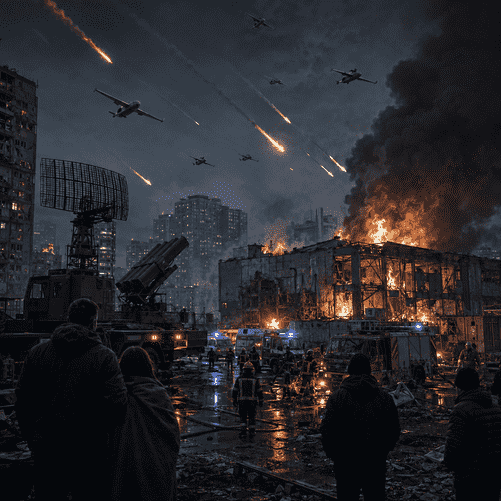
At least 17 people were killed after Ukraine failed to intercept a wave of ballistic and hypersonic missiles, intensifying pressure on its allies to accelerate deliveries of scarce Patriot ammunition.

A large-scale Russian missile and drone assault on Kyiv and its surrounding region killed at least 17 people and wounded 44, exposing a critical weakness in Ukraine’s air-defence network as stocks of advanced missile interceptors run dangerously low.
The overnight attack involved 115 drones and 28 missiles, including 24 ballistic missiles and four Zircon hypersonic weapons, according to Ukrainian authorities. Air-defence units shot down or electronically suppressed 98 of the drones but failed to intercept any of the missiles, allowing explosions to strike logistics facilities, warehouses and other sites across the capital region.
The contrast was stark. Ukraine has developed increasingly effective and comparatively inexpensive methods for confronting Russian attack drones, using electronic warfare, mobile firing teams and interceptor drones. Ballistic missiles present a far more difficult challenge, travelling at extreme speed and following trajectories that leave defenders only minutes to detect, track and destroy them.
Ukraine relies heavily on the American-made Patriot system—and particularly PAC-3 interceptors—to engage such threats. President Volodymyr Zelenskyy said the missiles penetrated Ukrainian defences because the necessary interceptor ammunition was unavailable, renewing his appeal for international partners to accelerate deliveries.
The attack struck warehouses and distribution centres used by some of Ukraine’s largest retailers and logistics companies. Facilities associated with the home-improvement chain Epicentr and online retailer Rozetka were among those damaged, while fires and extensive destruction disrupted commercial operations. Ukrainian officials described the sites as civilian infrastructure essential to the movement of consumer goods across the country.
Russia’s Defence Ministry offered a different account, saying its forces had targeted facilities connected to Ukrainian military logistics and the storage of components used in drone production. Moscow routinely maintains that its long-range attacks are directed at military or dual-use infrastructure, while Ukrainian authorities accuse Russia of striking civilian businesses and urban areas without sufficient distinction.
Emergency crews worked through damaged industrial and residential zones as fires spread through several locations. The bombardment also reportedly caused an ammonia leak at one facility, adding a hazardous-material emergency to the task facing firefighters and rescue teams. Some people were initially feared trapped beneath rubble as authorities searched the affected areas.
The casualties have placed renewed attention on the growing imbalance between the rate at which Russia can launch ballistic missiles and Ukraine’s ability to replenish the weapons needed to stop them.
Only days earlier, another Russian assault on Kyiv killed at least 10 people. During that attack, Ukraine intercepted just one of 27 ballistic missiles. Zelenskyy said the poor interception rate was not primarily the result of technical failure but of insufficient ammunition for the Patriot batteries guarding the country’s largest population centres.
Patriot missiles are expensive, complex and produced in limited quantities. Ukraine must compete for them with the defence requirements of the United States, European NATO members and American partners in other regions. Intensifying missile threats in the Middle East have further increased global demand for the same class of interceptors.
NATO Secretary-General Mark Rutte acknowledged in June that the available volume remained lower than Ukraine required and that intense military operations could place pressure on allied stocks. He said supplies continued to move from the United States but stressed that production needed to be expanded substantially.
A NATO-led procurement programme has become central to sustaining Ukraine’s air defences. According to Rutte, the initiative supplies most of the country’s imported air-defence ammunition and a large share of the missiles used by its Patriot batteries. Yet even continuing deliveries may not be sufficient when Russia launches concentrated waves designed to force Ukrainian crews to expend scarce interceptors.
The problem is compounded by the structure of Russia’s attacks. Moscow frequently combines inexpensive drones, decoys, cruise missiles and ballistic weapons in the same operation. The drones can exhaust defensive resources, reveal the positions of air-defence units and overwhelm tracking systems before the fastest missiles arrive.
Ukraine can afford to reserve its most sophisticated interceptors for ballistic targets only when adequate supplies are available. When stocks are depleted, commanders must either leave cities exposed or ration ammunition in anticipation of future attacks. That calculation has become increasingly severe as Russia expands the frequency and scale of its aerial campaign.
The latest bombardment also demonstrates the economic purpose behind attacks on warehouses and distribution networks. Even when facilities do not have a direct military role, destroying them can interrupt trade, reduce tax revenue, increase transportation costs and weaken public confidence. For a country sustaining both a war economy and the daily needs of millions of civilians, logistics centres are an important component of national resilience.
Ukraine, meanwhile, has expanded its own long-range drone campaign against Russian energy, industrial and logistics infrastructure. A Ukrainian strike recently damaged a warehouse belonging to the Russian retailer Wildberries in the Tula region, illustrating how both sides are increasingly targeting the networks that sustain economic and military activity behind the front lines.
The Ukrainian government is expected to hold emergency consultations with major retailers and transport operators to maintain the flow of essential goods after the latest destruction. Such measures may limit immediate disruption, but they cannot replace the physical protection provided by functioning missile defences.
Kyiv has pursued agreements that could eventually permit Ukrainian companies to manufacture Patriot interceptors under American licence. Zelenskyy said in July that an understanding had been reached at the political level, although establishing production lines for highly sophisticated missiles would require substantial investment, technology transfers and time.
That timeline offers little comfort to cities facing attacks now. Every missile shipment delayed, Ukrainian officials argue, creates another period in which Russia can exploit a visible gap in the country’s defences.
The deaths in Kyiv therefore carry a wider strategic warning. Ukraine has demonstrated that it can adapt to Russia’s mass drone campaign, but its protection from advanced ballistic weapons remains tied to a small number of Western systems and a limited global supply of interceptors.
Unless those stocks are replenished more quickly, Russia may continue to find openings through Ukraine’s defensive shield—not because the technology to stop its missiles does not exist, but because too little of it is available when the missiles arrive.