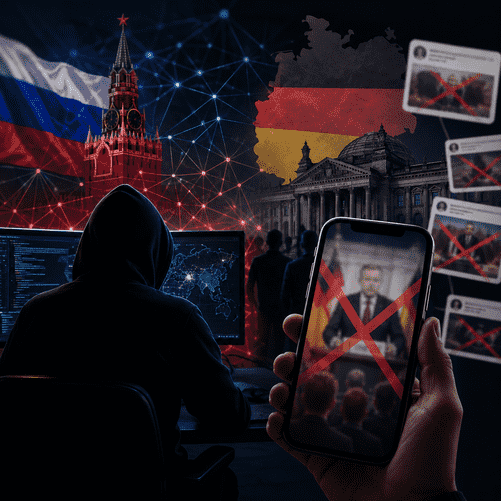
Security officials say a Russian-directed campaign is using fabricated news videos and false allegations to deepen political divisions as the far-right prepares for possible electoral gains.

Germany is facing an intensifying foreign disinformation campaign ahead of three closely watched state elections, according to security officials who say coordinated operations linked to Russia are attempting to discredit mainstream parties and further polarise the country’s political debate.
The campaign is targeting elections scheduled for September in Berlin, Saxony-Anhalt and Mecklenburg-Western Pomerania. The votes are expected to provide an important test of Germany’s political direction, with the far-right Alternative for Germany party positioned to make significant gains and potentially enter government in Saxony-Anhalt.
German security sources say the operation is being centrally organised from Russia through a network of companies. Its apparent purpose is to weaken confidence in established political institutions while attacking local opponents of the AfD, whose leadership has called for the restoration of closer relations between Berlin and Moscow.
The influence effort, known as “Matryoshka,” distributes manipulated or entirely fabricated videos through social-media platforms. The material frequently imitates the branding of established broadcasters, including Germany’s ARD and the BBC, in an effort to make false reports appear credible.
The videos contain accusations against regional political figures, including fabricated claims of financial wrongdoing, sexual harassment and abuse. By presenting such allegations in the visual style of professional journalism, the campaign seeks to exploit public trust in recognised news organisations while making the material more likely to circulate before it can be disproved.
Germany’s Interior Ministry has confirmed that the government is monitoring the operation. Officials say the campaign has not yet achieved substantial online reach, but they continue to regard it as a serious attempt to interfere with democratic debate. Authorities have not launched a broad effort to remove the videos, reflecting the legal and practical difficulties involved in countering rapidly distributed content across international platforms.
The operation illustrates how election interference has evolved beyond the large-scale hacking and document leaks associated with earlier foreign influence campaigns. Modern disinformation increasingly relies on a high volume of localised claims, synthetic media and impersonated news reports designed to create confusion rather than persuade voters of a single political message.
In this environment, the cumulative effect can be more important than the success of any individual falsehood. Repeated allegations may encourage voters to distrust political candidates, electoral institutions and the media, even when the specific stories are quickly challenged.
The timing of the campaign is particularly sensitive. Opinion surveys indicate that the AfD could achieve substantial results in all three elections. A strong performance would increase pressure on the governing Christian Democratic Union and its national coalition partner, the Social Democratic Party, while also reinforcing debate over whether mainstream parties should continue refusing cooperation with the far right.
The AfD has benefited from dissatisfaction over migration, living costs, energy policy and Germany’s support for Ukraine. Its leaders have also criticised sanctions on Russia and advocated a more conciliatory relationship with Moscow.
German security officials say the disinformation campaign appears to be attacking the CDU, the SPD, the Greens and the Free Democratic Party. The pattern suggests a wider effort to damage political forces seen as supportive of Ukraine or committed to Germany’s current European and transatlantic orientation.
Relations between Germany and Russia have remained deeply strained since Moscow launched its full-scale invasion of Ukraine in 2022. Berlin abandoned decades of energy dependence on Russia, imposed sanctions and became one of Kyiv’s most important military and financial supporters.
Russia has consistently denied conducting disinformation operations against Western democracies. Its embassy in Berlin did not immediately respond to Reuters’ request for comment on the latest German allegations.
The accusations are nevertheless part of a broader pattern identified by European governments. German authorities warned of another Russian-directed influence campaign before the country’s previous federal election, while Russia has also been accused of attempting to shape political developments in Moldova and Armenia.
Germany’s Foreign Ministry has described state-directed Russian information operations as an ongoing reality, although it has been careful not to attribute every suspicious campaign without supporting evidence. That distinction reflects the challenge facing democratic governments: responding firmly to foreign interference while avoiding conclusions that cannot be publicly verified.
The Matryoshka campaign also exposes vulnerabilities within the modern information system. Artificial-intelligence tools have made it easier to reproduce the visual identity of broadcasters, imitate voices and create convincing video footage. Content can be produced rapidly, translated into several languages and distributed through multiple accounts before platforms or authorities identify its origin.
Regional elections are especially vulnerable because local candidates often receive less national media coverage and have fewer resources to respond to false accusations. A fabricated report involving a relatively unknown politician may therefore circulate widely before voters encounter a credible correction.
Germany has strengthened cooperation between intelligence services, election authorities and technology companies, but the country remains cautious about restricting political content. Measures intended to suppress foreign propaganda can also raise legitimate concerns over freedom of expression and government censorship.
The immediate challenge is therefore not simply to remove misleading material. Authorities must also identify the networks distributing it, expose the methods being used and provide reliable information quickly enough to prevent fabricated claims from dominating political discussion.
For Germany, the September elections will be a test not only of party strength but also of institutional resilience. The disinformation campaign may currently have limited reach, yet its significance lies in the apparent willingness of a foreign actor to intervene repeatedly in local democratic contests.
As campaign activity intensifies, German officials are warning that even an unsuccessful influence operation can cause damage. Its purpose may be less to determine which party wins than to convince citizens that the political process itself cannot be trusted.