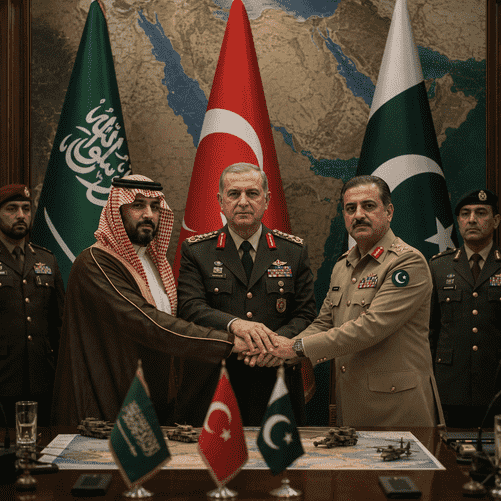
Saudi Arabia, Turkey and Pakistan commit to collective deterrence as the Iran war, attacks on Gulf infrastructure and doubts over traditional security guarantees drive a search for greater strategic autonomy.

Saudi Arabia, Turkey and Pakistan signed a landmark trilateral defense agreement in Mecca on Friday, establishing a collective-security framework under which an armed attack on any one of the three countries would be treated as an attack on all.
The Mecca Joint Defense Agreement was signed on August 7 by Saudi Crown Prince Mohammed bin Salman, Turkish President Recep Tayyip Erdoğan and Pakistani Prime Minister Shehbaz Sharif. It brings together three of the Muslim world’s most influential military and political powers at a moment of profound instability across the Middle East.
According to joint statements issued by the three governments, the agreement is designed to strengthen collective deterrence and expand cooperation across the defense sector. Its central provision closely resembles the principle of mutual defense found in other security alliances: aggression against one signatory is to be regarded as aggression against all three.
The timing is particularly significant.
The pact comes against the backdrop of the continuing Iran war, attacks on Gulf infrastructure, tensions surrounding the Strait of Hormuz and growing concern among regional governments that existing security arrangements may no longer provide sufficient protection against rapidly evolving threats.
Saudi Arabia has already been directly exposed to the regional conflict. Critical infrastructure and energy facilities in the kingdom have come under attack during the war, reinforcing Riyadh’s effort to diversify its security partnerships beyond its longstanding dependence on the United States.
For Riyadh, the new arrangement provides access to two powerful and complementary partners.
Pakistan is a nuclear-armed state with one of the largest militaries in the Muslim world and extensive experience in conventional warfare, counterterrorism and strategic deterrence.
Turkey, meanwhile, possesses NATO’s second-largest army and has developed an increasingly sophisticated domestic defense industry producing drones, missiles, armored vehicles and other advanced military systems.
Saudi Arabia adds enormous financial resources, political influence and the ability to fund major defense-industrial projects.
Together, the three countries combine military manpower, technological capability, strategic deterrence and financial strength in a way that could significantly alter the regional security landscape.
The agreement also formalizes cooperation that has been developing for years.
Saudi Arabia and Pakistan signed a separate bilateral mutual-defense agreement in September 2025, under which an attack on either country was similarly defined as an attack on both. Negotiations over a broader trilateral arrangement involving Turkey had been underway for months before Friday’s signing.
Saudi-Turkish relations have also undergone a striking transformation.
Only a few years ago, ties between Ankara and Riyadh were deeply strained, particularly following the 2018 killing of Saudi journalist Jamal Khashoggi inside the Saudi consulate in Istanbul. Since then, both governments have gradually repaired relations and expanded cooperation in trade, investment and defense.
The new agreement represents perhaps the clearest indication yet that the relationship has moved from reconciliation toward strategic alignment.
Saudi authorities, however, have sought to avoid portraying the agreement as the creation of a hostile military bloc.
Riyadh said the pact was not intended to establish a sectarian alliance or military axis and was not connected to nuclear proliferation or an arms race. Instead, Saudi officials described it as an effort to create sustainable, self-reliant defense capabilities while preserving the kingdom’s existing relationships with Gulf, Arab and international partners.
Erdoğan similarly described the agreement as defensive rather than confrontational.
The Turkish president said it was based on collective deterrence, would deepen defense cooperation and joint industrial projects, and was consistent with the right of self-defense under Article 51 of the United Nations Charter. Ankara has also indicated that the arrangement is not directed against any specific country.
The agreement could therefore extend well beyond a promise of military assistance in wartime.
Analysts expect closer cooperation in areas including intelligence sharing, weapons development, defense manufacturing, technology transfer, training and strategic coordination. Saudi investment could also provide additional capital to Turkey and Pakistan’s growing defense industries.
Large-scale troop deployments are considered less certain.
Security analysts cited by the Associated Press said Turkey and Pakistan are unlikely to station major permanent combat forces in Saudi Arabia solely as a result of the pact. Instead, the agreement may produce deeper military planning, technology transfers, joint production and limited deployments when circumstances require them.
Iran has already reacted critically.
Ebrahim Rezaei, a member of the Iranian parliament’s National Security and Foreign Policy Commission, argued that the agreement would not guarantee Saudi security and criticized Riyadh for seeking protection through external partnerships. Iran’s national leadership had not issued a formal response at the time of the initial reports.
The agreement also carries implications for Israel.
Turkey and Pakistan have both strongly criticized Israeli military actions in the region, while Saudi Arabia has continued to condition any normalization of relations with Israel on progress toward Palestinian statehood.
At the same time, all three governments insist that the new arrangement is defensive and does not identify Israel, Iran or any other country as an adversary.
The deeper significance of the agreement may therefore lie less in identifying a common enemy than in what it reveals about changing regional calculations.
For decades, the Gulf security architecture has depended heavily on American military power. The turmoil of recent years — from the Gaza war and attacks on shipping to the widening confrontation with Iran — has encouraged regional governments to hedge against uncertainty by developing their own networks of alliances.
Saudi Arabia’s strategy increasingly appears to combine its traditional partnership with Washington with deeper relationships involving other major regional powers.
Turkey, meanwhile, is demonstrating that NATO membership does not prevent Ankara from building parallel security structures outside the Western alliance.
Pakistan gains an opportunity to strengthen its strategic position in the Middle East while deepening economic and defense ties with two wealthy and militarily important partners.
The result is not necessarily a Middle Eastern equivalent of NATO. The agreement remains far less institutionalized, and important questions remain unanswered about exactly what military obligations would be triggered during a crisis.
Nevertheless, its political message is unmistakable.
Saudi Arabia, Turkey and Pakistan are signaling that they intend to play a more independent role in shaping regional security rather than relying exclusively on outside powers.
The Iran war has accelerated that transformation.
As the Middle East becomes increasingly fragmented between competing powers, armed groups and shifting alliances, governments across the region are searching for new forms of deterrence and strategic insurance.
The Mecca agreement may ultimately prove to be one of the most consequential examples of that trend — a sign that a new security architecture is beginning to emerge from the instability of the current conflict.