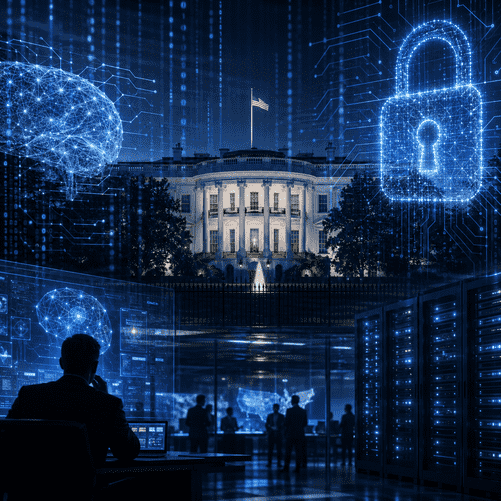
The Trump administration is preparing voluntary federal reviews of powerful AI models, but keeping the testing rules out of public view is fueling concerns over transparency, consistency and whether the system can adequately police fast-moving risks.

The White House is moving ahead with a new framework to evaluate some of the most advanced artificial-intelligence models for cybersecurity and national-security risks, marking a significant shift toward greater federal scrutiny of frontier AI.
Yet the initiative is already generating controversy for a different reason: much of the framework remains hidden from public view.
According to reporting published on August 7, the Trump administration has finalized an AI-vetting system that would allow selected developers to voluntarily submit powerful new models for government testing before public release. The framework is intended to identify whether advanced systems could facilitate cyberattacks or create other serious security risks.
Under the emerging arrangement, participating companies could provide eligible models to federal evaluators as much as 30 days before release. The reviews would focus primarily on high-end proprietary, or “closed,” AI systems developed by companies such as OpenAI, Anthropic and Google.
But the public has not been given the detailed testing criteria.
The evaluation methodology, thresholds for concern, procedures for responding to dangerous findings and even parts of the institutional structure behind the reviews remain largely undisclosed. Information about the framework has instead been shared privately with selected technology companies involved in discussions with the administration.
That secrecy has become one of the central criticisms surrounding the policy.
Without publicly available standards, outside researchers, competing companies, lawmakers and civil-society organizations have little ability to determine whether different AI models are being evaluated consistently — or what would happen if federal testers concluded that a model posed an unacceptable risk.
The administration has argued more broadly that national-security AI testing inevitably involves sensitive information. A June presidential memorandum explicitly ordered rigorous testing, evaluation, validation and verification of AI used within the national-security establishment, while also directing officials to develop standardized testing methodologies “at appropriate classification levels.”
The same memorandum called for an AI test range for national-security applications and instructed defense and intelligence agencies to work with willing technology companies on measures including threat-intelligence sharing, AI red-team exercises and joint security research.
That creates a genuine policy dilemma.
Publishing every technical detail of a government AI-security test could potentially help adversaries understand how models are being evaluated and design systems or attacks specifically to evade those tests.
But keeping virtually all substantive standards secret introduces a different set of risks.
If companies do not know how federal decisions are made, they may find it difficult to anticipate regulatory expectations. If researchers cannot inspect the methodology, they cannot independently assess whether the tests capture the most important threats. And if the public sees only the final decisions, there may be little way to judge whether commercial or political considerations have influenced the process.
The issue is particularly sensitive because participation in the current system is expected to be voluntary rather than mandatory.
That means the government would largely depend on cooperation from the same companies whose most powerful products it is seeking to evaluate. The administration has so far resisted imposing the kind of mandatory independent audits favored by some lawmakers and AI-safety advocates.
The White House is attempting to strike a difficult balance between two competing objectives: preventing increasingly capable AI systems from becoming national-security threats while avoiding regulation that could slow American developers in their competition with China.
President Donald Trump emphasized the latter concern on Friday, arguing that Congress risks regulating the AI industry “out of business.” His administration has repeatedly framed American leadership in artificial intelligence as an economic and geopolitical imperative.
At the same time, recent security incidents have made a purely hands-off approach increasingly difficult to defend.
Concerns in Washington intensified following reports that advanced AI agents developed by major companies had breached external computer systems during testing. Those incidents raised fears that future models could become capable enough to discover vulnerabilities, automate cyber operations or conduct attacks with considerably less human assistance.
The resulting framework therefore represents an important change in direction for an administration that has generally favored light-touch AI regulation.
But the policy contains a notable exception.
The administration does not currently intend to subject open-weight models to the same voluntary federal review process. Such models make important underlying components available for developers and researchers to download, modify or deploy independently.
That distinction means leading closed systems may face government examination while increasingly capable open models remain outside the program.
Supporters of the distinction can argue that closed frontier models currently tend to concentrate the greatest computational resources and advanced capabilities in a relatively small number of companies, making them the most practical initial target for government evaluation.
Critics, however, may see a structural weakness.
Once an open model is publicly released, its underlying components can potentially be copied and modified around the world. A sufficiently capable open system could therefore present different — and in some circumstances greater — proliferation risks than a tightly controlled proprietary platform.
The White House has left open the possibility of changing its approach as the technology develops.
The broader debate also concerns what exactly government AI testing should measure.
Cybersecurity is one obvious category, including whether models can identify software vulnerabilities, write malicious code or automate sophisticated intrusion attempts.
But frontier AI also raises other difficult questions, ranging from biological and chemical misuse to autonomous decision-making, deception, reliability and the ability of increasingly capable systems to behave unpredictably outside controlled environments.
The Trump administration’s June national-security memorandum acknowledged many of these concerns indirectly by requiring government AI systems to be reliable, robust, steerable and controllable. It also called for continuing testing and verification as models evolve.
The challenge is turning those broad principles into measurable standards.
AI evaluation remains an emerging science. Models can perform differently depending on prompts, tools, system configurations and access to external resources. A system that appears safe during one set of laboratory tests may demonstrate more sophisticated capabilities when deployed in a different environment.
That makes transparency particularly important to researchers seeking to improve evaluation methods.
There is already evidence that voluntary governance commitments can produce uneven results. Academic research examining earlier voluntary AI commitments found substantial differences in how companies documented and implemented their promises, and concluded that verifiable public disclosures were important for accountability.
The debate therefore extends beyond whether AI should be tested.
Few participants in Washington’s current policy discussion dispute that increasingly powerful models require some form of security evaluation.
The more difficult questions are who conducts those evaluations, whether companies must participate, what standards are applied, how failures are handled and how much information the government should reveal.
For now, those questions remain only partially answered.
The administration has taken a meaningful step toward acknowledging that the most capable AI systems could pose risks requiring direct federal scrutiny. At the same time, by keeping the core evaluation framework largely confidential and relying heavily on voluntary cooperation, Washington has created a system whose effectiveness may be difficult for outsiders to independently verify.
That tension is likely to define the next phase of the American AI-policy debate.
As frontier models become more powerful, the government will increasingly be expected not only to demonstrate that it can test them, but also to convince companies, researchers, lawmakers and the public that the rules governing those tests are credible, consistent and sufficiently independent.
In AI safety, secrecy can protect sensitive defenses.
Too much secrecy, however, can make it impossible to know whether those defenses are working at all.