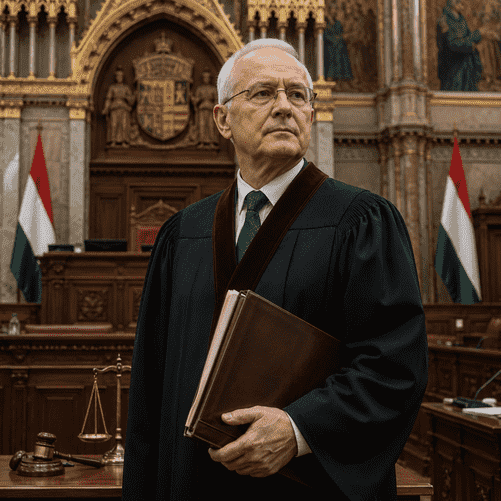
Former Supreme Court chief and European human-rights judge is expected to secure the largely ceremonial post when Hungary’s parliament votes on August 11.

Hungary’s governing Tisza party has nominated former Supreme Court president András Baka to become the country’s next head of state, placing a veteran jurist and former critic of Viktor Orbán’s judicial reforms at the centre of Hungary’s latest institutional transition.
The parliamentary group of Prime Minister Péter Magyar’s Tisza party selected Baka by secret ballot on Saturday, August 8. Parliament is scheduled to elect Hungary’s new president on Tuesday, August 11, and Baka is widely expected to win because Tisza holds a commanding majority in the National Assembly.
The nomination represents another significant personnel change since Magyar’s party swept to power in Hungary’s April parliamentary election, ending Viktor Orbán’s 16-year period as prime minister. Tisza won 141 of the National Assembly’s 199 seats, giving the new government a two-thirds parliamentary majority.
Baka, an experienced constitutional lawyer and former judge at the European Court of Human Rights, served as president of Hungary’s Supreme Court between 2009 and 2012. His judicial career later became closely associated with one of the most prominent legal disputes surrounding Orbán-era reforms.
His tenure at the head of the judiciary was cut short after constitutional and institutional changes adopted by the former Fidesz government reorganised the Supreme Court and replaced it with the Kúria.
Baka subsequently challenged his removal before the European Court of Human Rights. The court ruled that Hungary had violated his rights, finding that his premature dismissal was connected to criticism he had expressed regarding government-backed judicial reforms.
That history makes his nomination politically symbolic.
Tisza’s decision places a figure previously associated with resistance to some of the most controversial elements of the Orbán government’s institutional restructuring into one of Hungary’s highest constitutional offices. International reporting has described Baka as an Orbán critic, although his prospective role as president would formally require him to operate above day-to-day party politics.
The Hungarian presidency is largely ceremonial, but the office retains important constitutional responsibilities.
The president signs legislation, can refer laws to the Constitutional Court, represents Hungary internationally and formally appoints certain senior officials. The head of state can also send legislation back to parliament for reconsideration.
In a political system where the governing party enjoys a two-thirds majority, however, the president’s practical influence depends heavily on the officeholder’s willingness to exercise those constitutional powers independently.
Baka’s judicial background could therefore prove particularly significant.
His professional career has been built around constitutional law, judicial independence and human rights rather than party politics. Before heading Hungary’s Supreme Court, he spent two terms as a judge at the European Court of Human Rights in Strasbourg.
Prime Minister Magyar had publicly met Baka on August 5 as part of consultations over possible presidential candidates. Other figures considered during the selection process reportedly included historian Ignác Romsics and lawyer Botond Fülöp. Tisza said it had held discussions with several individuals whose character it believed could contribute to national unity.
Baka ultimately emerged as the parliamentary group’s choice and has accepted the nomination.
For Magyar, the selection sends a broader political message.
His government came to power promising an institutional break with the Orbán era, including stronger safeguards for judicial independence, closer engagement with European institutions and reforms aimed at restoring confidence in Hungary’s democratic institutions.
Selecting a former Supreme Court chief whose removal became an internationally recognised judicial-independence case reinforces that narrative.
At the same time, Baka’s nomination could help Tisza portray the presidency as institutionally separate from the government rather than simply another senior political appointment.
That distinction will be closely watched in Brussels.
Hungary spent years in conflict with European Union institutions over concerns involving the rule of law, judicial independence, media pluralism, corruption and the concentration of political power under Orbán.
The new Magyar government has sought to reset those relationships while demonstrating that Hungary intends to strengthen institutional checks and rebuild confidence among its European partners.
Installing a former European human-rights judge as president would provide a highly visible symbol of that shift.
Yet Baka would still face an important test once in office.
A president backed by the same parliamentary supermajority that controls the government could be perceived as politically aligned unless he demonstrates a willingness to scrutinise legislation and defend constitutional boundaries independently.
His past record suggests that institutional independence is likely to form an important part of his public identity.
For Hungary, therefore, the August 11 presidential vote is more than a routine constitutional procedure.
It represents another stage in the country’s political transformation following the collapse of Fidesz’s long dominance and the arrival of Magyar’s Tisza government.
If elected as expected, András Baka would return to the highest levels of Hungary’s constitutional system more than a decade after his controversial removal from the leadership of the judiciary.
His appointment would carry a striking historical symmetry: a judge once pushed out during Hungary’s institutional transformation under Viktor Orbán could now become head of state during the political order that followed Orbán’s defeat.