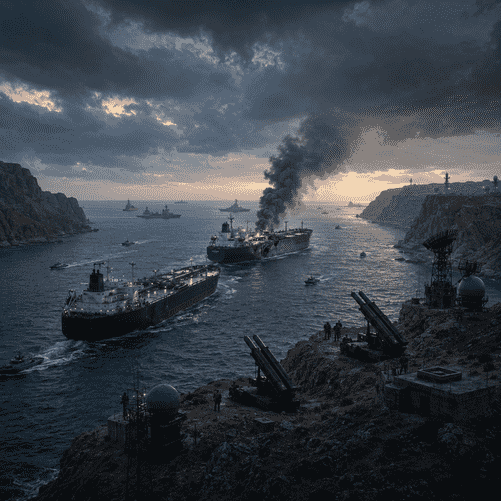
Iran’s top security official demands American military withdrawal, sanctions relief and compensation as another attack on commercial shipping deepens uncertainty around the world’s most critical energy chokepoint.

Iran has set out an expansive list of conditions for reopening the Strait of Hormuz, demanding that the United States withdraw military forces from the region, lift sanctions and provide compensation for wartime damage as tensions over one of the world’s most important shipping corridors enter a new phase.
Mohammad Bagher Zolghadr, secretary of Iran’s Supreme National Security Council, said on Saturday that the strategic waterway would remain closed until Washington fundamentally changed its military and economic policy toward Tehran.
His demands include an end to what Iran describes as a U.S. naval blockade, the withdrawal of American forces positioned around the country, the lifting of sanctions, the release of frozen Iranian assets and payment of reparations for damage caused during the conflict.
Zolghadr also called for an end to attacks against Iranian allies elsewhere in the Middle East and for Washington to cease military threats against the Islamic Republic.
The declaration sharply raises the stakes surrounding negotiations over the Strait of Hormuz, through which a substantial share of the world’s internationally traded oil and liquefied natural gas normally passes.
The waterway has remained heavily disrupted since the conflict between Iran and the United States escalated earlier this year, forcing shipping companies, energy producers and governments to reassess supply routes and security risks across the Persian Gulf.
Iran’s latest conditions suggest that Tehran now views control over Hormuz not merely as a military instrument, but as leverage in a much broader political settlement with Washington.
The announcement came as tensions at sea intensified again.
The United Arab Emirates said a commercial vessel linked to the Abu Dhabi National Oil Company had been targeted near the strait, adding to a series of incidents that have kept shipowners wary of returning to the region despite diplomatic efforts to create safer transit arrangements.
Iran has been negotiating separately with Oman over the creation of a controlled maritime corridor that could allow some vessels to pass through the area.
Those discussions have generated cautious optimism that limited shipping movements could resume, but Iranian officials have repeatedly drawn a distinction between establishing a restricted corridor and fully reopening the strait.
The latest demands reinforce that distinction.
For Tehran, a technical or maritime arrangement appears insufficient without concessions on the wider conflict.
For Washington, accepting Iran’s conditions would represent a major strategic retreat.
The United States maintains extensive military infrastructure across the Gulf, including forces stationed in Bahrain, Qatar, Kuwait and other regional partners. A withdrawal on the scale demanded by Iran would fundamentally alter the balance of power in the Middle East and weaken Washington’s ability to project military force around the Persian Gulf.
Sanctions are another central obstacle.
American restrictions on Iranian oil exports, financial transactions and other sectors have long been one of Washington’s primary instruments of economic pressure. Earlier ceasefire discussions reportedly linked comprehensive sanctions relief to a broader settlement over Iran’s nuclear programme rather than solely to freedom of navigation through Hormuz.
Iran is now attempting to link these issues together.
By making the reopening of the strait conditional on sanctions relief, military withdrawal, compensation and the release of frozen assets, Tehran is effectively seeking to transform control of the waterway into negotiating leverage across several longstanding disputes.
The economic consequences extend far beyond the two countries.
Hormuz is the principal maritime outlet for oil and gas producers including Saudi Arabia, the United Arab Emirates, Kuwait, Qatar and Iraq. Prolonged disruption can increase transportation and insurance costs, complicate energy deliveries and place upward pressure on global oil and gas prices.
Asian economies are particularly exposed because China, India, Japan and South Korea are among the largest consumers of Gulf energy.
European economies are also vulnerable to higher global energy prices, especially through liquefied natural gas markets and the wider inflationary effects of more expensive oil.
The crisis has already demonstrated how quickly geopolitical uncertainty in the Gulf can move financial markets. Earlier episodes of renewed fighting sent oil prices sharply higher and weighed on stock markets as investors assessed the risk of prolonged interruptions to energy supplies.
For shipping companies, political agreements alone may not immediately restore confidence.
Merchant vessels require clear security guarantees before operators and insurers are likely to resume large-scale transit through waters where missiles, drones, mines and small attack craft remain potential threats.
Even if Washington and Tehran were to reach a diplomatic understanding, restoring normal commercial traffic could therefore take time.
Iran’s ability to threaten navigation derives partly from geography. The Strait of Hormuz narrows to only a few dozen kilometres at its tightest point, forcing large commercial vessels through relatively predictable shipping lanes.
Iran’s extensive coastline and arsenal of shore-based missiles, drones, fast boats and naval mines give Tehran multiple ways to threaten those routes even without maintaining traditional naval superiority.
That asymmetric advantage has transformed Hormuz into one of Iran’s most powerful strategic assets.
The latest confrontation also highlights a fundamental disagreement over the future governance of the strait.
The United States and its allies have traditionally insisted on freedom of navigation through international waterways. Iran has increasingly asserted that passage through Hormuz should be subject to Iranian security oversight and, in some proposals, restrictions or charges targeting states it considers hostile.
Iranian lawmakers have recently discussed rules that could prohibit vessels connected with the United States, Israel or other adversaries from passing through the area and impose substantial penalties on ships deemed to have violated Iranian restrictions.
Such proposals would be strongly contested internationally and could establish a precedent extending well beyond the Persian Gulf.
For Tehran, however, the strategic calculation is clear: control over maritime access provides leverage that conventional economic and military power alone cannot deliver.
For Washington, the challenge is equally difficult.
Military action aimed at forcing the strait open risks further attacks on shipping, American bases and Gulf energy infrastructure. Accepting Iran’s political demands, however, could be portrayed as granting Tehran strategic rewards for disrupting international commerce.
The result is an increasingly complex standoff in which military pressure, diplomacy and global energy security have become tightly interconnected.
Iran’s new conditions therefore make clear that the dispute over Hormuz is no longer simply about whether ships can safely pass through a narrow stretch of water.
It has become part of a broader contest over sanctions, U.S. military power, Iranian regional influence and the future security architecture of the Gulf.
Until that larger confrontation is addressed, the world’s most strategically important oil corridor is likely to remain both an economic vulnerability and one of Tehran’s most valuable bargaining instruments.