From Copenhagen Fashion Week to celebrity wardrobes, the centuries-old kerchief is enjoying a major revival — carrying with it a complex history of labour, rebellion, music, politics and identity.

One of fashion’s simplest accessories is having an unexpectedly powerful moment.
The bandana — a square of printed fabric that has been worn for centuries by workers, soldiers, sailors, musicians, activists and political figures — has emerged as one of the defining accessories of summer 2026, appearing across street style, celebrity wardrobes and fashion-week crowds.
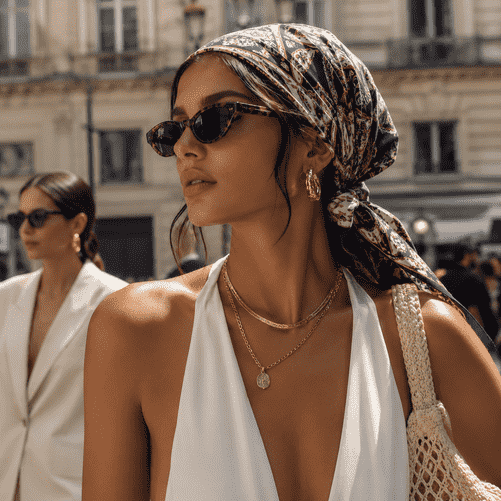
At Copenhagen Fashion Week this week, bandanas were repeatedly spotted tied over hair, knotted around necks and incorporated into otherwise minimalist outfits, reinforcing the accessory’s return as both a practical and stylistic statement.
Celebrities including Dua Lipa, Zendaya and Priyanka Chopra Jonas have also helped accelerate the revival, while retailers and secondhand platforms are seeing evidence that interest extends well beyond the runway.
According to reporting by The Guardian, searches for bandanas on resale platform Depop have recently increased by 152%, suggesting that consumers are embracing the accessory not only through new collections but through vintage and secondhand fashion.
The appeal is partly economic.
At a moment when designer handbags, jewellery and luxury accessories can cost hundreds or thousands of pounds, a bandana offers an inexpensive way to dramatically alter an outfit.
It can be folded into a headscarf, tied around the neck, wrapped around a ponytail, worn as a belt or attached to a handbag. That flexibility makes it particularly suited to a fashion culture increasingly driven by personal styling rather than rigid seasonal rules.
Yet the bandana’s resurgence is notable precisely because the accessory is anything but new.
Its history stretches back centuries and is closely connected to textile traditions originating in India.
The word itself is derived from bandhani, a traditional Indian tie-dyeing technique in which fabric is tightly bound before dyeing to create distinctive patterns. Textiles produced using related techniques were traded internationally and eventually influenced the printed kerchiefs that became familiar across Europe and North America.
Over time, the bandana became one of fashion history’s most adaptable objects.
It was worn by agricultural labourers and factory workers because it was practical — capable of protecting the head from sun, keeping dust away from the face or absorbing sweat during physical work.
Sailors and pirates helped create another enduring visual association.
In the American West, cowboys frequently used neckerchiefs and bandanas against dust and weather, helping establish the garment as a symbol of rugged independence.
But its cultural meaning has repeatedly changed.
Bandanas have appeared in political campaigns, protest movements, military environments and youth subcultures. They have been associated with organised gangs in the United States, where specific colours were sometimes used to communicate affiliation and territory.
In music, the accessory became especially influential through hip-hop.
Artists including Tupac Shakur and Missy Elliott helped transform the bandana into a powerful symbol of late-20th-century popular culture, wearing it in ways that connected street fashion with identity, rebellion and celebrity.
Rock musicians, motorcyclists and punk communities have similarly incorporated the bandana into their visual language.
That extraordinary range of associations is part of what makes the accessory so attractive to contemporary fashion.
Few objects can move as easily between glamour and utility.
A silk bandana worn with sunglasses and jewellery can evoke Hollywood sophistication, while the same basic shape in cotton can suggest workwear, western Americana or 1990s street culture.
Fashion’s current enthusiasm appears to embrace all of those references simultaneously.
At Copenhagen Fashion Week, bandanas were styled alongside tailoring, summer dresses and casual separates, reflecting a broader trend toward accessories that make otherwise restrained clothing appear more individual.
The resurgence also fits comfortably within the fashion industry’s current fascination with heritage pieces.
Consumers have increasingly returned to accessories with recognisable histories — from loafers and brooches to silk scarves, vintage watches and traditional handbags — while combining them with contemporary clothing.
Bandanas have an additional advantage: they are highly accessible.
Unlike many luxury revivals, participation does not require buying a specific designer product.
A vintage cotton kerchief found in a secondhand store can perform essentially the same styling function as a considerably more expensive designer interpretation.
That democratic quality may partly explain why the trend has travelled so quickly from celebrity photographs to street style.
The bandana also sits comfortably within the continuing expansion of secondhand fashion.
Because older examples often have faded colours, softened fabrics and distinctive printed patterns, signs of age can increase rather than reduce their desirability.
The accessory therefore lends itself naturally to vintage markets and resale platforms.
There is, however, a deeper cultural dimension to its revival.
Bandanas and similar head coverings have historically carried different meanings depending on who wears them, where they are worn and how they are styled.
For some communities, head coverings may carry religious, cultural or practical significance rather than functioning simply as fashion accessories.
The bandana’s associations with racial identity, organised gangs, political movements and working-class culture also mean that particular styles can communicate meanings far beyond aesthetics.
That complexity is one reason the accessory has survived repeated cycles of popularity.
Fashion frequently revives individual garments from the past, but the bandana is unusual because it has never belonged exclusively to one era or social group.
It has moved between presidents and protesters, labourers and celebrities, pirates and pop stars.
Each generation has been able to reinterpret it.
In 2026, the dominant interpretation is noticeably glamorous.
Bandanas are increasingly being worn with carefully styled hair, oversized jewellery, sunglasses and polished tailoring rather than functioning purely as practical head coverings.
The effect turns an object historically associated with work and utility into something deliberately theatrical.
That tension — between the ordinary and the glamorous — is central to its current appeal.
The bandana also reflects a broader shift away from highly prescriptive fashion.
Consumers increasingly combine luxury clothing with inexpensive accessories, vintage pieces with new designs and formal garments with items traditionally associated with workwear or street culture.
Within that environment, an accessory capable of carrying multiple identities becomes particularly useful.
It can make an outfit nostalgic without appearing costume-like, decorative without being overly formal and recognisable without belonging to a single brand.
For designers and retailers, that versatility makes the bandana commercially attractive.
For consumers, its appeal may be even simpler.
At a time when fashion trends increasingly appear and disappear at social-media speed, the bandana offers something unusual: an accessory that feels fashionable now but has already survived several centuries.
Its latest revival may therefore be less about rediscovering a forgotten object than recognising one that never truly disappeared.
From ancient textile traditions to the streets outside Copenhagen Fashion Week, the bandana has continuously adapted to the people wearing it.
This summer, fashion has simply decided to notice it again.