The world No. 1 will miss the final major warm-up tournament before New York after a right knee injury left him unable to compete, adding another layer of uncertainty to an already injury-hit men’s field.

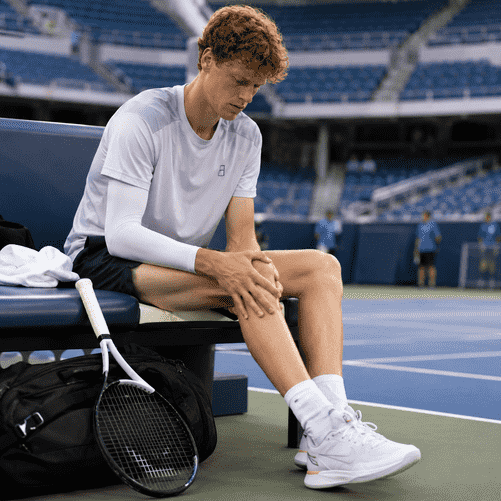
Jannik Sinner has withdrawn from the Cincinnati Open because of a right knee injury, forcing the world No. 1 to abandon one of the most important stages of his preparation for the US Open less than three weeks before the final Grand Slam tournament of the season. The 24-year-old Italian confirmed his decision on Sunday after working with his medical team in an attempt to recover in time for the ATP Masters 1000 event, saying that despite making progress, he did not feel physically ready to return to competition.
The withdrawal represents a significant interruption to what has otherwise been another exceptional season for Sinner. The Italian recently captured his fifth Grand Slam title at Wimbledon and remains at the top of the ATP rankings, but he has not competed since the grass-court major. He had already elected to miss the Canadian Open, making Cincinnati his expected return to competitive tennis before travelling to New York.
Sinner said he was disappointed to miss a tournament where he has enjoyed considerable success, but emphasised that recovery must take priority. Cincinnati has been particularly significant in his recent career: he won the title there in 2024 before finishing runner-up to Carlos Alcaraz in 2025. His absence this year means he will surrender the opportunity not only to defend ranking points but also to test his knee under competitive conditions before the US Open begins on August 30.
The timing makes the decision especially important. Hard-court preparation before a Grand Slam is generally used to rebuild match rhythm, adapt movement to the surface and test physical conditioning through consecutive high-intensity matches. If Sinner does not enter another tournament before New York, he could arrive at the US Open without having played a competitive match since Wimbledon, leaving practice sessions as his principal preparation for one of the most demanding events on the calendar.
Reports earlier in the week had already generated concern around Sinner’s fitness after he underwent medical examinations relating to the knee. He had continued training while receiving treatment, but the possibility of missing Cincinnati grew as his team assessed whether competing could aggravate the problem. His decision ultimately suggests that the priority is avoiding unnecessary risk before New York rather than attempting to accelerate his return.
For Sinner, caution is understandable given the physical demands of his playing style. His game is built around aggressive movement from the baseline, rapid changes of direction and exceptional balance while striking the ball at considerable speed. Even a relatively manageable knee problem can therefore become significant if it affects lateral movement or forces a player to compensate elsewhere in the body.
There has been no indication that Sinner currently plans to miss the US Open. The Italian has instead made New York the central objective of his rehabilitation, with his medical team working to ensure he is capable of competing safely when the tournament begins. The remaining weeks will nevertheless be closely watched, particularly if there are further interruptions to training or signs that the knee is responding slowly to treatment.
His withdrawal also compounds the problems facing the Cincinnati Open. Carlos Alcaraz, the world No. 2 and Sinner’s principal rival at the top of men’s tennis, has already pulled out because of an ongoing wrist injury. Alcaraz has not competed since April, making his own fitness ahead of the US Open a major concern.
The absence of both players removes the two highest-ranked men from a tournament that traditionally serves as one of the clearest indicators of form ahead of New York. It also reflects a wider period of physical strain across elite men’s tennis, where an increasingly demanding calendar has renewed debate over workload, recovery and the sustainability of playing schedules at the highest level.
For Sinner, however, the immediate calculation is considerably simpler. Cincinnati offers valuable preparation, but the US Open carries far greater significance. Entering the tournament without competitive hard-court matches is far from ideal, yet arriving with an aggravated knee injury would pose a much greater threat to his chances.
The coming weeks will therefore become a test not only of Sinner’s recovery but also of how effectively he can compensate for the absence of match play. Training can reproduce elements of competition, but it cannot completely replicate the intensity, pressure and physical unpredictability of tournament tennis.
Sinner has already demonstrated an ability to return quickly to elite level after interruptions, and his recent Grand Slam record ensures that he would remain among the leading contenders in New York if fully fit. The uncertainty lies not in his tennis but in whether his body will allow him to produce it over the demanding best-of-five-set format.
His Cincinnati withdrawal is therefore best understood as a precaution rather than a crisis. Yet with the US Open approaching rapidly, the margin for further setbacks is narrowing. For the world No. 1, the next victory will not come on a tennis court but in the rehabilitation room: getting his right knee ready for New York.