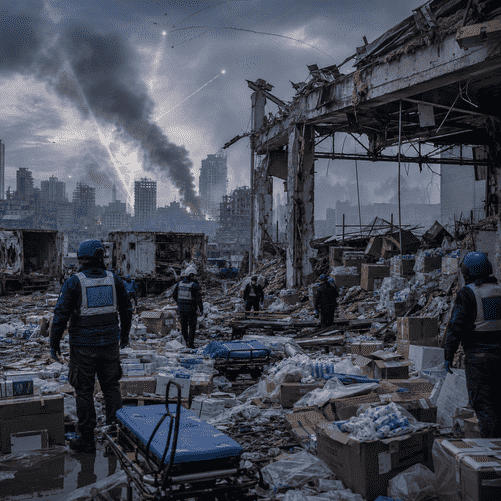
A Russian strike has destroyed a World Health Organization warehouse in Dnipro containing emergency medical supplies for frontline hospitals, as another night of missile and drone attacks brings fresh casualties on both sides of the conflict.

Russia and Ukraine exchanged another wave of overnight missile and drone attacks, leaving civilians dead and injured on both sides as the increasingly entrenched air war extends from frontline cities to logistics hubs, ports and critical infrastructure deep behind the battlefield.
The latest escalation has acquired an additional humanitarian dimension after the World Health Organization confirmed that one of its warehouses in the Ukrainian city of Dnipro had been struck and destroyed.
The facility contained humanitarian medical supplies intended primarily for health facilities operating close to the front line, including emergency medical equipment and materials required to sustain treatment in areas where hospitals already face severe wartime pressure.
WHO Director-General Tedros Adhanom Ghebreyesus said personnel and drivers had been working at the warehouse before the attack to remove humanitarian stocks. They succeeded in evacuating approximately 130 of around 300 pallets before leaving the area, and no casualties among WHO personnel had been reported.
The destruction nevertheless removes an important logistical node from an already strained Ukrainian health system.
Medical facilities in areas close to the fighting depend heavily on reliable supply chains for trauma equipment, medicines and emergency materials. Damage to warehouses can therefore have consequences far beyond the building itself, potentially disrupting the flow of supplies to hospitals treating civilians and military casualties in some of the country’s most exposed regions.
The WHO has repeatedly warned about the vulnerability of Ukraine’s health infrastructure. By February 2026, the organisation had documented at least 2,881 attacks affecting health care since Russia launched its full-scale invasion in February 2022, including incidents involving hospitals, health workers, ambulances and medical warehouses.
The destruction in Dnipro comes as both Russia and Ukraine dramatically expand the reach and frequency of their long-range attacks.
Overnight strikes into Sunday killed at least seven people across the two countries, according to official accounts reported by the Associated Press. Ukrainian drone attacks on Russia’s Belgorod region killed five people and injured more than 20, while Russian attacks on Ukrainian cities caused additional fatalities and injuries.
Ukraine’s southern port city of Odesa was among the principal targets of the latest Russian assault.
President Volodymyr Zelenskyy said Russian strikes damaged the city’s seaport and wounded around a dozen people. Odesa is strategically important not only to Ukraine but also to international agricultural markets because its Black Sea infrastructure remains a central route for Ukrainian food exports.
Russia said it had targeted fuel and other facilities used by the Ukrainian military in Odesa and nearby Chornomorsk. Kyiv, meanwhile, has continued to accuse Moscow of systematically attempting to degrade Ukraine’s energy, transport and export infrastructure.
Kharkiv, Ukraine’s second-largest city and one of the major population centres closest to the Russian border, was also hit. Three people were reported killed there during the latest attacks.
Ukraine simultaneously continued its own long-range campaign inside Russia.
Belgorod, situated immediately across the border from Ukraine, suffered one of the deadliest attacks of the night, while Kyiv has also been striking Russian oil refineries, logistics facilities and other infrastructure in an effort to weaken Moscow’s ability to sustain its military operations.
The reciprocal attacks illustrate how extensively the character of the war has changed.
Although ground forces continue to fight along a vast front across eastern and southern Ukraine, increasingly sophisticated drones and long-range missiles have transformed territory hundreds or even thousands of kilometres from the battlefield into part of the operational environment.
Ukraine has turned domestically produced long-range drones into one of its principal strategic weapons, targeting Russian refineries, fuel infrastructure, logistics hubs and industrial facilities.
Russia, meanwhile, retains a considerably larger missile arsenal and has intensified combinations of ballistic missiles, cruise missiles and large numbers of drones against Ukrainian cities and infrastructure.
Ukraine’s greatest vulnerability remains ballistic missile defence.
Recent Russian attacks have demonstrated the limitations of Kyiv’s available air-defence systems, particularly amid shortages of interceptor missiles for U.S.-supplied Patriot batteries. Ukrainian authorities have repeatedly appealed to Western partners for additional systems and ammunition.
That shortage has become increasingly consequential as Russia employs ballistic weapons that give Ukrainian forces only limited time to react.
During a major attack on the Kyiv region earlier this month, Ukrainian forces were unable to intercept a series of ballistic and high-speed missiles even while successfully destroying a large proportion of incoming drones. The assault killed 17 people and illustrated the growing gap between Ukraine’s ability to counter relatively slow unmanned aircraft and its capacity to stop advanced missiles.
The attack on the WHO warehouse adds another concern: the vulnerability of humanitarian infrastructure within the broader military campaign.
International humanitarian organisations operate extensive logistics networks across Ukraine, delivering medicines, shelter materials, generators, hygiene equipment and other essential supplies to communities affected by the fighting.
Those networks are particularly important near the front line, where hospitals and clinics face recurring interruptions to electricity, water, staffing and supplies. WHO assessments have previously found that health-care access is most severely compromised in frontline regions, where remaining populations frequently include elderly people and individuals with disabilities or chronic medical conditions.
The Dnipro warehouse was therefore more than a storage facility. It formed part of the infrastructure connecting international assistance with medical institutions treating some of Ukraine’s most vulnerable communities.
Tedros used the destruction to reiterate that health facilities and humanitarian medical operations must be protected during armed conflict.
The incident also occurs against the backdrop of a widening pattern of damage to humanitarian facilities.
In May, the United Nations refugee agency reported losing approximately $1 million worth of humanitarian assistance when another warehouse in Dnipro was destroyed in a Russian strike. That facility contained emergency shelter materials and hygiene supplies.
The cumulative effect is increasingly important.
Modern wars are sustained not only by ammunition and military logistics but also by civilian systems capable of keeping populations alive during prolonged conflict. Hospitals, warehouses, power grids, ports and transport networks consequently become central to the resilience of a country under sustained attack.
Ukraine’s strategy of striking Russian energy and logistics infrastructure reflects a similar calculation from the opposite direction: Kyiv is attempting to increase the economic and operational cost of the war for Moscow and disrupt the networks supporting Russia’s military campaign.
The distinction between the two campaigns remains heavily contested. Russia maintains that it attacks military or military-supporting infrastructure, while Ukraine makes comparable claims about many of the facilities it targets in Russia. Both governments deny deliberately targeting civilians. Independent verification of individual military claims is frequently difficult during active hostilities.
What is increasingly clear, however, is that neither side is limiting the conflict to the conventional battlefield.
The latest overnight attacks demonstrate a war in which drones, missiles, logistics networks and infrastructure have become inseparable from frontline operations.
The destruction of the WHO warehouse in Dnipro provides an especially stark illustration of the consequences. Hundreds of pallets of emergency medical supplies intended for facilities operating close to combat zones were caught within that expanding battlespace.
As the aerial campaign intensifies, Ukraine’s hospitals face a dual challenge: treating the victims of the attacks while simultaneously protecting the supply network required to keep those hospitals functioning.
That makes the loss in Dnipro not merely another destroyed building, but another pressure point on a health system that has been operating under extraordinary strain for more than four years of full-scale war.