The Italian fashion house may miss a March 2027 deadline for selling an initial 15% stake, underscoring the difficulty of preserving independence and brand identity during one of luxury’s most challenging market cycles.

Giorgio Armani’s carefully designed succession plan is entering a more uncertain phase, as deteriorating conditions across the global luxury industry threaten to delay the first major ownership change in the Italian fashion house’s history.
The company’s planned sale of an initial 15% stake may not be completed by the March 2027 deadline outlined in Giorgio Armani’s will, according to reports published on August 11. Company sources cited by Corriere della Sera indicated that negotiations are still at an early stage and that difficult market conditions mean securing an appropriate transaction could take longer than originally envisaged.
The delay would be significant for a company whose independence was closely associated with its founder. Giorgio Armani, who died in September 2025 at the age of 91, spent five decades retaining unusually tight control over the business he created, resisting the consolidation that brought many European luxury labels under large multinational groups. His will nevertheless established a detailed framework for the company’s future ownership after his death.
Under that plan, Armani’s heirs were instructed to sell an initial 15% holding within roughly 12 to 18 months, with preferential consideration given to LVMH, L’Oréal and EssilorLuxottica. The eventual investor could subsequently increase its position substantially, while a stock-market flotation remains an alternative should a private transaction fail to materialise.
The choice of potential partners reflects the unusually broad commercial reach of the Armani brand. LVMH represents the world of diversified luxury conglomerates; L’Oréal already has deep involvement in beauty and fragrance; while EssilorLuxottica brings enormous scale in premium eyewear, another strategically important component of the Armani business. Each would offer a different path for the house’s future development.
Yet the timing of the transaction has become increasingly complicated. The wider luxury sector is still emerging from a prolonged slowdown marked by weaker aspirational spending, pressure in China, geopolitical uncertainty and resistance to years of aggressive price increases. These conditions have made valuations more difficult and increased the pressure on luxury companies to prove that their brands can generate sustainable growth rather than relying primarily on higher prices.
Armani itself is not immune. Chief executive Giuseppe Marsocci has said net sales fell 7.5% during January and February 2026, driven mainly by weakness in wholesale distribution, although direct-to-consumer sales showed a modest improvement. The company has also reduced operating costs by approximately €25 million as it adapts to the softer trading environment.
Those figures illustrate why the owners may be reluctant to rush a transaction. Selling a major stake during a depressed luxury cycle could produce a valuation that fails to reflect the long-term strength of one of the world’s most recognisable fashion names. Company sources have consequently stressed that achieving satisfactory terms is more important than adhering rigidly to the timetable established in Armani’s will.
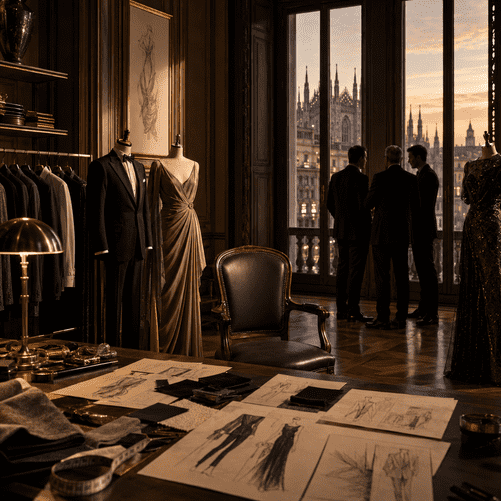
The question extends well beyond financial valuation. Any new shareholder would inherit a brand with a distinctive aesthetic identity built around understated tailoring, fluid silhouettes and restrained Italian elegance. Unlike many modern luxury houses, Armani has historically depended less on highly visible logos or rapid creative-director turnover and more on continuity of design philosophy.
That model is now being tested by changing consumer behaviour. Younger luxury customers are increasingly selective about large fashion purchases, while categories such as jewellery and prestige beauty have recently demonstrated greater resilience than traditional handbags and apparel. In China, for example, prestige skincare has been gaining ground as consumers become more cautious about spending heavily on entry-level designer products.
At the same time, several brands have demonstrated that strong creative direction can still generate substantial growth. Chanel reportedly recorded approximately 16% comparable revenue growth during the first half of 2026, helped by the reception of Matthieu Blazy’s collections, while Ralph Lauren has benefited from rising demand among younger shoppers in Asia and North America.
For Armani, the challenge is therefore twofold: preserve a highly valuable heritage while finding the capital, management structure and creative strategy necessary to compete in a luxury market undergoing fundamental change.
The Armani Foundation remains an important safeguard within that structure. Giorgio Armani’s succession arrangements were designed to ensure that the foundation retained a meaningful long-term position in the company, protecting the house’s identity even if outside investors eventually acquire substantial ownership.
An eventual public listing also remains possible. Such a move would represent a dramatic transformation for a business that spent most of its existence under the direct control of its founder, but it could allow Armani to access capital markets while avoiding outright absorption by another luxury conglomerate.
The uncertainty surrounding the March 2027 deadline consequently reveals something larger about the contemporary luxury industry. Some of Europe’s most prestigious fashion houses are confronting a difficult transition from founder-led independence to institutional ownership at precisely the moment when consumer expectations, distribution models and the economics of luxury are shifting.
For Armani, choosing the right investor may ultimately prove more consequential than meeting a specific date. The transaction will determine not simply who owns part of the company, but whether one of Italy’s most influential fashion institutions can preserve the restrained aesthetic and independence that made Giorgio Armani distinctive while adapting to a luxury market increasingly dominated by global scale, younger consumers and relentless competition.