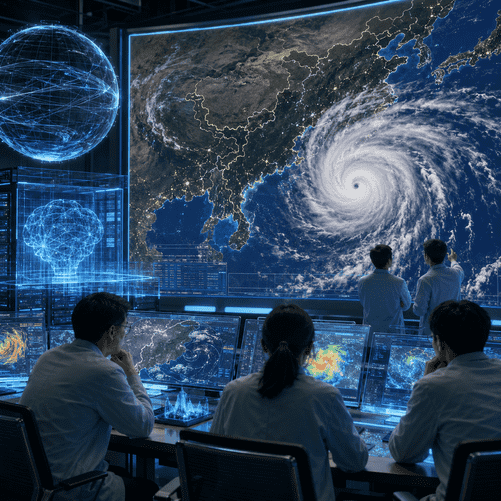
Chinese models are delivering increasingly accurate typhoon forecasts in a fraction of the time required by traditional systems, opening a new technological front in the global race to predict extreme weather.

Artificial intelligence is moving rapidly from laboratories and chatbots into one of science’s most computationally demanding fields: predicting the weather. In China, a new generation of AI forecasting systems is now being deployed alongside conventional meteorological models, with researchers reporting major gains in speed and, on some measures, accuracy.
The technology received an important real-world test as Typhoon Dolphin approached China in recent days. Meteorologists tracking the storm were able to compare traditional physics-based forecasting with predictions produced by emerging Chinese AI systems, illustrating how machine learning is beginning to reshape an industry that has depended on supercomputers for decades.
Among the systems attracting attention are Fengwu, developed by the Shanghai AI Laboratory; Pangu, created by Huawei; and Fuxi, developed by Fudan University. These models analyse enormous archives of historical atmospheric data and learn patterns governing changes in temperature, pressure, wind and other variables rather than repeatedly calculating the underlying physics of the atmosphere in the traditional way.
That distinction is crucial. Conventional numerical weather prediction requires powerful supercomputers to process complex mathematical simulations of the atmosphere. AI systems, once trained, can generate comparable forecasts much more rapidly and with significantly lower computational requirements. Researchers cited by Reuters say Chinese models already match or outperform traditional forecasts on some measures.
The implications could be substantial, particularly as governments confront increasingly disruptive extreme-weather events.
Typhoons, floods, heatwaves and other hazards require authorities to make decisions under severe time pressure. A forecast that identifies a storm’s likely path more quickly or provides additional confidence several days in advance could influence evacuation plans, airport closures, shipping operations, agricultural protection measures and emergency-resource deployment.
Fengwu has produced particularly striking results. Its developers reported that the model surpassed Google’s GraphCast across roughly 80% of the weather variables evaluated and extended useful global medium-range forecasting beyond ten days.
During Typhoon Dolphin, the model also provided a practical demonstration of its potential. Five days before the storm reached mainland China, Fengwu predicted its expected landfall to within approximately 30 kilometres and 30 minutes of the eventual location and timing, according to Techwind, the company responsible for commercial applications of the technology.
Such performance places China near the centre of an increasingly intense international competition in AI meteorology.
Google has developed GraphCast and GenCast, Nvidia has backed FourCastNet, while the European Centre for Medium-Range Weather Forecasts operates its own Artificial Intelligence Forecasting System, or AIFS. China’s Fengwu, Pangu and Fuxi now form another major technological bloc within this emerging field.
The competition reflects a broader transformation in artificial intelligence. Much of the public discussion surrounding AI has focused on generative systems capable of producing text, images, software and video. Scientific AI, however, may eventually prove just as consequential.
Weather prediction represents an especially important test because improvements can translate directly into economic and humanitarian benefits. More accurate forecasting can help utilities anticipate electricity demand, airlines reroute aircraft, shipping companies avoid dangerous seas, farmers protect crops and governments prepare populations for severe weather.
It could also make sophisticated forecasting more accessible. Traditional meteorological systems require enormous computing infrastructure, making the highest-quality numerical forecasting expensive to operate. AI models potentially reduce that computational burden considerably, raising the prospect that advanced forecasting capabilities could eventually become available to countries and institutions without access to some of the world’s most powerful supercomputers.
Yet the technology still has important limitations.
AI systems currently perform particularly well when predicting the trajectory of major storms, but conventional models remain stronger in some areas, including forecasting a typhoon’s intensity. Researchers also caution that AI weather models have not yet accumulated sufficient evidence to demonstrate reliable prediction of major long-term climate phenomena.
That means meteorologists are unlikely to abandon physics-based forecasting.
Instead, the emerging model is one of cooperation between the two technologies: traditional atmospheric simulations providing scientifically grounded forecasts while AI systems offer rapid alternative projections that can be compared against them. The combination may ultimately prove more valuable than either approach operating alone.
Trust will also become critical. Weather forecasts can trigger evacuations involving millions of people and decisions affecting billions of dollars in infrastructure, transportation and agricultural activity. An AI system must therefore demonstrate reliability across years of unusual and extreme events before governments can depend on it for the most consequential decisions.
Nevertheless, the progress visible in China suggests that the technological transition has already begun.
The significance of Fengwu and its competitors is not simply that artificial intelligence can predict a typhoon. It is that AI is demonstrating an ability to perform a task previously associated with some of the most sophisticated scientific simulations and powerful computers ever constructed.
If that progress continues, weather forecasting could become one of the first fields in which AI fundamentally changes how humanity understands and anticipates the physical world — transforming meteorology from a discipline dominated almost exclusively by numerical simulation into one where learned artificial intelligence becomes an increasingly important partner in predicting what the atmosphere will do next.