Four leading U.S. human rights organizations argue that Washington’s campaign against the International Criminal Court unlawfully restricts free speech, international advocacy and efforts to pursue accountability for alleged war crimes in Gaza.

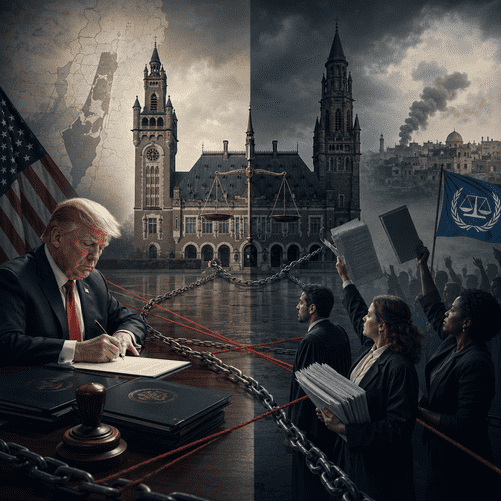
Four prominent U.S. human rights organizations have filed a federal lawsuit challenging the Trump administration’s escalating sanctions against the International Criminal Court, opening a new legal front in the confrontation between Washington and the institution responsible for prosecuting genocide, war crimes and crimes against humanity.
Human Rights Watch, the Center for Constitutional Rights, the American Friends Service Committee and the Open Society Institute filed the case on August 11 in the U.S. District Court for the Southern District of New York. The organizations argue that sanctions imposed under President Donald Trump’s February 2025 executive order have severely constrained their ability to communicate and cooperate with ICC officials, conduct human-rights advocacy and support international accountability efforts.
The lawsuit challenges Executive Order 14203, which authorizes financial sanctions, asset freezes and immigration restrictions against certain individuals involved in ICC investigations concerning U.S. citizens or nationals of allied countries that have not consented to the court’s jurisdiction. The order also allows sanctions against people or organizations deemed to have provided material, financial or technological assistance to targeted activities or individuals.
The plaintiffs contend that the restrictions violate protections contained in the First and Fifth Amendments and, in the case of the American Friends Service Committee, protections under the Religious Freedom Restoration Act. They argue that the sanctions effectively criminalize or deter forms of communication, research and advocacy that would ordinarily constitute constitutionally protected activity.
At the heart of the confrontation is the ICC’s investigation into alleged crimes committed in the Palestinian territories and its decision in 2024 to issue arrest warrants for Israeli Prime Minister Benjamin Netanyahu and former defence minister Yoav Gallant. The court alleged that there were reasonable grounds to believe the Israeli leaders bore criminal responsibility for war crimes and crimes against humanity. Israel has rejected the allegations and disputes the ICC’s jurisdiction. The United States, which is also not a party to the Rome Statute that established the court, has likewise rejected the ICC’s authority over American and Israeli nationals.
The Trump administration has portrayed the court’s actions as an infringement of national sovereignty. In his February 6, 2025 executive order, Trump declared that ICC investigations targeting Americans or nationals of certain U.S. allies constituted an “unusual and extraordinary threat” to U.S. national security and foreign policy. The administration has subsequently widened pressure on ICC officials and supporters as part of a broader campaign against the institution.
Human rights organizations, however, argue that the measures reach far beyond the individuals formally sanctioned. According to the plaintiffs, financial institutions, technology providers and other organizations have become increasingly reluctant to interact with people or groups associated with the ICC for fear of potentially violating U.S. sanctions. That chilling effect, they argue, has disrupted cooperation across international legal and human-rights networks.
The dispute has already generated a series of legal challenges. In July 2025, a federal court granted a preliminary injunction protecting two human-rights advocates from enforcement of the sanctions, finding that they were likely to succeed in their argument that the restrictions violated their First Amendment rights. Additional lawsuits were filed in 2026 by advocacy groups and by ICC judges directly targeted by U.S. sanctions.
The latest case therefore carries implications extending beyond the Israeli-Palestinian conflict. At issue is the extent to which the executive branch can use economic sanctions normally associated with foreign-policy and national-security threats against international judicial officials — and whether those restrictions can lawfully limit the activities of American organizations engaging with them.
For Washington, the confrontation reflects a longstanding refusal to accept ICC jurisdiction over U.S. personnel and nationals of allied states that have not joined the court. The Trump administration maintains that allowing the ICC to prosecute individuals from non-member countries without their governments’ consent represents an unacceptable erosion of sovereignty.
For the plaintiffs, the issue is fundamentally different: whether presidential sanctions authority can be extended so broadly that American researchers, lawyers and human-rights organizations are prevented from exchanging information with an international court.
The case now places that dispute before the U.S. judiciary. Its eventual outcome could determine not only the future reach of Washington’s sanctions campaign against the ICC, but also how far a U.S. administration may go in restricting domestic engagement with international institutions it considers hostile to American interests.