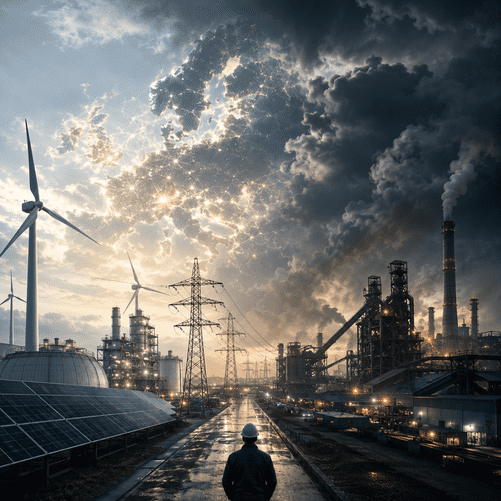
Strong corporate earnings and improving economic sentiment are masking a deeper structural challenge for Europe, where expensive energy and geopolitical instability are putting renewed pressure on manufacturers and raising questions about the continent’s ability to compete with the United States and Asia.

Europe’s economy is entering the second half of 2026 with an uncomfortable contradiction. Financial markets remain resilient, corporate earnings have surprised on the upside and economic activity has shown signs of improvement, yet one of the continent’s most persistent vulnerabilities is once again moving to the centre of the economic debate: the cost of energy.
European policymakers are accelerating plans to expand domestic electricity production and modernise power networks as governments confront the combined pressures of volatile global energy markets, geopolitical instability and weakening industrial competitiveness. The scale of the challenge is substantial, with Europe expected to require trillions of euros of investment in renewable generation, nuclear capacity, transmission infrastructure and electricity grids over the coming years.
The urgency has increased as renewed geopolitical tensions push energy security back onto the economic agenda. Oil markets have become increasingly volatile amid disruption risks in the Middle East, while concerns over global supply have raised the possibility that elevated energy prices could once again feed through into European inflation and corporate costs.
For Europe’s industrial base, the issue is particularly sensitive.
Energy-intensive industries including chemicals, steel, glass, fertilisers and heavy manufacturing have struggled for several years with electricity and natural-gas costs that can be considerably higher than those faced by competitors in the United States, China and other parts of Asia.
Although the most extreme price shocks associated with the European energy crisis have eased, the structural disadvantage has not disappeared. Companies operating large industrial facilities must increasingly weigh European production costs against alternative locations offering cheaper energy, stronger subsidies or faster infrastructure development.
That pressure has contributed to a broader debate over Europe’s ability to maintain its position as a global manufacturing centre.
The European Central Bank has already acknowledged the competitiveness problem. Its latest projections indicate that euro-area exporters are continuing to lose global market share, while persistent competitiveness challenges are expected to constrain export growth. The ECB currently projects euro-area GDP growth of only 0.8% in 2026, followed by 1.2% in 2027 and 1.5% in 2028.
Those modest forecasts illustrate why industrial performance matters so much.
Europe cannot rely indefinitely on consumer spending and services to generate expansion if manufacturing investment, exports and productivity remain subdued. Germany, Italy, France and several Central European economies retain large industrial sectors whose performance has significant implications for employment, trade and government revenue.
Recent economic data show that the picture is not uniformly negative.
European Union GDP expanded by 0.5% in the second quarter of 2026, while unemployment remains comparatively low. Economic sentiment has also strengthened, suggesting that the bloc has avoided the deeper stagnation feared earlier in the year.
European equity markets have reflected some of that resilience. The STOXX 600 has recently traded near record highs, supported by unexpectedly strong corporate results. Second-quarter earnings among European companies have risen sharply, with the energy sector contributing heavily to the improvement.
Yet strong financial markets should not necessarily be interpreted as evidence that Europe’s structural economic problems have been resolved.
Energy companies can benefit from higher commodity prices even when those same prices damage manufacturers, transport companies and consumers. A profitable energy sector can therefore coexist with deteriorating competitiveness elsewhere in the economy.
This divergence is becoming increasingly important.
Europe’s central economic challenge is no longer simply obtaining sufficient energy. It is obtaining electricity and fuel at prices that allow European companies to compete globally while simultaneously reducing dependence on politically unstable suppliers and meeting climate targets.
That requires a transformation of extraordinary scale.
Governments are increasingly promoting renewable electricity, expanded nuclear capacity, energy storage and cross-border grid connections as part of a broader strategy to reduce exposure to imported fossil fuels. But building the infrastructure necessary to support that transition requires enormous capital investment and can take years.
Electricity grids represent one of the most difficult bottlenecks. Europe possesses considerable renewable-energy potential, but new wind and solar projects cannot always be connected quickly enough to transmission networks. Grid congestion can also prevent inexpensive electricity generated in one region from reaching industrial consumers elsewhere.
At the same time, electricity demand is expected to rise as transport, heating and industrial processes become increasingly electrified.
Europe must therefore expand its power system while simultaneously replacing ageing infrastructure, reducing emissions and keeping energy affordable.
The geopolitical dimension makes the challenge even more complicated.
The continent’s experience following Russia’s invasion of Ukraine demonstrated the economic consequences of excessive dependence on a concentrated energy supplier. Since then, European governments have diversified natural-gas imports and accelerated renewable investment, but global energy markets remain vulnerable to conflict and disruption.
Renewed instability in the Middle East is now testing that strategy.
Higher oil and gas prices can quickly increase transport and manufacturing costs, while prolonged energy inflation could complicate the European Central Bank’s monetary policy decisions.
Euro-area inflation stood at 2.8% in June, down from 3.2% in May but still above the ECB’s 2% medium-term target. Industrial import prices have also remained considerably higher than a year earlier, illustrating how external cost pressures can continue to affect European businesses even when headline inflation moderates.
The economic implications extend well beyond energy policy.
If European electricity remains significantly more expensive than in competing markets, investment decisions could gradually shift abroad. New factories producing chemicals, batteries, semiconductors, metals and other strategically important products may increasingly be built where energy costs are lower and government incentives stronger.
Such a trend would intensify concerns about industrial decline and strategic dependence.
Europe’s response is therefore evolving into something much broader than an energy transition. It is becoming an industrial strategy.
The objective is increasingly to create an electricity system capable of supporting competitive manufacturing while reducing vulnerability to geopolitical shocks and meeting ambitious environmental objectives.
Achieving all three simultaneously will be difficult.
Europe’s recent economic resilience gives policymakers some breathing room. But the underlying numbers suggest that the continent cannot afford complacency. With growth expected to remain modest and exporters already losing market share, energy costs are becoming a critical test of Europe’s long-term economic model.
The next stage of Europe’s energy transition will therefore be judged not only by how much carbon it eliminates, but by whether it can deliver electricity cheaply and reliably enough to keep European factories operating.
If it succeeds, energy investment could become one of the foundations of a new European industrial cycle.
If it fails, the continent risks discovering that the transition to energy independence came too slowly to prevent a much broader erosion of its manufacturing competitiveness.