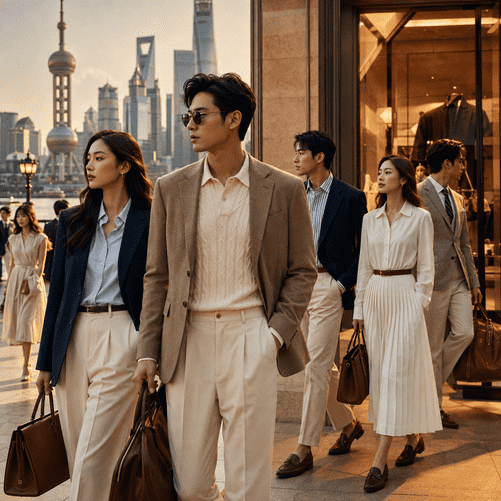
As traditional luxury houses struggle with cautious consumers and years of aggressive price increases, Ralph Lauren is surging across Asia by combining heritage, lifestyle appeal and a more attainable interpretation of premium fashion.

Ralph Lauren has emerged as one of the standout performers in a difficult global luxury market, recording extraordinary growth in China and strengthening evidence that consumers are beginning to redefine what they expect from premium fashion.
The American fashion group reported revenue of approximately $2 billion for its first fiscal quarter of 2027, an increase of 14% from a year earlier. Asia was the company’s fastest-growing major region, with revenue rising 24% to $589 million and comparable sales increasing 23%. Digital commerce in the region climbed 32%.
China delivered an even more striking performance. Sales there increased by more than 40%, according to Reuters, extending a remarkable run for a brand operating in a market where many of the world’s largest luxury houses have struggled with weak consumer confidence and more selective spending.
The figures matter beyond Ralph Lauren itself.
They suggest that the global luxury slowdown is not simply a story of consumers abandoning expensive fashion. Instead, shoppers appear to be becoming more discriminating about which brands deserve premium prices and what they expect to receive in return.
Ralph Lauren has positioned itself unusually well for that shift.
Its proposition sits between mass-market fashion and the highest reaches of European luxury. A customer can enter the brand through a relatively accessible Polo shirt, sweater or cap, while wealthier shoppers can move into tailored clothing, handbags, leather goods, home collections and more elevated Ralph Lauren lines.
That broad price architecture gives the company an advantage at a moment when many consumers are questioning whether the cost of traditional luxury goods still corresponds with their perceived value.
Over the past decade, leading luxury houses have repeatedly raised prices, particularly for handbags and leather accessories. The strategy initially strengthened margins and exclusivity, but it also pushed entry-level consumers out of the market and created growing resistance among aspirational shoppers.
Ralph Lauren is benefiting from occupying some of the territory left behind.
Its success in China is particularly instructive. Reuters reported earlier this summer that the company had built an increasingly enthusiastic following among younger Chinese consumers, including collectors attracted not simply to individual products but to the broader mythology surrounding the brand: polo, Ivy League style, Western Americana, country estates and an idealized version of affluent American life.
That lifestyle dimension has become one of Ralph Lauren’s most valuable assets.
The company is not selling only clothing. It is selling an unusually coherent visual world.
Oxford shirts, cable-knit sweaters, linen tailoring, equestrian references, leather bags and classic sportswear all belong to the same recognizable universe. At a time when consumers are confronted with rapidly changing creative directors and aesthetic identities across the luxury industry, Ralph Lauren’s consistency has become a form of differentiation.
The strategy is especially powerful among younger shoppers.
Rather than abandoning traditional style, younger consumers have increasingly reinterpreted it. Preppy clothing, relaxed tailoring, vintage sportswear, loafers, polo shirts, linen trousers and heritage-inspired outerwear have all gained renewed cultural visibility.
The popularity of “quiet luxury” accelerated that transition, encouraging consumers to focus on fabrics, silhouettes and recognizable quality rather than conspicuous logos.
Ralph Lauren fits naturally into that environment without having to reinvent itself.
Many of the elements now considered fashionable — relaxed blazers, knitted polo shirts, pleated trousers, suede jackets and country-club sportswear — have existed inside Ralph Lauren’s aesthetic vocabulary for decades.
The result is an unusual convergence between nostalgia and contemporary fashion.
Something designed to evoke the American East Coast of the 1970s or the sporting aristocracy of an earlier era can simultaneously feel highly current to a Gen Z consumer discovering the look through social media.
Ralph Lauren has also become more disciplined about how it presents and distributes its products.
The company spent years reducing dependence on heavy discounting and closing less desirable wholesale distribution. Instead, it invested in flagship stores, digital platforms, higher-quality products and marketing designed to elevate the brand’s image.
That strategy is visible in its financial performance.
Gross margin reached 73.7% in the latest quarter, 1.4 percentage points higher than a year earlier, helped by higher average unit retail prices and a more favorable mix of products and sales channels. Adjusted operating margin increased to 18.7%.
In other words, Ralph Lauren is not generating growth by returning to aggressive promotions.
It is selling more while simultaneously convincing customers to pay more.
That distinction separates the current expansion from the discount-led model that weakened the brand during earlier periods of its history.
China has become an important laboratory for the strategy.
Ralph Lauren has invested in major stores and highly theatrical brand experiences in cities including Shanghai, Beijing and Chengdu. Rather than attempting to hide its American identity in an increasingly competitive Chinese market, it has amplified it.
The company recently staged its first Polo Cup in Beijing, using the equestrian event to connect fashion, sport and lifestyle branding. Such experiences allow customers to encounter the brand as a cultural universe rather than simply another collection displayed on luxury-store shelves.
That approach appears particularly effective at a moment when Chinese luxury consumers are becoming more demanding.
Economic uncertainty and a prolonged property downturn have made some consumers increasingly price conscious. Aspirational shoppers who once routinely purchased entry-level products from major European houses are reconsidering the value proposition.
At the same time, affluent Chinese consumers have not disappeared.
The challenge for luxury companies is persuading them that a product is worth its price.
Ralph Lauren’s positioning gives it room to operate between those two realities. It retains the status and emotional appeal of an international premium brand while often remaining considerably less expensive than the most exclusive European competitors.
Its performance consequently represents part of a wider restructuring of the luxury hierarchy.
The strongest growth is no longer automatically concentrated among the houses capable of charging the highest prices.
Brands with clearly recognizable identities, convincing craftsmanship and multiple entry points are increasingly competitive.
Ralph Lauren is not alone in benefiting from the shift, but its recent results make it one of the clearest examples.
The contrast with parts of the European luxury industry is notable.
LVMH reported only 1% growth in fashion and leather goods in its latest quarter, below market expectations, while analysts have continued to debate how quickly the broader sector can recover.
Chanel has been a notable exception, with comparable first-half revenue reportedly rising approximately 16%, demonstrating that brands capable of generating strong creative momentum can still outperform the market.
Together, those results point toward an increasingly fragmented luxury landscape.
There is no longer one universal consumer recovery.
Different geographic markets, product categories and price levels are moving at very different speeds.
Jewellery has shown greater resilience than some fashion categories. Prestige beauty has gained ground among Chinese shoppers looking for an attainable luxury experience, while expensive handbags have faced greater resistance.
Ralph Lauren’s growth fits neatly into this new environment because its business extends across several levels of consumption.
A customer may purchase a fragrance or polo shirt without entering conventional luxury price territory. Another may spend significantly more on tailoring, leather goods or home products.
The brand can therefore maintain aspirational reach without depending exclusively on the small group of ultra-wealthy consumers who increasingly dominate the very top of the luxury market.
Its recent success also reinforces another powerful fashion trend: the resurgence of classic menswear and polished casual dressing.
After years in which streetwear dominated much of fashion culture, wardrobes have shifted toward more structured but still comfortable clothing.
The contemporary suit is softer. Jackets are frequently worn without ties. Trousers have become wider. Knitwear replaces formal shirts. Loafers and suede shoes accompany relaxed tailoring.
Ralph Lauren has spent decades operating precisely in this space between formal and casual clothing.
Its visual vocabulary allows a navy blazer, white trousers and a knitted polo to look sophisticated without appearing corporate. A suede jacket can communicate luxury without the obvious branding of a monogrammed handbag.
That understated approach corresponds closely with the direction of premium menswear in 2026.
The same phenomenon is visible in womenswear, where heritage fabrics, equestrian influences, tailored separates and elevated basics have maintained their appeal even as more experimental runway trends continue to cycle rapidly.
What is changing is the consumer’s definition of novelty.
Luxury once depended heavily on presenting something visibly new every season. Increasingly, value can come from permanence: a garment that appears relevant today but could plausibly remain wearable a decade from now.
That is particularly advantageous for heritage brands.
Ralph Lauren’s imagery has barely changed at its foundations because it does not need to. The settings may evolve and the styling becomes more contemporary, but the underlying fantasy remains recognizable.
The company has managed to turn that consistency into cultural currency.
Its latest financial performance suggests the strategy is also becoming increasingly valuable commercially.
North American revenue rose 13% in the quarter, while European revenue increased 7%. Strong growth across several regions helped Ralph Lauren raise its full-year revenue expectations.
Europe remains the more challenging market, partly because weaker tourism and geopolitical uncertainty have affected luxury spending. But Ralph Lauren’s geographic diversification reduces its dependence on any single group of customers.
That is becoming increasingly important as the luxury industry operates in what analysts describe as a two-speed global market: relatively strong consumption in the United States and selected parts of Asia alongside weaker conditions elsewhere.
The lesson for the wider industry may therefore extend beyond one brand’s successful quarter.
Consumers still want luxury.
But they are becoming less willing to accept price increases simply because a label possesses historical prestige.
They increasingly expect a recognizable identity, emotional connection, credible product quality and a sense that the object retains value beyond the initial purchase.
Ralph Lauren currently offers all four through an aesthetic that has become unexpectedly aligned with contemporary fashion.
The company spent decades selling an imagined lifestyle built around timeless affluence. In today’s unsettled luxury market, that consistency may have become more powerful than novelty itself.
And as younger shoppers in Beijing, Shanghai, New York and beyond rediscover polo shirts, linen tailoring, cable knits and classic American sportswear, Ralph Lauren’s resurgence suggests that the industry’s next important trend may not involve inventing an entirely new idea of luxury.
It may involve convincing consumers that the old one is worth believing in again.