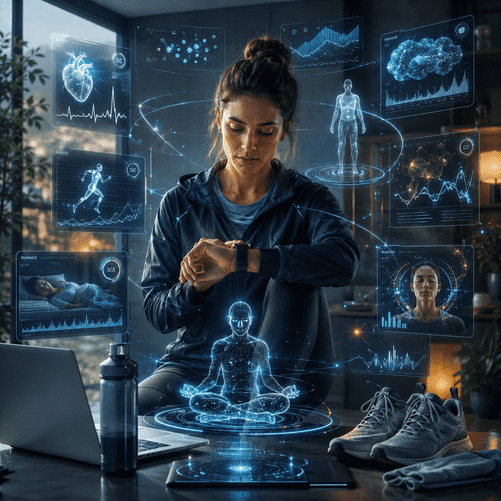
Health enthusiasts are combining wearables, calendars, sleep records and years of personal metrics with generative AI, creating highly individualized digital coaches that promise unprecedented insight — while raising difficult questions about accuracy, privacy and the limits of self-optimization.

For years, the quantified-self movement encouraged people to count steps, measure sleep and monitor their heart rates. In 2026, a more intensive version of that culture is emerging: people are feeding increasingly complete records of their daily lives into artificial-intelligence systems and asking the machines to tell them what the numbers mean.
The practice has been dubbed “datamaxxing.” Rather than simply checking a smartwatch dashboard or following the recommendations generated by a fitness app, its most committed practitioners are connecting multiple streams of personal information — exercise sessions, sleep, heart-rate variability, nutrition, calendars, work patterns and other behavioral records — to large language models capable of analysing them conversationally.
The objective is to create something much more ambitious than a fitness tracker: a continually evolving digital coach built around one individual.
A recreational runner, for example, can provide an AI assistant with months or years of workout history and ask it to design a marathon-training schedule that takes previous performance, recovery and recent workload into account. Another user might combine calendar data with heart-rate measurements to investigate whether particular meetings, colleagues or periods of the working day consistently correspond with elevated stress.
The attraction is easy to understand.
Consumer wearables have become extraordinarily effective at generating data. Smartwatches and rings can continuously record movement, heart rate, sleep and other physiological signals, producing thousands of measurements that most users will never examine individually. What has remained difficult is turning those measurements into meaningful conclusions.
Generative AI offers a new interface for doing that.
Instead of navigating multiple graphs, users can increasingly ask ordinary questions: Why was my recovery worse last week? Did late meetings coincide with poorer sleep? Have my long runs improved since I changed my training schedule?
The AI can search across the available information, identify relationships and respond in natural language.
That shift — from collecting data to conversing with it — may prove more significant than the proliferation of sensors themselves.
Recent research reflects the same direction. Scientists are developing systems specifically designed to transform wearable measurements into personalized insights, including AI agents capable of carrying out multistep analysis of behavioral health data rather than merely summarizing individual metrics.
Other researchers have explored conversational interfaces that allow people effectively to “talk” to their own wearable records rather than interpret conventional health dashboards themselves.
The development represents the latest phase of a much older technological idea.
The quantified-self movement was built around the belief that systematic measurement could reveal patterns invisible to intuition. People recorded exercise, food, sleep, mood and productivity in pursuit of what proponents sometimes described as “self-knowledge through numbers.”
Artificial intelligence changes the scale of that experiment.
A spreadsheet can tell someone how many hours they slept. A modern AI system can potentially compare sleep against exercise intensity, travel schedules, working hours, alcohol consumption, menstrual-cycle information, resting heart rate and months of previous behavior — and then explain the apparent relationships conversationally.
That possibility is drawing a particularly enthusiastic audience among endurance athletes, technology workers and people already accustomed to detailed personal monitoring. The Wall Street Journal reported on August 12 that some users are constructing custom systems that link their data directly to general-purpose AI models rather than relying exclusively on commercially packaged health applications.
Some are going considerably further.
Privacy-conscious enthusiasts are creating self-hosted systems in which sensitive records remain on computers they control rather than being continually transmitted to external services. Research published this summer has similarly explored locally deployable AI health agents designed to process real-time wearable information while keeping the underlying data under the user’s control.
That privacy question is likely to become increasingly important.
The information involved in datamaxxing can be extraordinarily intimate. A sufficiently detailed dataset may reveal sleep patterns, movements, stress responses, menstrual cycles, medical results, exercise habits and working routines.
Individually, each measurement may appear relatively mundane. Combined across months or years, however, they can create an unusually detailed portrait of a person’s physical and behavioral life.
The more useful an AI coach becomes, therefore, the more information users may feel encouraged to provide.
That creates an inherent tension between personalization and privacy: the system generally becomes more individualized as it receives more context, but every additional source of context expands the volume of sensitive information being collected and potentially exposed.
Accuracy presents an equally important limitation.
Health data are notoriously context dependent. An elevated heart rate can indicate intense exercise, emotional stress, excitement, caffeine consumption or numerous other factors. Without sufficient context, an algorithm can identify a numerical relationship without understanding its cause.
Recent research into wearable-based stress analysis illustrates the problem. Physiological measurements can be noisy, and identical signals can reflect very different experiences depending on what a person was actually doing at the time. Researchers have therefore experimented with combining sensor readings with users’ own annotations of activities and events to make those signals more interpretable.
Large language models introduce another layer of uncertainty.
They are exceptionally effective at generating plausible explanations, but plausibility is not the same as medical validity. An AI system can confidently identify a pattern that is coincidental, misinterpret incomplete information or generate health recommendations unsupported by adequate clinical evidence.
That distinction matters as users move from asking descriptive questions — “How has my resting heart rate changed?” — toward prescriptive ones such as “Should I change my diet?” or “Is this symptom dangerous?”
Researchers developing health-oriented AI systems have consequently placed growing emphasis on contextual relevance and safety. One recent large-scale research effort trained wearable-health models using more than one trillion minutes of sensor signals from millions of participants, while also evaluating an associated personal health agent with clinicians.
Even sophisticated systems, however, do not turn consumer wearables or chatbots into physicians.
For the moment, the strongest use case may be considerably more modest: helping people notice trends, organize information and formulate better questions rather than independently diagnosing disease.
That distinction could determine whether AI health coaching becomes a useful extension of personal health management or another source of technological anxiety.
There is already evidence that constant measurement can change the relationship people have with their bodies.
A poor sleep score can influence how tired someone believes they feel. A decline in a recovery metric can persuade an athlete to alter training even when they otherwise feel strong. The arrival of AI potentially intensifies that dynamic because the numbers are no longer passive — a conversational system can continuously interpret them, explain them and suggest what to do next.
For enthusiasts, that responsiveness is precisely the attraction.
An ordinary fitness application typically serves millions of users through predefined categories and recommendation systems. A datamaxxer can theoretically create a coach that knows years of personal history and can answer highly specific questions that no generic dashboard was designed to address.
The possibilities extend far beyond sports.
An AI system could compare workplace schedules with sleep and stress, examine whether travel consistently affects recovery, analyze long-term laboratory results, or help users summarize months of health information before a medical appointment. Emerging health-AI research is explicitly exploring such longitudinal analysis as a way of helping individuals understand changes relative to their own baselines.
Consumer technology companies are moving in the same direction. AI is becoming more deeply integrated with wearable health platforms, with increasingly personalized coaching and interpretation positioned as major product features rather than peripheral experiments.
The broader technological trajectory is therefore clear.
The first generation of digital health technology measured people.
The second organized those measurements into dashboards.
The emerging generation is attempting to interpret them.
That is a fundamental shift because interpretation has traditionally been the scarce resource. Consumers already possess enormous amounts of data about themselves; what they lack is the time and expertise to examine it continuously.
AI promises to supply that analytical layer at almost zero marginal effort.
Whether the promise can be delivered safely remains unresolved.
Personal health information is messy, incomplete and frequently ambiguous. Correlation can easily be mistaken for causation, while increasingly persuasive AI interfaces can make uncertain conclusions appear authoritative.
There is also the psychological question of how much optimization is actually desirable.
The same technology that helps an athlete recognize overtraining could encourage another person to monitor every biological fluctuation. A tool intended to produce self-knowledge can become a mechanism for continuous self-surveillance if every meal, heartbeat, night of sleep and stressful meeting is treated as another variable requiring improvement.
Datamaxxing therefore sits at an intriguing boundary between empowerment and obsession.
At its best, it represents an unusually powerful form of personal analytics: thousands of otherwise disconnected measurements transformed into understandable patterns that help users reflect on their behavior.
At its most problematic, it risks replacing one imperfect source of intuition with an apparently precise but potentially unreliable algorithmic interpretation of the human body.
What makes the trend significant is that the underlying infrastructure is already arriving.
Wearable sensors are increasingly ubiquitous. Generative AI systems are becoming capable of processing larger personal datasets. Developers are building health-specific agents, while technically sophisticated users are already connecting the pieces themselves.
The result may be the emergence of a new kind of personal technology relationship — one in which people do not simply ask an AI what it knows about the world, but what it knows about them.
For the datamaxxers, the ultimate ambition is not merely to record life more accurately.
It is to build a machine capable of watching thousands of small signals accumulate over time and discovering something about the individual that the individual could not see alone.