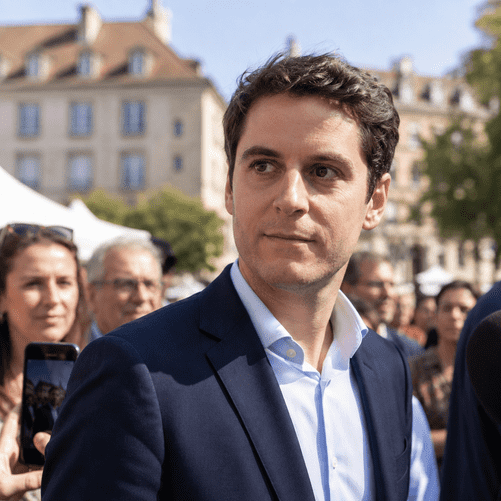
While France’s political class retreats for the traditional August break, the former prime minister is touring the country, courting voters and dominating the airwaves in an effort to close the gap ahead of the 2027 presidential election.

August traditionally brings French politics to a near standstill. Ministers disappear from Paris, party leaders retreat to holiday destinations and the country’s political machinery slows as voters turn their attention to summer. Gabriel Attal has chosen to do the opposite.
The former prime minister and leader of President Emmanuel Macron’s Renaissance party is spending the summer crisscrossing France, appearing at public events, speaking to local communities and maintaining an unusually intense media presence while most of his principal rivals have temporarily stepped away from the campaign trail. The strategy is unmistakable: with the 2027 presidential election approaching and Attal still trailing some of his competitors, he is attempting to turn France’s quietest political month into an opportunity.
Attal formally entered the presidential race in May, positioning himself as a candidate capable of preserving elements of Macron’s pro-business and reformist agenda while simultaneously convincing voters that he represents a new political chapter. At 37, the former prime minister is attempting to capitalize on his youth, communication skills and national profile, but his close association with Macron remains both an asset and a liability.
His summer offensive is partly intended to address another problem: Édouard Philippe, the former prime minister and leader of the center-right Horizons party, has generally enjoyed a stronger position among potential centrist presidential candidates. When Attal entered the race, polling cited by Reuters placed Philippe at as much as 25% in a hypothetical first round, compared with around 14% for Attal. The two men have agreed to reassess their respective positions before the election in an effort to prevent the centrist vote from becoming dangerously fragmented.
With Philippe and conservative leader Bruno Retailleau maintaining a lower profile during the August holiday period, Attal has been able to occupy political space that would normally be shared among several presidential hopefuls. His appearances have taken him well beyond the traditional territory of a centrist technocrat, as he seeks to project the image of a candidate willing to confront contentious issues directly.
The campaign has increasingly focused on four areas Attal regards as central to France’s future: education, wages, immigration and artificial intelligence. His proposals have included reducing the size of the public sector by approximately 100,000 positions, establishing immigration quotas and pursuing a long-term objective of eliminating France’s budget deficit by 2037.
This more muscular political style also reflects Attal’s effort to broaden his appeal beyond Macron’s traditional centrist electorate. During his time in government, he already developed a reputation for taking relatively firm positions on law and order, immigration and education. As education minister, his decision to prohibit abayas in public schools became one of the most visible measures of his tenure.
His summer campaign has gone further. Highly publicized encounters with citizens and his willingness to engage with conservative media have drawn comparisons with the energetic campaigning style of former president Nicolas Sarkozy. They have also attracted criticism from opponents on both the left and right, who accuse Attal of pursuing attention rather than developing a coherent presidential program.
That is one of the central risks of his strategy. Being almost alone on the campaign trail guarantees visibility, but it also concentrates scrutiny. Every controversial remark, awkward encounter or policy proposal receives greater attention when political news is otherwise scarce.
For Attal, however, visibility is precisely what the campaign needs. His challenge is not simply to become better known — he served as prime minister in 2024 and remains one of France’s most recognizable political figures — but to persuade voters that he represents something more than a continuation of Macronism.
That distinction is becoming increasingly important as the Macron era approaches its constitutional endpoint. President Emmanuel Macron cannot seek a third consecutive term in 2027, creating an unusually open contest for the political center and forcing several figures who served under him to compete for the same electorate. Attal and Philippe are among the most prominent contenders attempting to inherit parts of Macron’s coalition while distancing themselves from the unpopular aspects of his record.
The broader presidential environment is considerably more difficult than the centrist competition alone suggests. France’s far right remains a dominant force in national polling, while candidates from the left and traditional right are also seeking to exploit public dissatisfaction over living standards, immigration, public services and political instability. Recent polling has continued to show Marine Le Pen ahead of major rivals in several hypothetical presidential scenarios.
Attal therefore faces a strategic dilemma. To reach the second round, he must first consolidate enough moderate and center-right voters to overtake rivals such as Philippe. But to win nationally, he must also demonstrate independence from a president whose political movement created his career.
His campaign launch already reflected that tension. Attal has presented himself as a candidate of generational renewal and national reconnection, deliberately choosing settings outside Paris and emphasizing direct contact with voters. At the same time, his political biography is inseparable from Macron: government spokesperson, education minister and ultimately France’s youngest prime minister.
The emphasis on experience across the emerging 2027 field makes that record useful. After a decade dominated by Macron’s promise of political disruption, several presidential contenders are now presenting governing experience as evidence of credibility in an era marked by economic difficulties, international instability and institutional uncertainty. Attal is trying to combine both messages — experience without stagnation, continuity without dependence.
There is another increasingly modern dimension to his campaign. Attal has recently been among French political figures targeted by Russian-linked disinformation operations identified by France’s foreign-interference watchdog, Viginum. He has publicly framed those attacks as part of a wider challenge to French democracy and has continued to emphasize support for Ukraine.
For now, however, his most immediate adversary may simply be time.
The 2027 presidential election is still months away, but the competition for political positioning is already well advanced. Philippe has a strong centrist base, the far right commands a formidable national electorate and numerous other candidates are preparing campaigns of their own.
Attal’s decision to sacrifice the traditional August holiday is therefore less a display of political enthusiasm than a calculated attempt to change the dynamics of the race before they become fixed.
By campaigning while his rivals rest, he can dominate headlines and manufacture momentum. Whether that visibility ultimately translates into votes is another matter.
For Gabriel Attal, the summer of 2026 has become an early test of a much larger proposition: whether relentless campaigning, political reinvention and a deliberate break with France’s August traditions can transform Macron’s former protégé into a credible contender to succeed him at the Élysée Palace.