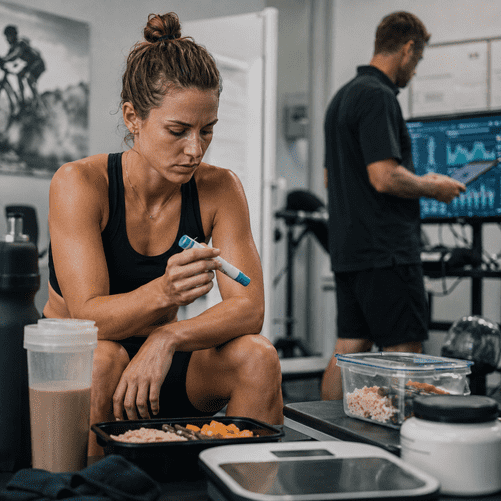
Growing use of GLP-1 medications among athletes is challenging traditional ideas about weight control and performance, as sports doctors warn that becoming lighter can come at the cost of muscle, recovery and long-term health.

A new and controversial trend is emerging at the intersection of elite sport and nutrition: athletes using powerful weight-loss medications such as semaglutide and tirzepatide despite having no medical need to lose weight.
New international research led by Britain’s Loughborough University suggests that GLP-1-based drugs — better known through brands including Ozempic, Wegovy and Mounjaro — are beginning to penetrate competitive sport. A survey of 114 physicians working with highly trained athletes across 93 sports and 38 countries found that roughly one in ten were aware of athletes using weight-loss medication without a medical indication.
The findings have opened a new debate over the meaning of performance nutrition at a time when pharmaceuticals capable of dramatically suppressing appetite are becoming increasingly accessible.
For decades, athletes competing in endurance, aesthetic and weight-sensitive disciplines have carefully manipulated diet, hydration and body composition in pursuit of marginal performance gains. GLP-1 medications introduce a radically different tool: rather than relying primarily on calorie restriction or intensive training, athletes can pharmacologically reduce hunger and potentially lose significant amounts of body weight.
The appeal is easy to understand. In sports where carrying less mass can appear advantageous, even small reductions in body weight may seem attractive. Physicians participating in the research reported awareness of use across disciplines including swimming, diving, artistic swimming, cycling, badminton, volleyball, equestrian sport, horse racing and bodybuilding.
Yet sports scientists increasingly warn that the assumption that lighter automatically means faster is dangerously simplistic.
GLP-1 receptor agonists work partly by reducing appetite and slowing digestion. For people living with obesity or diabetes, these effects can provide substantial medical benefits when the drugs are appropriately prescribed. Elite athletes, however, represent a fundamentally different physiological population: their nutritional requirements are often extremely high because training and competition impose enormous energy demands.
Suppressing appetite in that environment can make adequate fueling considerably more difficult.
One of the principal concerns is low energy availability, a condition in which an athlete consumes too little energy to support both training and normal biological functions. Prolonged under-fueling can contribute to Relative Energy Deficiency in Sport, commonly known as RED-S, which can affect hormonal function, bone health, metabolism, immunity, recovery and ultimately athletic performance.
Muscle preservation presents another problem. Weight lost during GLP-1 treatment does not consist exclusively of body fat. Research into substantial medically induced weight loss has documented reductions in lean mass as well, making adequate dietary protein and resistance exercise especially important.
For an elite athlete, that trade-off could prove critical. A runner, cyclist or jockey may benefit from carrying less excess mass, but reductions in muscle could eventually compromise power, acceleration and training capacity. The very intervention intended to improve the power-to-weight equation could therefore undermine the power side of that equation.
There is currently no strong published evidence showing that semaglutide or tirzepatide improves competitive performance in healthy, highly trained athletes, and much of the existing clinical research has focused on people who are overweight, living with obesity or managing diabetes rather than elite sportspeople.
That scientific uncertainty has placed the World Anti-Doping Agency in an increasingly important position.
Semaglutide has been part of WADA’s monitoring programme since 2024, allowing anti-doping authorities to gather information about its use among athletes. WADA is also supporting research into analytical methods capable of identifying GLP-1 receptor agonists in biological samples.
The medications are not currently prohibited under WADA rules, but the growing attention surrounding them illustrates how rapidly sports medicine is being forced to respond to pharmaceutical innovation. In the international physician survey, 44% of respondents believed weight-loss medications should be banned in sport, primarily because of concerns about athlete health.
For a substance to enter WADA’s prohibited list, it must normally satisfy at least two of three broad criteria: the potential to enhance performance, a potential or actual health risk, and incompatibility with what the agency defines as the spirit of sport. The lack of direct research on healthy elite athletes makes the performance question particularly difficult to answer.
The debate also exposes a deeper problem within sporting culture.
In many disciplines, athletes have historically been encouraged to equate lower body weight with improved performance. That pressure has contributed to restrictive eating practices, chronic under-fueling and concerns surrounding body image, particularly in endurance and aesthetic sports.
A medication that dramatically reduces appetite can potentially intensify that culture rather than correct it.
Sports physicians interviewed as part of the emerging research have consequently expressed concern that widespread GLP-1 use could be especially dangerous for athletes already vulnerable to eating disorders or disordered eating.
The controversy coincides with a wider transformation in sports nutrition. Athletes and recreational competitors are increasingly moving beyond the traditional combination of carbohydrates, protein powders and electrolyte drinks toward sophisticated personalized fueling strategies, continuous monitoring and pharmaceutical or medically inspired approaches to body composition.
At the same time, another 2026 fitness trend — sometimes described as “proteinmaxxing” — illustrates the opposite side of the nutritional conversation. Protein intake has become a major focus throughout fitness culture, partly because users of appetite-suppressing medications are increasingly concerned about preserving muscle while losing weight.
The collision of these two trends is significant. Modern sports nutrition is no longer simply concerned with how much an athlete eats. Increasingly, the question is how nutrition, medication, body composition and training interact.
For professional teams and governing bodies, the challenge will be separating genuine medical treatment from performance-driven weight manipulation without stigmatizing athletes who legitimately require these medications.
For athletes, the message emerging from sports scientists is more fundamental: body weight is only one component of performance.
Strength, energy availability, recovery, hormonal health, bone density and the ability to sustain months of high-quality training can matter far more than achieving the lowest possible number on a scale.
GLP-1 drugs have transformed modern obesity medicine and are likely to remain an important therapeutic tool. Their arrival in elite sport, however, introduces a very different experiment — one taking place faster than the scientific evidence can currently follow.
The newest diet trend in competitive sport may therefore ultimately become less about discovering another way to lose weight and more about rediscovering a principle sports nutrition has spent years trying to establish: elite performance requires enough fuel, not simply a lighter athlete.