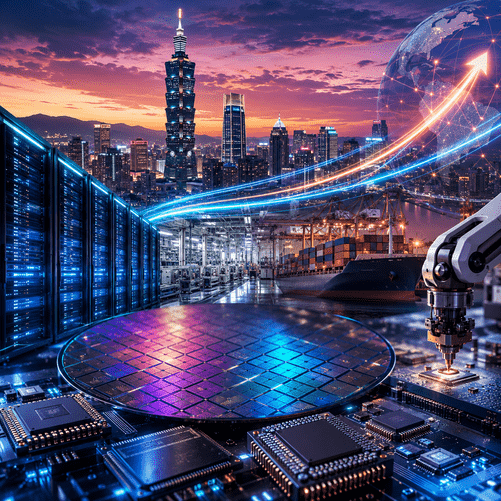
Taipei sharply raises its 2026 growth forecast to 11.05% as surging global demand for semiconductors, AI infrastructure and advanced computing fuels an extraordinary expansion in exports and investment.

Taiwan is heading toward its strongest economic performance in almost four decades, powered by an artificial-intelligence investment boom that has transformed the island’s semiconductor industry into one of the principal engines of global technology growth.
Taiwanese authorities on August 14 raised their forecast for gross domestic product growth in 2026 to 11.05%, up significantly from the 9.64% projection issued in May. If achieved, the expansion would represent Taiwan’s fastest annual growth rate in 39 years and one of the most remarkable performances among advanced Asian economies this year.
The acceleration reflects extraordinary international demand for advanced semiconductors, high-performance computing equipment and servers required to build and operate increasingly powerful artificial-intelligence systems. Taiwan occupies a pivotal position in that supply chain, with its technology industry manufacturing many of the sophisticated chips and components used by global technology companies.
At the centre of the expansion is the semiconductor ecosystem led by Taiwan Semiconductor Manufacturing Company, whose advanced fabrication capabilities have become strategically important to technology companies developing AI processors and data-centre infrastructure. The broader wave of spending by cloud-computing providers and technology groups has translated into rapidly expanding orders for Taiwanese manufacturers.
The scale of the export surge illustrates how dramatically AI investment is reshaping the economy. Taiwan’s Directorate General of Budget, Accounting and Statistics expects merchandise exports to approach $904 billion in 2026, representing growth of around 41% from the previous year and the strongest expansion in approximately half a century.
Investment is rising alongside exports. Taiwanese manufacturers have increased spending on production capacity and advanced equipment as they attempt to keep pace with global demand. The government consequently lifted its forecast for private investment growth to 11.58%, a substantial increase from its previous estimate.
The latest figures represent another major upgrade to an outlook that was already unusually strong. At the beginning of the year, authorities expected GDP to expand by 7.71% in 2026. The estimate was lifted to 9.64% in May before being raised again to 11.05% in August, demonstrating how rapidly demand for AI-related hardware has exceeded expectations.
Economic activity has also remained exceptionally strong during the first half of the year. Second-quarter GDP growth was revised to approximately 12.9% year on year, reinforcing evidence that the technology-driven expansion has extended beyond a temporary surge in orders.
Despite the dramatic increase in output, inflation remains comparatively contained. Taiwan’s government now expects consumer prices to rise by about 2.07% in 2026, slightly higher than previously forecast. That combination — double-digit economic growth alongside relatively moderate inflation — gives policymakers greater flexibility than would normally be expected during such a rapid expansion.
The boom nevertheless exposes Taiwan to a growing concentration risk. Its economic momentum has become increasingly dependent on the global cycle in artificial intelligence, semiconductors and data-centre investment. A slowdown in capital expenditure by major technology companies, weaker demand for AI hardware or disruption to international trade could therefore have an outsized impact on future growth.
Geopolitical considerations remain another persistent uncertainty. Taiwan sits at the centre of one of the world’s most strategically sensitive technology supply chains, and governments in the United States, Europe, Japan and elsewhere have been investing heavily in domestic semiconductor manufacturing in an effort to diversify production. Over time, those policies could gradually alter the geography of an industry in which Taiwan currently maintains an exceptional competitive position.
For the moment, however, global appetite for computing power continues to overwhelm such concerns. Taiwan’s government expects economic growth to moderate to 6.04% in 2027 — substantially below this year’s extraordinary pace but still indicative of continued expansion.
The new forecast offers one of the clearest demonstrations yet of AI’s impact beyond the technology sector itself. While debate continues over the profitability and long-term economic consequences of enormous investments in artificial intelligence, Taiwan is already experiencing their macroeconomic effects in factories, exports, capital expenditure and national output.
What began as a technology investment cycle has become something considerably larger: an economic boom capable of pushing one of Asia’s most sophisticated manufacturing economies toward its fastest growth rate since the late 1980s.